


Beyond guava: The rise of hog plum in Bangladesh's floating orchard belt

For generations, guava has defined the identity of Nesarabad's floating market in Pirojpur.
But today, hog plum has also emerged as an increasingly lucrative crop, giving farmers a profitable alternative while transforming one of Bangladesh's most distinctive wetland farming systems.

The change is most visible in Atghor Kuriana union, where endless orchards stretch across low-lying wetlands.
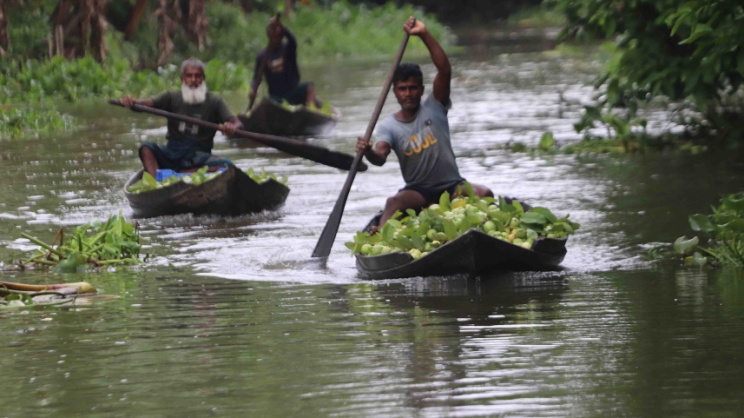
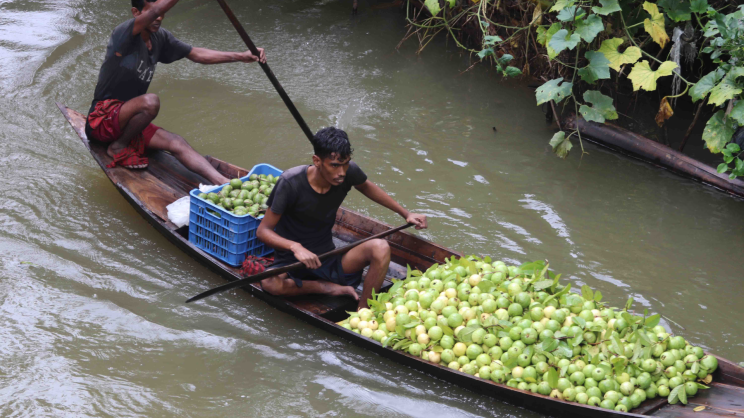
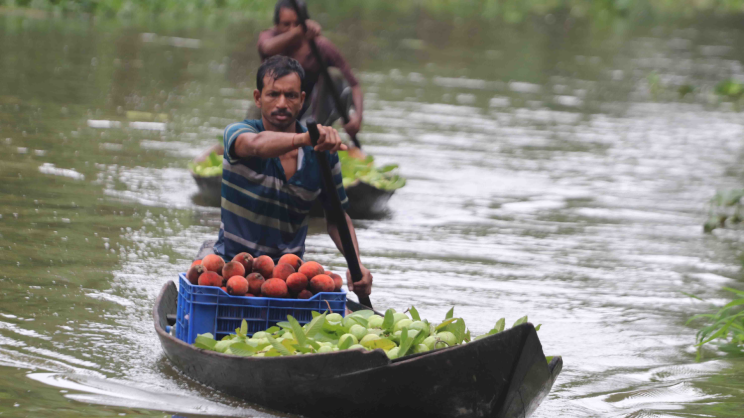
During the monsoon, the canals that weave through the villages become bustling waterways as farmers load freshly harvested fruit onto small boats before dawn and head to the region's iconic floating markets.
The daily trade in guava and hog plum sustains thousands of families, making the fruits the backbone of the local economy.
Guava cultivation in Nesarabad dates back nearly 150 years.
According to local folklore, the crop began when a resident of Bhadrank village, Purna Mondal, returned from Gaya in India's Bihar state, carrying guava seeds, which he planted in his village.
From those humble beginnings, guava cultivation spread rapidly across Atghar Kuriana, neighbouring Jalabari union and parts of Jhalakathi Sadar, where farmers successfully adapted the traditional ‘Sarjan’ cultivation method to the area's waterlogged landscape.
Land unsuitable for most crops was gradually transformed into one of the country's major fruit-producing belts, supplying to markets in Dhaka and other parts of Bangladesh.
According to local agriculture offices, 1,384 farmers cultivate guava on around 600 hectares in Nesarabad, while nearly 3,000 more grow it on 295 hectares in neighbouring Jhalakathi Sadar. Last year, average production stood at about 9.5 tonnes per hectare.
But the biggest change has come over the past decade as hog plum cultivation has expanded rapidly.
Today, 3,389 farmers grow the fruit on 295 hectares in Nesarabad, while another 900 cultivate it on 160 hectares in Jhalakathi Sadar.
Average yields reached 10 tonnes per hectare last year.
The shift is driven largely by economics.
Farmers say a bigha of guava may generate up to Tk 40,000 annually, whereas hog plum can earn as much as Tk 500,000 from the same area. Hog plum commands higher prices -- typically Tk 1,000 to Tk 2,000 per maund -- compared to guava's peak price of around Tk 800.
Unlike guava, which ripens quickly and spoils within days, hog plum can remain on the tree after maturing, allowing growers to harvest and sell when prices are favourable.
"Nearly every household here depends on guava and hog plum in one way or another," said Rathin Mistri of Atghar village.
Veteran farmer Makhan Lal Majumdar remembers a very different era, when guavas were sold individually rather than by weight and oversupply sometimes forced farmers to throw unsold fruit into nearby canals.
Improved roads have since ended the region's dependence on waterways alone, allowing trucks and pickup vans to transport fruit quickly to markets across the country.
Farmers say guava yields have declined in recent years, a trend some attribute to the increasing use of chemical herbicides instead of manual weeding.
 For all latest news, follow The Daily Star's Google News channel.
 Md Mahfuzur Rahman, agriculture officer of Nesarabad, acknowledged that some growers use herbicides but said the Department of Agricultural Extension continues to encourage manual weed control using hoes and other farming tools.
Despite the growing popularity of hog plum, farmers are not ready to abandon the fruit that built Nesarabad's reputation.
With guava prices remaining favourable in recent years, many believe the two crops will continue to grow side by side -- one preserving the region's heritage, the other securing its future.