


Budget success rests on quality of execution: CPD
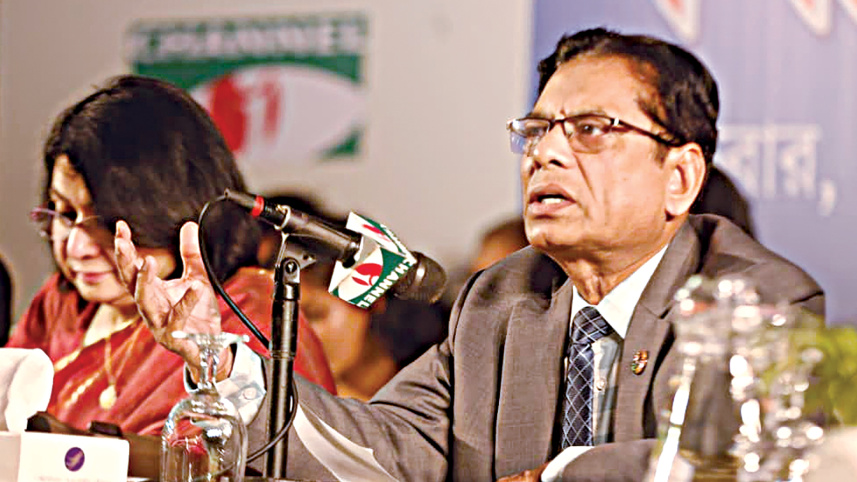
The Centre for Policy Dialogue (CPD) yesterday said while the proposed budget for fiscal year 2026-27 is larger than previous ones, its success will depend on the government’s ability to implement it at a time when the economy is attempting to recover.
“Its success will ultimately depend less on its size than on the quality of its execution,” the think tank said, sharing its assessment of the proposed budget at a press conference at a hotel in Dhaka.
 For all latest news, follow The Daily Star's Google News channel.
 “If transparency in the use of block allocations cannot be ensured, there is a risk of misuse of these funds.”
“This will require strong institutions with the capacity to implement the budget efficiently and deliver tangible outcomes,” it added.
The CPD said the budget represents the first major opportunity for the new government to demonstrate its ability to drive economic recovery through sustained structural reforms.
The government came to power with a commitment to building a welfare-oriented state based on three pillars: an inclusive economy, high economic growth and environmentally sustainable development, Mustafizur Rahman, distinguished fellow at CPD, said in response to questions from journalists.
Viewed from that perspective, he added that the budget contains several proposals aimed at promoting growth. “It protects import-substituting and export-oriented industries through various tariff measures.”
In some cases, supplementary duty (SD), advance income tax (AIT) and other taxes have been increased to protect domestic industries, while tariff rates have been reduced in other areas to support export-oriented sectors, Mustafizur said.
Through social protection programmes, such as Family Card, Farmers Card and similar initiatives, it is also trying to improve income and wealth redistribution, noted the policy expert.
On the environmental front, incentives have been proposed for electric vehicles, solar panels and other green initiatives, he added.
IMPLEMENTATION CHALLENGES
The key question, according to Mustafizur, is whether the government has the institutional capacity to achieve these objectives, with the first major risk lying in the baseline assumptions underpinning the budget.
Many projections appear inconsistent with current economic realities, including those related to revenue collection, investment growth, private-sector credit growth, exports, imports and GDP growth, he said.
For example, he said, exports contracted by around 1.8 percent during the first 10 months of the current fiscal year, yet the budget assumes export growth of about 8.7 percent. Inflation remains above 9 percent, but projections suggest it will decline significantly.
Revenue collection is projected to grow by around 18.9 percent from a revised target of more than Tk 5,88,000 crore for FY2025-26, even though actual collections are likely to fall short of the target by 25 percent to 30 percent, he also said.
He pointed out that achieving the proposed revenue target of Tk 6,95,000 crore would require a 54.4 percent increase from the likely actual collection in the outgoing fiscal year.
“That is not possible unless significant reforms are implemented and institutional capacity is strengthened,” said Mustafizur.
He said the projections appear to assume a dramatic turnaround in the fourth quarter, with stronger growth, lower inflation, faster private-sector credit expansion and a substantial increase in revenue collection.
“A more realistic baseline would have strengthened the credibility of the budget,” he added.
The policy expert said there is little disagreement regarding the government’s priorities in resource allocation, but noted that achieving those objectives will depend largely on implementation capacity.
For example, he said the budget proposes tax incentives and tariff reforms to stimulate investment and support both import-substituting and export-oriented industries.
“But even if tax reforms are introduced, investment cannot expand if adequate gas and electricity supplies are not available,” he argued.
He described the government’s moves toward deregulation as an important departure that could open new opportunities, but said Bangladesh must ensure adequate institutional capacity and infrastructure to capitalise on them.
Many of these challenges, he noted, cannot be resolved within a single year since expanding domestic gas production, drilling new wells and conducting offshore bidding -- all require time.
He also warned about growing fiscal risks.
Historically, Bangladesh has operated in a low-level equilibrium where revenue collection was modest, public expenditure was relatively low and fiscal deficits remained manageable.
“If government spending rises while revenue collection falls short, borrowing requirements will increase significantly,” he said.
In that case, the government would need to rely more heavily on domestic and foreign borrowing.
He noted that the foreign borrowing target is already sizable. Bangladesh currently spends around $7 billion annually servicing external debt, and additional borrowing would push those costs higher.
“Improving revenue collection remains critical,” he said.
He also described the government’s proposed reforms, including end-to-end digitalisation of tax administration, reducing tax exemptions and curbing tax evasion, as positive initiative. “But they all depend on institutional capacity.”
Responding to criticism that the budget favours large businesses over small and medium enterprises (SMEs), Mustafizur disagreed.
He pointed to a range of support measures for SMEs, including bond-related facilities, bank guarantees, programmes linking SMEs with international markets, SME Foundation initiatives, startup funds and employment-generation programmes.
He also stressed the need for a stronger labour-market policy that accounts for both domestic employment and overseas labour markets.
“I did not see a particularly large or comprehensive strategy in the budget regarding overseas employment and skills development,” he said, noting that remittances have become one of Bangladesh’s key economic stabilisers.
On external debt, Mustafizur said comparisons with countries such as the US and Japan can be misleading.
“For Bangladesh, in terms of GDP percentage, foreign debt is not very high. But the impact of foreign debt on the economy should not be measured simply as a percentage of GDP,” he said.
He noted that the IMF now places greater emphasis on a country’s ability to service its debt rather than relying solely on debt-to-GDP ratios.
“Our foreign debt servicing was around $3.5 billion five or six years ago. It has now doubled,” he said.
For many large projects, grace periods have ended, meaning both principal and interest repayments are now due.
“This means the actual debt-servicing burden will increase, and the pressure will rise further if the domestic currency depreciates,” Rahman added.
CPD Executive Director Fahmida Khatun said reducing inflation to the government’s target of 7.5 percent would require significant efforts to improve food and energy supplies alongside a realistic monetary policy.
She also expressed concern over the increase in operating expenditure and the large block allocation proposed in the budget.
“If transparency in the use of block allocations cannot be ensured, there is a risk of misuse of these funds,” she said.
Fahmida warned that increased government borrowing from banks could crowd out private-sector credit at a time when higher investment is needed to create jobs.
She welcomed the increased allocation for education and praised the higher allocation for the health sector, particularly support for kidney patients.
She also welcomed the introduction of Family Card and Farmers Card initiatives, but said the government must ensure that the benefits reach the intended recipients.
Comments