


Subsidy burden set to rise for power, fertiliser

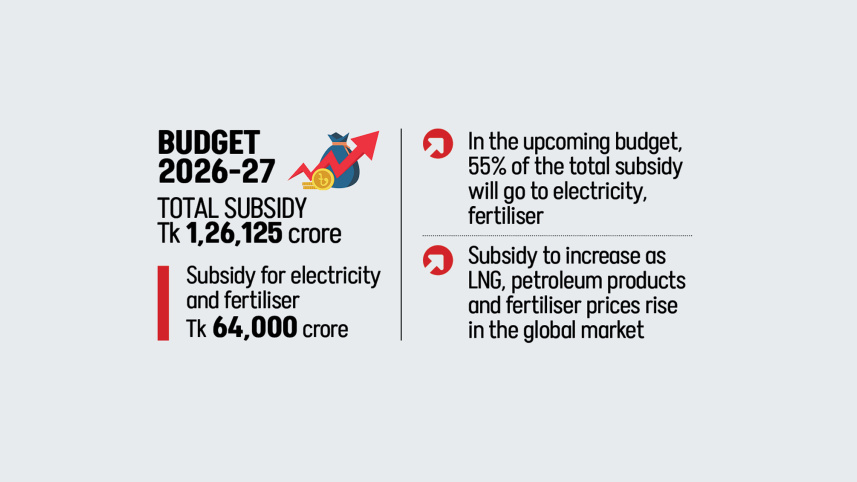
The government will allocate Tk 1,26,125 crore for subsidies and incentives in the upcoming fiscal year’s budget, with 55 percent going towards electricity and fertiliser.
In the original budget for this fiscal year, Tk 1,25,904 crore was allocated, with fertiliser and electricity accounting for more than 50 percent of the sum.

However, the prices of LNG, petroleum products and fertiliser have risen in the global market, so the subsidy for electricity and fertiliser may be increased by Tk 4,600 crore and Tk 2,000 crore respectively in the revised budget, The Daily Star has learnt from finance ministry officials involved with the proceedings.
In the upcoming fiscal year, Tk 64,000 crore will be allocated for electricity and fertiliser subsidies, of which Tk 37,000 crore is for electricity alone.
But the power division is pushing for more allocation due to the rising prices of primary fuels such as gas and fuel oil used in power generation.
The gas price for the power sector has increased by 208 percent, while the price of liquid fuel such as diesel used in power generation has also risen, alongside the depreciation of the taka.
Subsidies in the gas sector are mainly provided for LNG imports. For several years, Tk 5,000–6,000 crore was allocated.
This fiscal year, Tk 6,000 crore was allocated, but due to the Iran war, an additional Tk 14,000 crore may be required in the LNG sector.
While the government has raised the electricity prices, it has no plan to hike the fertiliser price.
To provide relief to the poor and low-income groups from the impact of high inflation, food subsidies are being significantly increased.
In the upcoming fiscal year, Tk 9,600 crore has been allocated, the same as the current fiscal year. However, in the revised budget, this has been increased to Tk 10,214 crore.
Remittance incentives may rise by about 13 percent to Tk 7,000 crore, a move that is being criticised by economists as superfluous at this point given the depreciation.
When the incentive was introduced, the exchange rate was Tk 85 per dollar, which is now around Tk 122. This means the taka has depreciated by about Tk 37 against the dollar during this period.
For export incentives, Tk 7,825 crore has been allocated, the same as this fiscal year.
Bangladesh was supposed to withdraw export incentives in 2026 after graduating from LDC status, but since graduation has been delayed by three years, the incentives will continue for some more time.
Apart from these, the government also provides subsidies and incentives in jute products and various other sectors, which will continue in the upcoming fiscal year.
To reduce fertiliser subsidies, the price of fertiliser for farmers would have to be increased, which is a politically very difficult decision, said Zahid Hussain, a former lead economist of the World Bank’s Dhaka office.
And now that the prices have gone up in the global market, the scope for reducing subsidies has become limited.
On electricity subsidies, he said: “It’s like the hands of a clock -- it will keep adding every day. You give today, tomorrow it adds again. The reason is the capacity charge, which exists like a ticking time bomb.”
There are two solution options: cost reduction or price increases, he said.
 For all latest news, follow The Daily Star's Google News channel.
 But cost reduction requires reforming the capacity charge agreements, which are already contractually determined. Unless those contracts are reformed, the capacity charge will not decrease.
“The government would have to resort to some cleverness here. The private power producers are currently in a strong contractual position. If the government unilaterally cancels contracts, it may have to pay compensation in international arbitration.”
Therefore, to reduce costs, the government should either negotiate with them or, if evidence of irregularities in the contract process is found, use that as leverage to revise the contracts.
Beyond this, there are limited opportunities to reduce costs.
Some savings could be achieved by reducing distribution losses and increasing efficiency in electricity management, but compared to total expenditure, these are not very significant.
The alternative is price increases, he said.
Implementing such a decision could generate about Tk 13,000 crore in additional annual revenue. Even then, a significant amount of subsidy would still be required, he said.
On export sector incentives, he said that as Bangladesh graduates from the list of Least Developed Countries, it will have to gradually withdraw export subsidies.
However, instead of directly reducing incentives, increasing the source tax rate would have the same effect in a roundabout way.
On remittance incentives, he said that since the dollar exchange rate has risen significantly, the need for incentives is not as strong as before.
“However, this is a politically very sensitive issue. If incentives are reduced, many economists and opposition parties will become vocal in criticising such a government decision.”
Comments