


1cr jobs by FY31: Can services shoulder the weight?

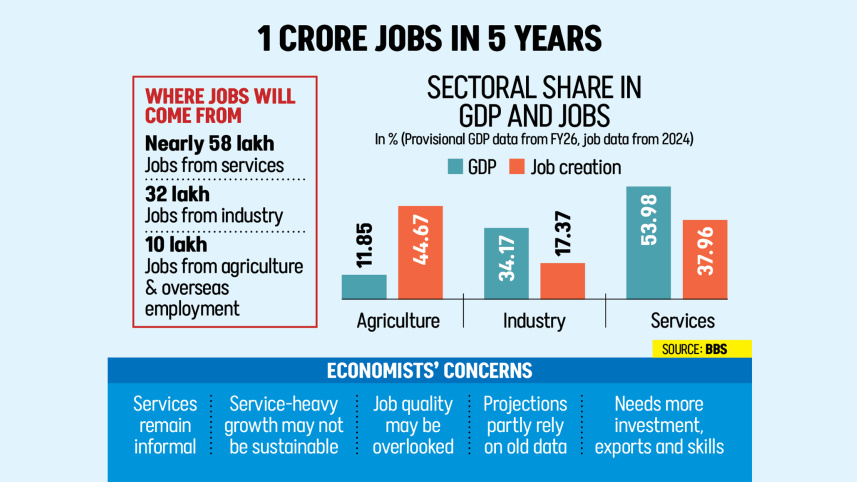
The BNP government plans to create 1 crore jobs over the next five years, with a greater focus on the services and less pressure on the industrial sector. This means the services sector will have to provide nearly 60 percent of the target.
That is a big bet on a sector where much of the country’s employment is already informal and low-paid, while industrial job creation has slowed despite growth in manufacturing output.

In its Five-Year Strategic Framework for Reform and Development, the government projects domestic employment to increase by 97.8 lakh, from 6.91 crore in fiscal year 2025-26 to 7.88 crore in fiscal year 2030-31. Including overseas employment, the total increase is expected to be around 1.02 crore.
By FY31, services are projected to add 58 lakh domestic jobs, industry 33 lakh, and agriculture and overseas employment the rest.
The bigger question, however, is whether those jobs will be productive and adequately paid. Economists also question whether some of the assumptions behind the government’s projections are too favourable.
Services already account for 37.96 percent of total employment, compared with 44.67 percent for agriculture and 17.37 percent for industry, according to Labour Force Survey 2024 data cited in the five-year framework.
The government expects services employment to rise by 58 lakh to 3.21 crore by FY31. That would make the sector responsible for roughly 60 percent of the projected increase in domestic employment.
The government is depending heavily on services partly because they have historically created more jobs as the economy grows. The sector has the highest employment elasticity of 0.55, compared with 0.45 for manufacturing, 0.50 for construction and mining, and 0.10 for agriculture.
But the recent trend is not especially strong. Services-sector employment growth slowed from 2.6 percent a year between 2017 and 2022 to 2.4 percent.
The sector still added nearly 30 lakh jobs during that period, while industrial employment declined despite industrial output growing by around 9 percent a year.
Automation and more capital-intensive expansion have allowed industry to grow without creating as many jobs.
That leaves services as the government’s main source of new employment. But economists say that the sector’s ability to absorb workers does not necessarily mean it can provide the kind of jobs the country needs.
“Currently, our employment is largely concentrated in agriculture and low-skilled services, so the projection appears to follow the existing trend,” said Prof Sayema Haque Bidisha, a labour economist.
She said services could provide livelihoods in the short term, but sustainable job creation should come from mid and high-skilled manufacturing and high-value services.
“Service-sector-led employment is the second-best option. We should aim for greater employability in manufacturing,” she said.
Prof Sayema said the government should focus on “decent employment”, as envisaged under the Sustainable Development Goal 8.
Niaz Asadullah, a professor of economics at Dhaka University, said reliance on services is not necessarily “undesirable”.
“Modern services, such as ICT, finance, logistics, healthcare, education, tourism and professional business services, can indeed generate productive jobs, exports and linkages with manufacturing,” he said.
But he cautioned that “services” covers a wide range of activities. Much of the sector remains informal, low-paid and low-productivity.
That creates a risk that the projection could reflect “simply an expansion of petty trade, transport and other precarious activities”.
 For all latest news, follow The Daily Star's Google News channel.
 INDUSTRY STILL MATTERS
Economist Birupaksha Paul said the government may be putting too much emphasis on services before building a stronger manufacturing base.
“People are going into the services sector, but look at the pattern of the economy first. You develop a strong manufacturing base and gradually become like Singapore. Singapore has a huge services sector. But our bias towards the services sector is a sign of premature development,” said Birupaksha, an economics professor at State University of New York at Cortland, US.
He said services should grow alongside manufacturing and support its expansion.
“The services sector comes later. The services sector will support manufacturing. If I have a factory, service-sector businesses will grow around that factory. There will be export-import businesses, indenting and various other services,” he said.
“But in our case, young people are taking whatever money they have and opening mobile phone shops. That is also the services sector, but this kind of service-sector growth does not generate much economic growth,” he said.
Pointing to China and Vietnam, Birupaksha said Bangladesh had yet to build a sufficiently strong manufacturing base.
“Even now, the factories have not started operating. Closed factories have not reopened. So that part is not hopeful,” he said.
The government argues that manufacturing growth has already been taken into account.
Monzur Hossain, member-secretary of the General Economics Division, said the services projection is based on past employment patterns and the sector’s relatively high employment elasticity.
“This is broadly consistent with the employment pattern we have seen in the past,” he said.
But he said that the figures are projections, not a guarantee.
“With digitalisation and technological innovation, productivity may increase, while employment could decline in some areas,” he said.
Monzur said Bangladesh still has scope to expand services, especially transport, healthcare, public administration and emerging activities. Services already contribute more than half of GDP.
“Manufacturing growth has already been taken into account. But as technology advances, manufacturing can become more productive without necessarily creating more jobs. In contrast, the scope for expanding services is still quite large in Bangladesh,” he said.
HOW REALISTIC IS THE PROJECTION?
The most serious challenge to the government’s target concerns the assumptions used to calculate it.
Towfiqul Islam Khan, additional director (research) at local think tank Centre for Policy Dialogue (CPD), questioned the methodology behind the projections.
“It relies on an old employment framework and does not adequately take into consideration the ICLS standards [global benchmarks for labour statistics],” he said.
Towfiqul said linking employment growth with economic growth is standard practice, but questioned the use of employment elasticity, which is the responsiveness of employment growth to economic growth, based on data up to 2017.
“If more recent data had been used, we would have seen that in many cases economic growth has taken place without a corresponding increase in employment. In some areas, employment has actually declined. So, the elasticity used here appears somewhat favourable to the projection,” he said.
That matters because recent experience has shown that economic growth does not always translate into jobs at the same pace.
Prof Sayema also questioned the link between GDP growth and employment.
“Our major problem is that employment does not increase at the same rate as GDP. This is where employment elasticity becomes important,” she said.
She said the focus should not simply be on adding people to the ranks of the employed. “Our job is not simply to create employment. We also have to create decent jobs,” she said.
Around 84 percent of the country’s employed population remains in informal work, while the figure is above 92 percent among women and youth. The government framework proposes formalisation incentives, apprenticeships and subsidies for first-time job seekers, but moving workers into more secure and productive employment will remain a major challenge.
There is also a problem with the 1 crore headline figure itself.
The target includes projected overseas deployment rising from 11.2 lakh to 15.8 lakh a year, with cumulative deployment of 65.3 lakh workers over five years. But those are gross deployments and exclude returnees.
The framework also says there is no reliable data on the number of Bangladeshis already working abroad. So, the 65.3 lakh figure cannot simply be treated as 65.3 lakh new jobs.
THE REAL TEST
The government’s target is ambitious. But creating 1 crore jobs will require more than an expansion of existing economic activities.
It will require stronger private investment, faster industrialisation, new export sectors and a workforce with skills that employers need.
Prof Asadullah described the target as an expression of ambition rather than a firm job-creation plan.
“I see the 1 crore employment target as an expression of ambition... a conditional projection rather than a credible job-creation strategy,” he said. “With private investment subdued and manufacturing already under pressure, the plan needs to identify where the new productive capacity, firms and occupations will come from.”
He said the real test is not whether Bangladesh creates 1 crore jobs in a statistical sense, but whether it creates 1 crore additional opportunities for productive and adequately paid work.
Towfiqul made a similar point.
He said the important question going forward is not simply how many jobs will be created, but what kind of employment will be created. The quality and nature of employment are important.
Comments