


21 junk stocks dodge DSE axe, trade at premium

They are the stock market’s dividend-free club.
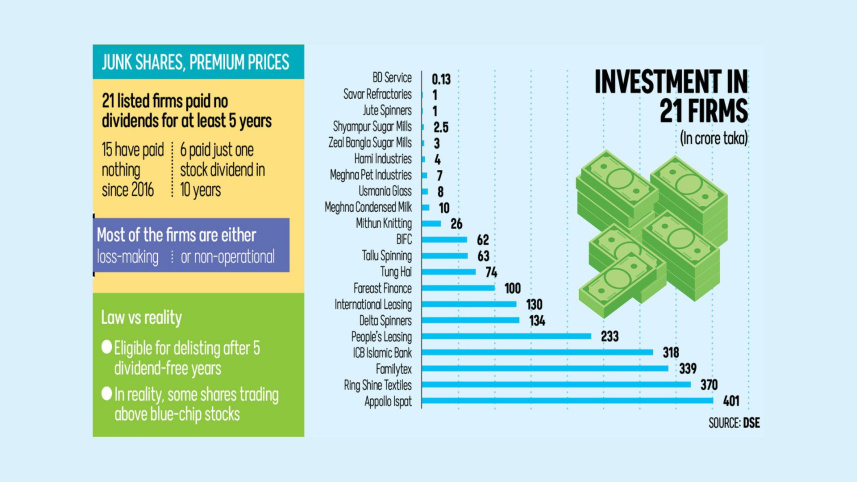
The 21 listed companies have not paid shareholders any dividend for at least five years. Most have shut their factories, while others are burdened by constant losses.

Under stock exchange rules, these companies should already have been delisted. Market analysts say keeping them on the market is an anomaly by almost any international standard.
The Dhaka Stock Exchange (DSE) also acknowledges it has allowed the problem to persist for too long. The DSE says it is now reviewing the companies one by one before deciding on the next steps.
Even as the market considers action against these junk stocks, investors continue to trade them. And some are changing hands at prices higher than those of some of the country’s strongest listed companies.
According to DSE data, shareholders have invested Tk 2,286 crore in paid-up capital across the 21 companies. Paid-up capital represents the equity shareholders have committed through initial public offerings and subsequent share issues, including stock dividends.
In return, investors have received nothing from what has effectively become dead capital. In some cases, they have gone without any return for nearly a decade, as 15 of the 21 companies have paid neither cash nor stock dividends since 2016.
The companies are Bangladesh Services, Bangladesh Industrial Finance Company (BIFC), Fareast Finance and Investment (FFIL), Hami Industries, ICB Islamic Bank, Jute Spinners, Meghna Condensed Milk Industries, Meghna Pet Industries, Mithun Knitting and Dyeing, People’s Leasing and Financial Services, Savar Refractories, Shyampur Sugar Mills, Tallu Spinning Mills, Tung Hai Knitting & Dyeing, and Zeal Bangla Sugar Mills.
The remaining six companies issued a single stock dividend at some point during the past decade but have paid neither cash nor stock dividends in the past five years.
They are Appollo Ispat Complex, Delta Spinners, Familytex BD, International Leasing and Financial Services, Ring Shine Textiles, and Usmania Glass Sheet Factory.
Under the listing regulations, a listed security may be delisted if the issuer fails to declare a cash or stock dividend for five years from the date of its last dividend or from the date of listing.
Saiful Islam, president of the DSE Brokers Association of Bangladesh (DBA), said most people who buy these shares either do so without fully understanding what they are investing in or knowingly take the risk in the hope of making short-term profits.
“Market manipulators target these stocks because they belong to companies with relatively small paid-up capital. They create manipulative traps to lure inexperienced investors into buying them,” he said.
Saiful added that every market has a group of day traders who treat the stock market like a casino, chasing these gambling-type stocks.
On the impact of keeping such companies listed, the DBA president said, “Most of these are virtually non-existent companies. They will not be able to generate returns over the long term. Instead, they create noise in the market and undermine the overall ecosystem.”
“The number of such companies is increasing day by day. When investors in these companies incur losses, the ripple effects spread across the entire market.”
“Moreover, if the share price of these companies exceeds that of fundamentally sound companies, what kind of image does that create about the market?”
Saiful said such companies should be removed from the market. “Listing and delisting should proceed in parallel in the stock market.”
DSE Managing Director Nuzhat Anwar acknowledged that the exchange had allowed the problem to persist for too long.
“Decisions regarding many of these companies should have been taken much earlier, but they were not,” she said. “As a result, the problems have accumulated over a long period and reached their current state.”
 For all latest news, follow The Daily Star's Google News channel.
 “We are currently reviewing the matter,” she added.
The exchange said it is reviewing the companies individually, holding discussions before submitting its findings to the Bangladesh Securities and Exchange Commission (BSEC).
“We intend to clean up the situation,” Nuzhat said. “However, we want to ensure that any action we take is justified, which is why we are proceeding carefully and taking the necessary time.”
She said the DSE has recently suspended trading in several companies whose factories were closed but whose share prices continued to rise. In some cases, the companies themselves said there was no valid reason for the increase.
“Halting trading sends investors a signal that something is wrong,” she said.
“At the same time, we are working to bring more quality companies to the market so that investors have better investment opportunities and a wider range of sound investment options,” she added.
Apart from the 21 companies, another 13 appear to have found a way to remain listed. Each paid a token dividend of between 0.1 percent and 2 percent on a single occasion, apparently enough to stay within the five-year requirement.
Speaking at a public event last week, Masud Khan, the newly appointed chairman of the BSEC, said Bangladesh is an outlier in the way it manages its capital market.
“Most stock markets do not keep non-operational companies listed indefinitely, but Bangladesh does, leaving retail investors exposed to risks they may not fully understand,” he said.
The responsibility rests with the stock exchange as the primary regulator, said Masud, and the DSE is now trying to establish a more rational and transparent process.
Under the proposed approach, he said inactive companies could be given a fixed period, such as one year, to resume operations before facing further action.
The BSEC chairman also urged investors to be cautious about companies that are non-operational, are no longer going concerns, fail to hold annual general meetings or do not pay dividends.
Meanwhile, a senior DSE official, speaking on condition of anonymity, said the exchange had tried several times to delist these companies but backed down each time for fear of protests from investors.
Comments