


5G-ready handsets gain ground as users upgrade
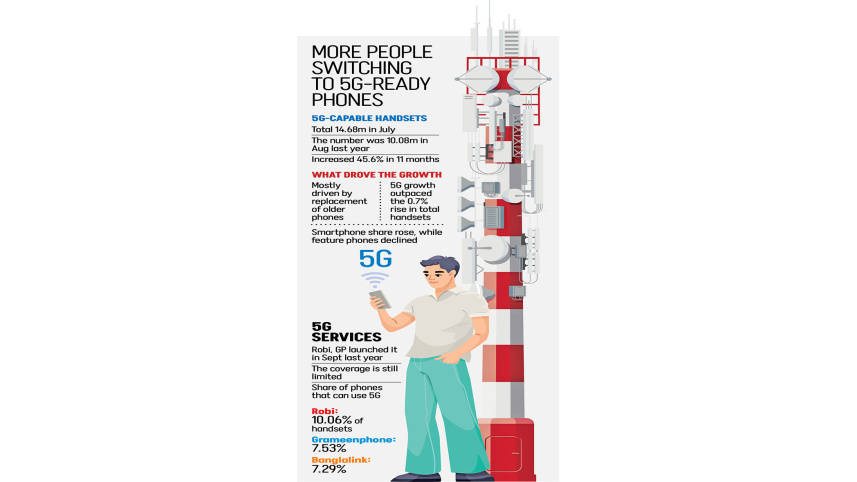
The share of 5G-enabled handsets on Bangladesh’s three major mobile networks rose from 5.74 percent in August 2025 to 8.29 percent in July 2026, showing that consumers are steadily moving towards next-generation smartphones despite limited 5G availability.
Grameenphone, Robi and Banglalink had a combined 14.68 million 5G-capable handsets on their networks in July, up 45.6 percent, or nearly 4.6 million, from 10.08 million in August last year, according to Bangladesh Telecommunication Regulatory Commission (BTRC) data compiled from the operators.

The growth far exceeded the 0.7 percent increase in total handsets, which rose from 175.75 million to 177.02 million over the 11 months. This suggests that most of the growth in 5G devices came from consumers replacing older phones rather than from a significant increase in the overall number of handsets.
However, the figures do not represent unique physical devices. Operators count handsets separately on their networks, meaning the same phone may be counted more than once if it uses SIM cards from different operators. Industry people said many users keep multiple SIMs for better call rates, data offers and network coverage.
Smartphones, including 3G, 4G and 5G devices, accounted for 65.15 percent of handsets in July, up from 62.68 percent in August last year. The share of feature phones fell from 37.32 percent to 34.85 percent.
Globally, 5G adoption is accelerating, with subscriptions reaching 3.1 billion in the first quarter of 2026, according to Ericsson. Bangladesh remains far behind mature 5G markets, but the rising number of compatible devices indicates that consumers are preparing for wider adoption.
Of Bangladesh’s four mobile operators, only Robi and Grameenphone commercially launched 5G on September 1, 2025. Neither has disclosed the number of customers using 5G or the number of sites upgraded for the technology.
ROBI LEADS IN 5G READINESS
Grameenphone had the largest number of 5G-capable handsets, at 6.19 million in July, up 44.3 percent from 4.29 million in August last year.
Tanveer Mohammad, chief corporate affairs officer of Grameenphone, said the operator has launched 5G services across all divisional headquarters, but “the wider 5G ecosystem in Bangladesh -- including device availability, practical use cases and industry readiness -- is still developing.”
He said a stronger and more reliable 4G network would help drive 5G demand. Grameenphone has also started deploying its 700 MHz spectrum to improve network quality, indoor coverage and nationwide reach.
“Looking ahead, we see significant potential for 5G not only in consumer services but also in enterprise and industrial applications,” he said, adding that the company would expand coverage as the ecosystem and demand grow.
Robi, meanwhile, had the highest share of 5G-capable handsets. It had 5.74 million such devices in July, up 46.9 percent from 3.91 million 11 months earlier, the fastest growth among the three operators.
As a result, 10.06 percent of Robi’s handsets were 5G-capable, compared with 7.53 percent at Grameenphone and 7.29 percent at Banglalink.
Shahed Alam, chief corporate and regulatory affairs officer of Robi Axiata, said Robi is carrying the highest volume of 5G traffic in the market as more customers adopt 5G devices.
“We aim to provide 5G coverage wherever there is sufficient demand and a meaningful number of 5G-enabled devices connected to our network. In many locations, we already have blanket 5G coverage, with speeds exceeding 100 Mbps,” he said.
Shahed said Robi’s focus was not simply on expanding coverage but on developing practical uses for 5G beyond social media and video streaming.
“We believe the real value of 5G lies in developing meaningful use cases beyond simply browsing social media or streaming videos,” he said, adding that the technology could create new digital experiences, businesses and services for consumers and the economy.
He also said Robi wants local innovators, developers and entrepreneurs to use 5G to develop solutions for local needs, creating an ecosystem where 5G is “not just a faster network, but a platform for innovation and new possibilities.”
Banglalink had 2.75 million 5G-capable handsets in July, up 46.1 percent from 1.88 million in August last year.
 For all latest news, follow The Daily Star's Google News channel.
 Taimur Rahman, chief corporate and regulatory affairs officer of Banglalink, said the operator would consider launching 5G if spectrum prices are significantly reduced during the renewal process in November.
He said a successful rollout would also require lower spectrum prices, investor-friendly policies and regulations, and greater network sharing.
“Bangladesh cannot sustain some of the world’s highest spectrum prices and telecom taxes while having one of the world’s lowest ARPUs (average revenue per user),” he said.
“As 5G deployment requires significant investment, these issues must be addressed to ensure quality and affordability,” he added.
Banglalink plans to launch 5G initially in areas with high demand and a large concentration of 5G-capable devices. It also plans to explore enterprise solutions based on the technology as part of its initial rollout strategy.
Comments