


Apparel exports to EU, US tumble in Jan-May
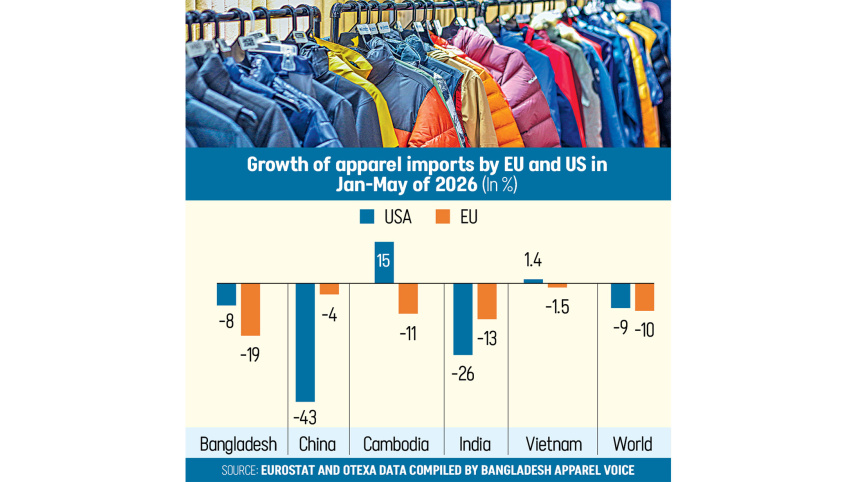
Bangladesh’s apparel exports to its two largest markets -- the European Union (EU) and the United States -- declined sharply in the first five months of 2026 as weaker global demand reduced export volumes and prices.
Data from Eurostat and the US Office of Textiles and Apparel (OTEXA) show that Bangladesh performed worse than most of its major competitors, particularly in the EU market, where it recorded the largest decline among leading apparel suppliers.

Between January and May, Bangladesh’s apparel exports to the EU fell 18.89 percent year-on-year to €7.28 billion. Export volumes declined 10.46 percent, while average unit prices dropped 9.41 percent, showing that the country shipped fewer garments and earned lower prices.
In May alone, exports to the EU dropped 17.12 percent from a year earlier. Shipment volumes fell 13.55 percent, while average unit prices declined 4.13 percent.
Overall, the EU imported €33.84 billion worth of apparel during January-May, down 9.96 percent year-on-year. Import volumes decreased 6.46 percent, while average unit prices declined 3.74 percent, reflecting weaker consumer demand and lower prices.
Among major competitors, India recorded the second-largest decline in apparel exports to the EU during the period, falling 13.33 percent to €2 billion. China’s exports declined 4.2 percent to €9.59 billion, while Cambodia’s exports fell 10.77 percent. Vietnam was the most resilient, with a decline of only 1.51 percent.
The US market also remained weak, although the decline was less severe compared with the EU.
Bangladesh’s apparel exports to the US fell 8.08 percent year-on-year to $3.25 billion in January-May. Shipment volumes declined 6.21 percent, while average unit prices fell 2 percent, reflecting weaker demand and pricing pressure.
However, exports to the US recovered in May, rising 6.04 percent year-on-year to $582 million after several months of decline.
Overall, US apparel imports fell 9.25 percent to $28.78 billion during the period, as import volumes dropped 9.48 percent and unit prices increased only 0.25 percent.
Among competitors, Cambodia was the strongest performer in the US market during January-May, with apparel exports rising 14.90 percent, followed by Vietnam with 1.46 percent growth. China’s exports plunged 42.75 percent to $2.8 billion, while India’s declined 26.37 percent to $1.79 billion.
The latest trade data indicate that Bangladesh’s apparel sector is losing momentum in global markets.
In 2025, the country’s apparel exports grew only 0.89 percent, significantly below the global average growth of 4.46 percent. This marked a sharp reversal from 2024, when Bangladesh’s export growth was about three times higher than the global average.
The slowdown also reduced Bangladesh’s share of the global apparel market. Its share fell to 6.76 percent in 2025 from 7 percent a year earlier, a decline of 0.24 percentage points. This wiped out nearly three-fourths of the gains made in 2024, when its share rose from 6.68 percent to 7 percent.
Md Mohiuddin Rubel, former director of the Bangladesh Garment Manufacturers and Exporters Association (BGMEA) and founder and CEO of Bangladesh Apparel Voice, said Bangladesh’s heavy reliance on the EU market creates a structural risk as the country prepares to graduate from the least developed country (LDC) category in November.
“After graduation, Bangladeshi apparel exports to the EU will face average tariffs of around 12 percent unless we secure GSP+ benefits,” he said.
He said the industry’s outlook from 2027 would depend on Bangladesh’s transition to the EU’s GSP+ scheme.
“If we meet the eligibility criteria, much of the impact can be offset. Otherwise, we risk losing more market share to competitors such as China and Vietnam,” he added.
On the US market, Rubel said LDC graduation would not affect tariff treatment.
“The recent weakness in the US reflects a competitiveness gap rather than a tariff issue. Tariffs alone cannot fix this,” he said.
 For all latest news, follow The Daily Star's Google News channel.
 Bangladesh currently ships nearly 70 percent of its apparel exports to the EU and US markets.
Rubel said growth in both markets has increasingly come from higher shipment volumes rather than better prices, indicating weaker pricing power.
“To sustain growth, Bangladesh must diversify into value-added and technical apparel products instead of relying mainly on basic garments,” he added.
Comments