


Asia's rise triggering ‘perverse’ response from dominant powers: Rehman Sobhan
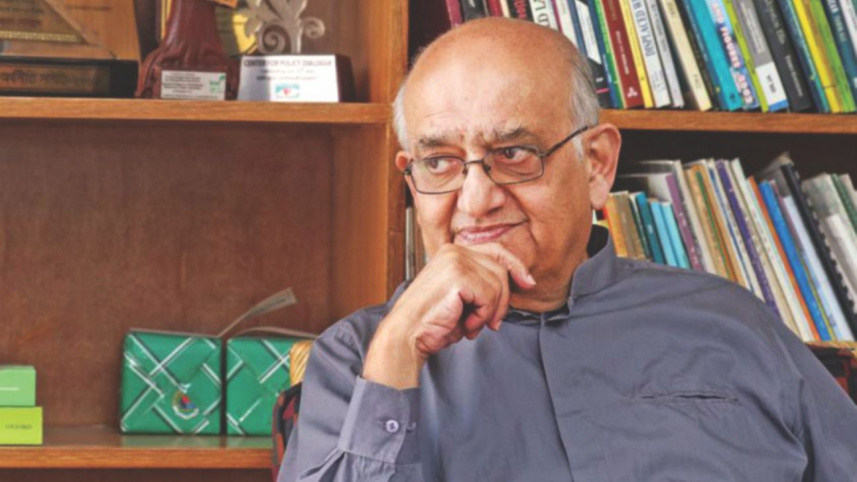
The world's dominant economic powers, led by the United States, are dragging global trade back to the colonial era, using tariffs to bully weaker nations into buying their goods and investing in their economies, eminent economist Prof Rehman Sobhan has said.
He made the remarks at a session titled, "The New International Economic Disorder", during the "Bay of Bengal Conversation" at a Dhaka hotel today.

"We are witnessing a return to the colonial model of trade," he said, adding that countries are being "compelled to buy goods not on the marketplace ... but because they are being pressurised by tariff interventions", and "coerced" to invest in those markets.
"To compel people to buy your goods suggests that you are no longer able to produce these competitively," he added. The US is also using tariffs for political ends, pressuring Brazil, Canada, China, and even India over its trade with Russia.
The disorder, he argued, is the dominant powers' "perverse" response to Asia's rise. With capital surpluses now accumulating in Asia, developing countries need not rely on Western aid and investment, which once gave the West leverage over their policies.
China, he noted, is now the world's largest source of official aid and loans, a role once held by the US and Western Europe.
Unlike colonialism, which created captive markets through conquest, Asia's rise has come "largely within the marketplace", he said. Yet, the old powers are fighting it through market intervention rather than competition.
Trying to revive US industry by protecting its market -- as President William McKinley did in the 1890s -- is a "non-starter for the most advanced economy in the world", he said, adding that the World Trade Organization has been marginalised.
Still, Asia is going to progressively emerge as the centre of the economic universe. China, already ahead of the US in purchasing power terms, is set to overtake it as the dominant economic power, he said.
The disorder has already hit Bangladesh, he observed, citing the economic fallout of the war in the Middle East. He blamed the war on Israel, calling it a "rogue nation".
Bangladesh's exports remain confined to a narrow range of markets, though its imports and capital comes from Asia, he said, urging deeper integration into Asian value chains. Neighbours China and India, which he expects to be the world's largest and third-largest economies respectively in a decade or so, offer an opportunity that Bangladesh has yet to fully exploit.
"We have certainly integrated our manufacturing process into the value chains of these countries. But we have not integrated Bangladesh's export opportunities into the opportunities opening up for us over there," he said.
Blaming weak policymaking, the economist said, "We are not very effective in terms of strategic planning for the future and even less effective in the way we set out to implement our strategic plans."
Bangladesh's real strategic value, he argued, lies not in the Bay of Bengal but "in our land areas". The Padma and Jamuna bridges allow the country to link Southeast Asia, South Asia, West Asia, and eventually Europe, as once envisaged under the Bangladesh-China-India-Myanmar (BCIM) initiative that he helped found.
Earlier in the day, Prime Minister Tarique Rahman inaugurated the 5th edition of the forum organised by the Centre for Governance Studies (CGS). The three-day international forum is hosting around 200 speakers, 300 delegates, and over 1,000 participants from more than 100 countries, according to CGS.
 For all latest news, follow The Daily Star's Google News channel.
Comments