


Bangladesh more a target than user of anti-dumping: BFTI study

Bangladesh has barely used its three trade remedy tools -- anti-dumping, countervailing duty and safeguard measures -- against unfair imports even as it remains a frequent target of such measures abroad, a Bangladesh Foreign Trade Institute (BFTI) study has found.
The findings come as India’s Directorate General of Trade Remedies (DGTR) carries out an anti-dumping investigation into polyethylene terephthalate (PET) films exported from Bangladesh, China and Thailand, and has asked interested parties to take part in an oral hearing.

Producers not individually listed in the review findings face a residual duty of $445 per tonne on yarn and twine and $283 per tonne on sacking bags.
The neighbouring country has also completed a mid-term review of anti-dumping duties (ADD) on jute goods from Bangladesh and Nepal.
In final findings dated June 25, the Indian authority recommended a revised, producer-specific duty structure to replace the existing rates, which range from zero to $351.72 per tonne and have been in place since a December 2022 reimposition.
Under the new structure, most named Bangladeshi producers would face duties of $69 per tonne on jute yarn and twine and $120 per tonne on sacking bags.
Producers not individually listed would face a residual duty of $445 per tonne on yarn and twine and $283 per tonne on sacking bags.
The recommended rates will take effect once implemented through a Customs Notification from India’s Ministry of Finance.
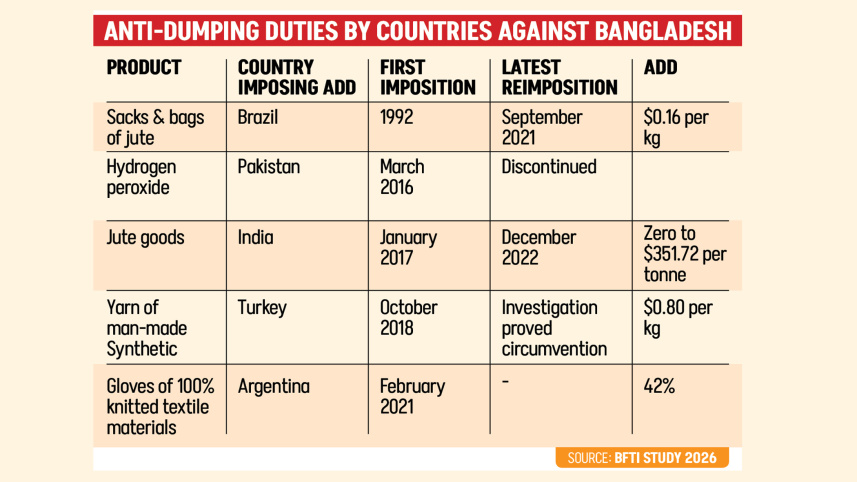
According to the BFTI study, four other Bangladeshi export products currently face anti-dumping duties abroad, each imposed by a different country.
Pakistan applies duties of 12.14 percent on hydrogen peroxide from most Bangladeshi exporters, with lower individual rates for named companies, following a review completed in October 2021.
Turkey applies a duty of $0.80 per kilogramme on man-made synthetic and artificial staple fibre yarn, after an investigation found circumvention of existing measures, with an exemption for one Bangladeshi company.
Argentina applies a 42 percent duty on gloves made of 100 percent knitted textile materials, imposed in February 2021. Brazil applies a duty of $0.16 per kilogram on jute sacks and bags, a measure in place since 1992 and last reviewed in September 2021.
Since 1992, Bangladeshi exporters have faced nearly a dozen anti-dumping investigations by the above-mentioned importing countries, the BFTI study mentions.
The study, conducted for the Bangladesh Trade and Tariff Commission (BTTC), said Bangladesh is at a critical juncture as it prepares to graduate from least developed country status this November. After graduation, the country will lose duty-free and preferential market access and other trade support measures extended to LDCs.
“This transition will expand market access opportunities but simultaneously erode policy space for traditional protective measures such as regulatory duties, supplementary duties, and minimum tariff values,” the BFTI paper said.
In this changing landscape, WTO-compliant trade remedy mechanisms, including anti-dumping, countervailing duties and safeguard measures, will become essential both to shield domestic industries from unfair trade practices and to support Bangladeshi exporters facing investigations abroad, the paper said.
The LDC graduation is expected to expose local industries to intensified competition, including dumping, subsidised imports and sudden import surges, the BFTI warned.
A BTTC official, seeking anonymity, said import tariffs will decline as Bangladesh meets obligations under bilateral and multilateral trade agreements.
Harunur Rashid Shams, research fellow at the BFTI, told The Daily Star their research shows Bangladesh’s current tariff regime needs a gradual shift away from broad para-tariff protection toward a more transparent, evidence-based and WTO-compliant trade remedy system.
Para-tariffs are fees or taxes, other than customs duties, charged at the border on imported goods.
 For all latest news, follow The Daily Star's Google News channel.
 “As Bangladesh prepares for LDC graduation, strengthening anti-dumping, countervailing and safeguard mechanisms will be critical to protecting domestic industries without undermining international trade commitments,” he said.
The paper also said strengthening trade remedy mechanisms is important to support Bangladeshi exporters facing investigations abroad.
Shams said enhancing the BTTC’s analytical capacity with specialised economists, cost analysts, trade lawyers and a modern trade surveillance system is vital for Bangladesh to identify unfair trade practices and respond with internationally accepted policy tools.”Our findings also recommend creating secure mechanisms through which trusted industry associations can access product-specific import data. Better data will improve transparency, strengthen evidence-based analysis and support more credible trade remedy investigations,” he said.
Comments