


Bangladesh ranks high among LDCs in remittance costs
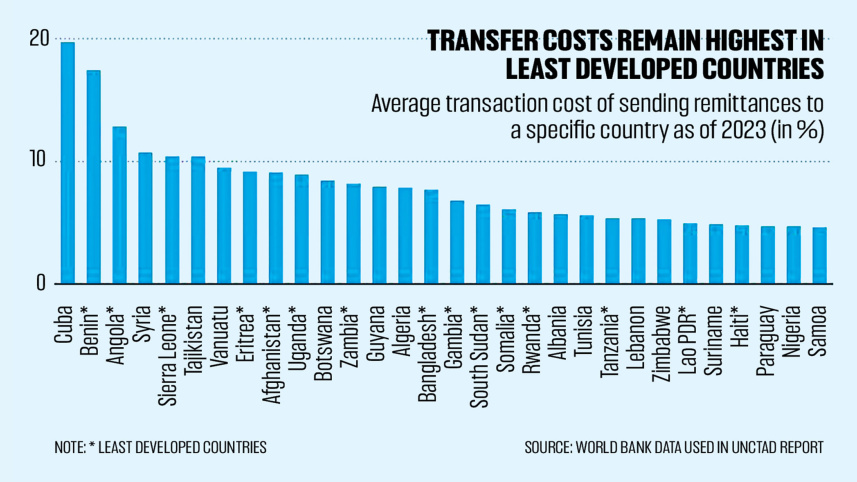
Bangladesh has one of the highest costs for remittance transfers among the least developed countries (LDCs), with the average transaction cost of sending remittances to the country standing at 7-8 percent.
According to the latest global trade update by the United Nations Conference on Trade and Development (UNCTAD), Bangladesh was featured in a 2023 remittance transfer benchmark by the World Bank.

Bangladesh is one of the top 10 remittance-receiving countries in the world, thanks to millions of migrant workers, mainly in the Middle East, who send money home, helping the country meet much of its external payment needs.
The UNCTAD report said LDCs account for half of the countries with the highest remittance costs globally. Benin and Angola have the highest remittance transfer costs, while Lao PDR and Haiti have the lowest among LDCs.
“However, real progress has been made, particularly in Africa,” said the UNCTAD report, released on September 4.
Bangladesh is one of the top 10 remittance-receiving countries in the world, thanks to millions of migrant workers, who send money home, helping the country meet much of its external payment needs
The report said mobile money use among adults in sub-Saharan Africa rose from around 27 percent in 2021 to about 40 percent in 2024. The Pan-African Payment and Settlement System (PAPSS) is also helping to lower cross-border transaction costs and reduce reliance on offshore clearing.
UNCTAD said trade in digitally deliverable services is growing rapidly, but LDCs are not keeping pace.
It said that over the past decade, global services exports expanded by about 6.7 percent annually, outpacing goods exports, and increased by 8.3 percent in 2025.
“The expansion of digitally deliverable services (DDS) has been an important driver of this growth, enabled by the spread of digital platforms, cloud computing and improved connectivity in some regions,” it said.
DDS trade grew faster than total services, at an average annual rate of 7.1 percent, and now represents 56 percent of global services exports.
LDCs have benefited far less from this growth. Their services exports grew by only 3 percent annually over the same period, while their share of global services exports, already below 1 percent in 2010, declined further to just 0.6 percent in 2025.
Moreover, digitally deliverable services, which include telecommunications, computer services and professional consulting, now account for 56 percent of global services exports. In developed economies, DDS accounts for 61 percent of services exports, compared with only 16 percent in LDCs.
After 2020, LDC DDS exports showed very little progress, widening the gap with the rest of the world, said the report.
The UNCTAD report also highlighted “servicification” — the growing use of services as inputs across all sectors, such as logistics, finance, design and data management.
“Servicification has emerged as a key driver of economic diversification, structural transformation and participation in global value chains,” it said.
By 2022, services accounted for 71 percent of global intermediate inputs, ranging from 78 percent in developed economies to 61 percent in developing economies. In LDCs, services accounted for 58 percent of intermediate inputs.
UNCTAD said services represent 33 percent of intermediate inputs in industrial goods exports globally, but this drops to just 13 percent in LDCs, including Bangladesh.
“Services should be viewed not only as a sector in their own right but also as critical inputs into the production and export of goods. The quality, cost and availability of services directly affect competitiveness and participation in global value chains across all sectors,” it said.
The role of services in developing countries’ trade is often underestimated because the services embedded in goods exports are not adequately measured, it added.
 For all latest news, follow The Daily Star's Google News channel.
 “Unlocking the benefits of servicification, the growing use of services as inputs across all sectors, requires targeted action to strengthen data governance, digital infrastructure, regulatory frameworks and participation in trade negotiations, particularly for developing and least developed economies,” it added.
The UNCTAD report said services are reshaping global trade, but poor connectivity, costly cross-border payments and skills gaps continue to restrict participation by developing countries.
“Artificial intelligence may widen the gap because computing capacity, data, finance and expertise remain concentrated in a few economies.”
The report also flagged sluggish progress in multilateral rules on digital trade. It said divergent provisions in regional and bilateral agreements have increased regulatory complexity.
“Developing countries need better data, stronger digital infrastructure and greater capacity to shape emerging rules.”
Comments