


BASIC Bank still struggling to heal from Bacchu-era damage

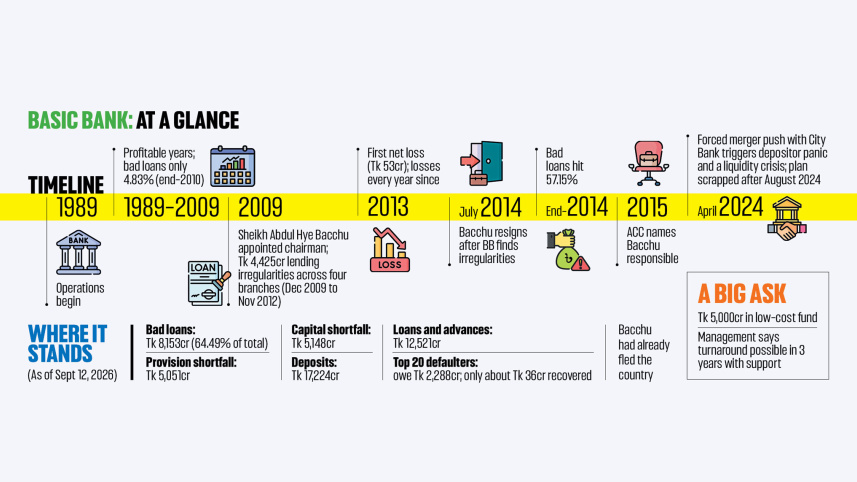
Once a reputed and profitable state-owned lender, BASIC Bank is still struggling to recover from the financial damage caused during the tenure of its former chairman Sheikh Abdul Hye Bacchu, under whom irregularities involving around Tk 4,500 crore came to light.
Established in 1989, the bank was profitable till 2009, when the then Awami League government appointed Jatiya Party leader Bacchu as its chairman.

Soon after, the commercial lender became mired in financial irregularities.
An inspection by the Bangladesh Bank (BB) later found that loans worth Tk 4,424.93 crore were disbursed with serious irregularities across four branches between December 2009 and November 2012. The loans are yet to be recovered by the bank.
Bacchu resigned as BASIC Bank chairman in July 2014, shortly after BB uncovered massive irregularities and scams and recommended that the finance ministry dissolve the bank’s board.
By then, the state lender’s bad loans had jumped to 57.15 percent from just 4.83 percent at the end of 2010.
Although widespread irregularities and corruption took place at the bank, Bacchu was not officially held responsible until 2015.
By the time the Anti-Corruption Commission (ACC) identified him as responsible, he had already fled the country.
FAILED MERGER WORSENED BASIC CRISIS
Amid the irregularities and scams, BASIC Bank posted a net loss of Tk 53 crore in 2013. Since then, it has reported losses every year.
The loss stood at Tk 416 crore in 2023 and had reached Tk 655 crore by September 12 this year, according to the bank’s data.
Over the same period, its bad loans rose to Tk 8,153 crore, or 64.49 percent of its total disbursed loans, while its provision shortfall stood at Tk 5,051 crore as of September 12 this year. The bank also faces a capital shortfall of Tk 5,148 crore, show data.
Under the previous Awami League government, then BB governor Abdur Rouf Talukder pushed BASIC Bank towards a voluntary merger with City Bank, one of the country’s largest private lenders, in April 2024.
The move was part of a broader central bank drive to merge weak banks with stronger ones.
However, the rescue initiative dealt another blow to the bank. It triggered a severe liquidity crisis as public and institutional depositors panicked. The plan was eventually scrapped following the political changeover in August 2024.
The image problem still hurts deposits and business despite improvements over the past two years, according to Helal Ahmed Chowdhury, chairman of the bank, who took charge in November 2024.
Helal, a senior banker with nearly five decades of experience, said that the bank’s main wound is the scam that started in 2009. “We are still struggling to overcome its impact.”
He said the bank is now focused on reducing non-performing loans (NPLs), expanding export and import business, onboarding new exporters, strengthening its foreign currency position and attracting remittances through arrangements with overseas banks.
TK 5,000CR DEPOSIT SOUGHT FOR RECOVERY
The current chairman of the bank said they are seeking Tk 5,000 crore in low-cost deposits from the government or BB to improve its financial position and reduce NPLs.
 For all latest news, follow The Daily Star's Google News channel.
 “The proposal is still under process.”
Helal said the low-cost funds could be used to replace some high-cost deposits, helping strengthen the bank’s liquidity position and rebuild depositor confidence.
The bank is also seeking government support to open Special Notice Deposit (SND) accounts with government agencies and to be included among the banks designated to receive government deposits and loans.
An SND account is a short-term, interest-bearing bank account for businesses, institutions and individuals who need frequent transactions but want to earn a higher return than a standard current account.
As of September this year, the bank’s deposits stood at Tk 17,224 crore, while its loans and advances stood at Tk 12,521 crore, according to data.
Helal said the bank is working with Sonali Bank and other lenders on bilateral arrangements and is seeking agency agreements with overseas banks to facilitate remittance inflows.
To boost lending and recovery, BASIC Bank has introduced a system requiring every branch to submit two loan proposals and two recovery plans each month.
The bank has 72 branches and 35 sub-branches, along with other operational units.
Up to September this year, the bank recovered Tk 79 crore in cash and Tk 229 crore through non-cash recovery from classified loans, according to data.
‘SIGNS OF IMPROVEMENT IN SIGHT’
The chairman said the bank has already begun to show signs of improvement, although its large legacy losses mean positive results have yet to fully offset accumulated losses.
Policy support from BB, including relevant regulatory measures and schemes, would be crucial to the bank’s turnaround, he said.
“We believe there is every possibility of turning the bank around within the next three years, provided we receive the necessary support,” he said, adding that the bank has drawn up a three-year action plan involving low-cost funds from BB, policy support, reduced cost of funds and capital injection.
TOP 20 DEFAULTERS OWE TK 2,288CR
As of June this year, BASIC Bank’s top 20 defaulters collectively owed Tk 2,288.25 crore in classified bad loans, all rated “Bad/Loss”, the worst category under the Bangladesh Bank’s loan classification norms.
Real estate firm Amader Bari Ltd topped the list with Tk 204.66 crore in outstanding dues, followed by Crystal Steels & Ship Breaking Ltd, Western Housing Ltd, Well Tex Ltd and Zeal Wears Ltd.
Other large defaulters include Cox’s Developer Ltd, Map Paper Board Mills Ltd, IG Navigation Ltd, Bay Navigation Ltd, and Regent Weaving Ltd -- each owing more than Tk 110 crore.
The remaining names on the list are Confidence Shoes Ltd, The Aristocrat Agro Ltd, Ali Trade International Ltd, Ajbina Agro Industries Ltd, Atlas Food & Beverage Ltd, Barshon Agro Industries Ltd, Techno Design & Development Ltd, Mynco Jute Mills (Composite) Ltd, New Auto Define, and Lohozong Trade International Ltd.
Bank data show recovery against these accounts has been minimal, with cumulative collections of only about Tk 36.4 crore so far -- barely 2 percent of the total outstanding -- while the forced sale value of pledged collateral covers just Tk 364.71 crore, or roughly 16 percent, of the amount owed.
The chairman said the bank is pursuing legal action against the defaulters through the money loan court, under the Negotiable Instruments (NI) Act, and through cases filed by the Anti-Corruption Commission.
Recovery efforts against loans disbursed during the period of major irregularities are also continuing, he said, suggesting that the actual recovery position be assessed from a specific cut-off date.
The bank’s recovery efforts could be significantly strengthened if it regained control of its building, currently under dispute with a developer, he said. The bank also needs additional manpower and technological upgrades, including an updated core banking system (CBS).
‘GOVERNANCE KEY TO ANY RECOVERY’
Toufic Ahmad Choudhury, former director general of the Bangladesh Institute of Bank Management (BIBM), said there is no example in Bangladesh of a weak bank becoming strong through government liquidity support or capital injection.
He described some state-owned banks, including BASIC Bank, as “bottomless baskets” that cannot recover on liquidity support alone.
Strong governance and a focus on reducing non-performing loans are essential, he told The Daily Star.
“Liquidity support should not be provided without ensuring good governance,” he said.
“The government itself is responsible for the distress of state-owned banks. Fixing them requires political commitment, but the government lacks the willingness to reform them. If it had the political will, these banks would have recovered by now,” Toufic added.
Comments