


Bicycle exporters look beyond recovery to post-LDC challenges

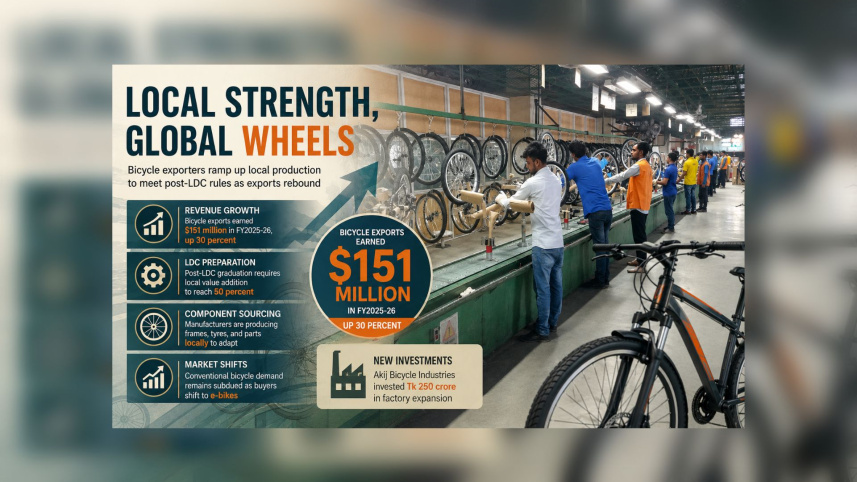
Bangladesh’s bicycle industry is moving beyond simple assembly towards deeper manufacturing, with exporters increasingly producing components locally to strengthen competitiveness in global markets.
But industry leaders say substantially higher local value addition will be essential to retain preferential market access after the country’s graduation from the least developed country (LDC) category.

Manufacturers are now investing in local component production to reduce their import dependence and meet stricter rules of origin that will apply after LDC graduation.
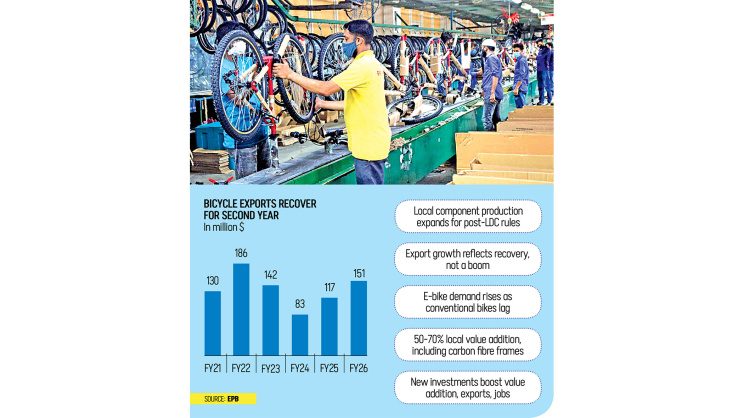
The shift comes as bicycle exports continue to recover. According to the Export Promotion Bureau (EPB), bicycle exports earned $151 million in FY2025-26, up around 30 percent from $116 million a year earlier.
Industry executives say the recovery reflects Bangladesh’s improving manufacturing capability, competitive production costs and established relationships with European buyers.
However, RN Paul, managing director of RFL Group, noted that the rise in bicycle exports reflects a recovery from last year’s unusually weak base rather than a full-fledged market rebound.
“Exports have bounced back, but the market is still well below where it was three or four years ago, including 2022,” he said. “It’s a case of things getting better from a very bad situation, not a boom.”
He attributed the recent improvement to some overseas buyers resuming orders after a prolonged slowdown rather than the emergence of new export destinations.
Paul said global demand for conventional bicycles remains subdued as consumers gradually shift towards electric bicycles, which typically cost about 30 percent more. At the same time, economic uncertainty caused by ongoing geopolitical conflicts has made consumers more cautious about spending.
“The transition to e-bikes is happening, but volumes are not growing at the pace we expected,” he said.
RFL has introduced e-bikes in both the domestic and export markets, although demand remains limited, he added.
While RFL is navigating a gradual recovery in demand, other manufacturers are focusing on expanding local production to strengthen their long-term competitiveness.
Md Luthful Bari, chief operating officer of the Tyre Division of Meghna Group of Companies, said the company manufactures most bicycle components locally, including frames, forks, rims, tyres, tubes, pedals, saddles, handlebars and grips. Only a few specialised inputs, such as paint and Shimano gear systems for multi-gear bicycles, are imported.
He said specialised bicycle paint is not produced in Bangladesh and attracts an import duty of about 60 percent, increasing production costs.
Multi-gear components are also imported because overseas buyers prefer internationally recognised brands such as Shimano, while steel sheets and rods are brought in as raw materials.
Bari said local value addition ranges between 50 percent and 70 percent, depending on the type and specifications of the bicycle.
Meghna’s exports are gradually gaining momentum after a prolonged slowdown, with Germany remaining its largest market, followed by Denmark.
The company is also expanding into new European markets, although exports to Italy have declined.
“Export orders are improving gradually,” Bari said, expressing optimism that overseas demand will continue to recover.
He added that Meghna began manufacturing high-end carbon fibre frames and forks a few years ago, claiming it was the first company in South Asia to do so.
 For all latest news, follow The Daily Star's Google News channel.
 The company plans to start producing fully carbon fibre bicycles soon, targeting the premium segment of the global market.
Newer manufacturers are also making significant investments with the post-LDC trade regime in mind.
Among the new entrants, Akij Bicycle Industries is building its strategy around increasing domestic value addition.
Sayed Joynul Abedin, chief executive officer of Akij Bicycle Industries Ltd, said the company began exporting bicycles in March after spending the previous two years establishing its manufacturing facilities.
“So far, we have exported to three European countries -- the Netherlands, Poland and Germany. The response has been encouraging, and we already have several export orders in hand,” he said.
The company expects to export around 100,000 bicycles this year.
Abedin said Akij has invested about Tk 250 crore, including land acquisition and factory development, in its bicycle manufacturing project in Mirzapur, Tangail.
He said increasing local value addition has become a strategic priority as Bangladesh prepares to graduate from LDC status.
“At present, we can qualify for export preferences with around 30 percent value addition. After LDC graduation, the requirement will rise to about 50 percent. Keeping that in mind, we are investing in tyre manufacturing, which we expect to begin commercial production next year and help raise local value addition,” he said.
The factory currently employs around 800 workers, with the workforce expected to exceed 1,000 by the end of the year, he added.
Comments