


BTRC seeks to phase out 2G in three years
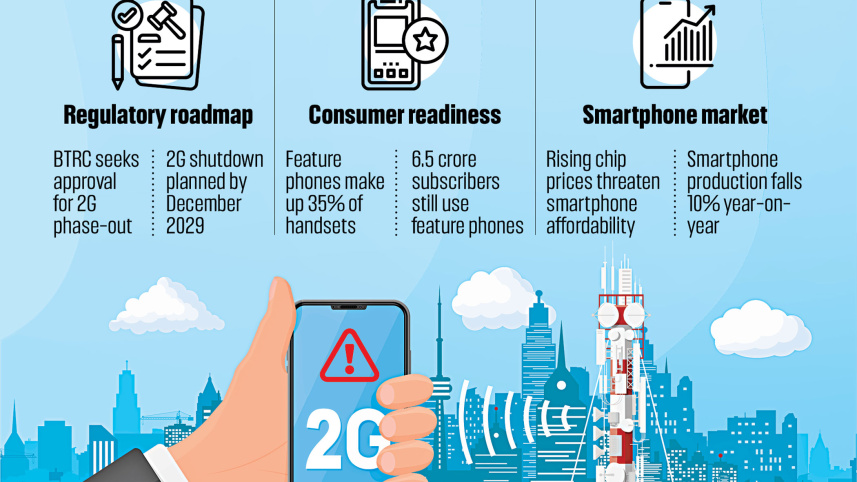
The Bangladesh Telecommunication Regulatory Commission (BTRC) has decided to seek government approval for phasing out 2G mobile networks by December 2029.
The decision was taken at a commission meeting this week as the regulator considers a roadmap for the eventual shutdown of 2G services, officials said.

The move comes as the government seeks to expand internet connectivity and the digital economy. It also plans to introduce a system based on a single digital identity and wallet to encourage wider use of digital transactions.
However, experts point out that the planned 2G phase-out could face a major challenge as a significant portion of mobile users still rely on feature phones.
According to BTRC data, feature phones, which mostly support 2G and some 3G services, accounted for 35 percent of handsets in July 2026, while smartphones, including 3G, 4G and 5G devices, accounted for the remaining 65 percent.
Another set of BTRC data shows that more than 6.5 crore mobile subscribers out of around 19 crore subscriptions use feature phones.
BTRC officials said the commission would also seek the government’s views on when Bangladesh should stop allowing the import of raw materials used to manufacture feature phones.
The regulator recently held a workshop with mobile operators and handset manufacturers to seek their views on whether a 2G sunset by 2028 would be possible.
Participants at the event said it was technically possible, but the transition would face difficulties because handsets have a lifecycle and consumers generally expect to get maximum value from their existing devices.
According to officials familiar with the matter, most participants recommended December 2029 as the deadline for the sunset.
The affordability of smartphones is another major concern.
Industry insiders said a sharp rise in memory prices has increased handset production costs, making it more difficult to offer affordable smartphones to consumers.
“The biggest challenge today is the global surge in component costs,” said Ziauddin Chowdhury, country general manager of Xiaomi Technologies Bangladesh.
He said rising memory-chip prices, driven partly by the rapid expansion of artificial intelligence technologies, were putting “significant pressure on the affordability of entry-level and budget segments”.
Gartner, a leading global technology research and advisory firm, estimates that combined prices of DRAM, a type of working memory, and solid-state drives (SSDs), used for data storage, could rise 130 percent by the end of 2026 from 2025 levels, potentially increasing smartphone prices by 13 percent.
Local manufacturers also depend heavily on imported components, limiting their control over costs. Meanwhile, local smartphone production is falling.
BTRC data show smartphone output dropped 10 percent year-on-year to 53.76 lakh units in January-August 2026, with the grey market estimated to account for more than 60 percent of sales.
Earlier in September, Rehan Asad, the prime minister’s ICT and telecom adviser, announced a government plan to make locally produced smartphones available to consumers for less than Tk 4,000. The target was later revised to Tk 5,000 due to a rise in component prices.
To facilitate low-cost smartphone production, the national budget for the ongoing fiscal year 2026-27, slashed the advance income tax on imports of 22 raw materials used in local phone manufacturing to 1 percent.
Duty exemptions on raw materials and components, along with conditional VAT exemptions, were extended until June 2030.
 For all latest news, follow The Daily Star's Google News channel.
 Speaking about the 2G phase-out, BTRC Commissioner Brig Gen (retd) Iqbal Ahmed said the regulator needed to set a fixed timeline for the transition.
“We need to set a fixed timeline because without a timeline and proper planning, we cannot make progress. However, if necessary, the timeline can be adjusted later,” he said.
Mobile operators are now expanding their 4G networks rather than 2G. At the same time, BTRC and relevant stakeholders are taking initiatives to bring smartphone prices down.
“We are also encouraging support measures, including facilities through the banking system, to help people make the transition to smartphones,” Iqbal said.
Among the top 17 mobile phone manufacturing companies in Bangladesh, the four largest have completely stopped producing 2G handsets and are now manufacturing only 4G devices.
“As the global and local telecom ecosystem evolves, equipment for older technologies such as 2G is becoming more expensive to produce because of lower volumes,” said the BTRC chairman.
He added, “Whether the vendors are Chinese, Western or Nokia, the cost of producing equipment for older technologies is increasing. We expect the ecosystem to mature further and become more affordable over the next two to three years.”
The cheapest locally manufactured smartphone now costs more than Tk 9,500, while the cheapest locally manufactured feature phone costs Tk 950.
Abu Nazam M Tanveer Hossain, a telecom expert, said phasing out 2G by 2029 is a reasonable target, but the transition must be driven by readiness rather than simply a deadline.
“Bangladesh already has 99 percent 4G population coverage, yet only 46 percent of people use mobile internet, exposing a substantial usage gap,” he said.
“The priority should therefore be affordable 4G/VoLTE devices, reliable nationwide voice coverage and migration incentives. Sunsetting 2G should be the outcome of digital inclusion, not a precondition for it,” he added.
Comments