


Business leaders push for deregulation
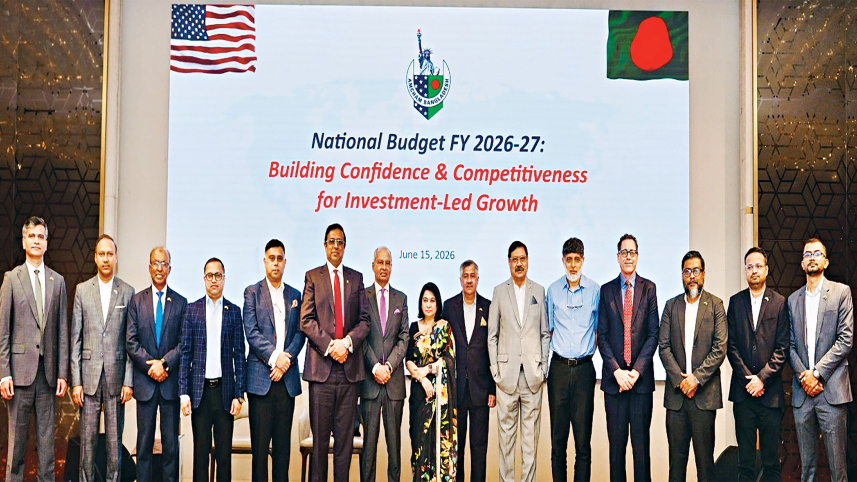
A group of private sector entrepreneurs has called for meaningful deregulation to improve the ease of doing business and attract more foreign direct investment (FDI), particularly from the United States.
They voiced their suggestions and concerns at a post-budget discussion organised by the American Chamber of Commerce in Bangladesh (AmCham) at the Sheraton Dhaka yesterday.

Economists and business leaders attended the event, urging the government to improve power and energy supplies, ensure the safety and security of both foreign and domestic investments, and undertake vital reforms to encourage greater private-sector investment.
The entrepreneurs said the proposed national budget for fiscal year 2026-27 had addressed many of their concerns, but not comprehensively.
Presenting the keynote paper, M Masrur Reaz, chairman and chief executive officer of Policy Exchange Bangladesh, said the budget was a pragmatic effort to support economic recovery while laying the foundation for long-term transformation.
Economists and business leaders urged the government to improve power and energy supplies and ensure safety and security of both foreign and domestic investors
He said the budget sent positive signals for private sector-led growth through measures aimed at easing business costs, encouraging investment and strengthening social protection.
However, achieving its objectives would require overcoming significant challenges, including the ambitious GDP growth target of 6.5 percent, higher revenue mobilisation, persistent inflationary pressures, and vulnerabilities in the banking and energy sectors.
He stressed that effective implementation would be crucial to translating policy intentions into tangible outcomes.
“I feel business people face the same challenges when doing business in Bangladesh,” said Ahsan Khan Chowdhury, chairman and chief executive officer of PRAN-RFL Group, one of the country’s largest business conglomerates. He was speaking as a panellist.
“Making money in Bangladesh should be easier so that people from around the world come here to invest and do business. As an export hub, Bangladesh should compete with Vietnam and Cambodia to attract investment from China.”
He said Bangladesh should place greater emphasis on skills development, noting that the country receives around $17 billion to $18 billion in inward remittances annually.
However, he questioned whether the budget addressed why an average Filipino worker in the Gulf earns roughly double the salary of an average Bangladeshi worker.
Bangladesh should focus on producing a more skilled workforce so that inward remittances can increase from $18 billion to $36 billion, he added.
Also speaking as a panellist, Naser Ezaz Bijoy, immediate past chief executive officer of Standard Chartered Bangladesh, said financing the budget would be a major challenge, as the government would need to generate more than 50 percent of the additional revenue from collections above the revised target for the outgoing fiscal year.
Government borrowing is also likely to increase further to finance the budget, he said.
AmCham President Syed Mohammad Kamal said that although achieving the inflation target of 7.5 percent was possible, the government must implement deregulation measures to attract foreign investment, particularly from the United States.
Immediate past AmCham president Syed Ershad Ahmed urged the government to implement the logistics policy to facilitate business, reduce hassles, improve efficiency in trade and commerce, and lower the cost of doing business.
Fahmida Khatun, executive director of the Centre for Policy Dialogue, questioned how the budget would be financed, given the revenue authority’s recent failure to meet its collection targets.
She said that if the government relied on borrowing from banks and foreign sources, the private sector could face a liquidity squeeze in the banking system, while the country’s external borrowing level was also approaching a moderately risky position.
 For all latest news, follow The Daily Star's Google News channel.
Comments