


Construction sector loses steam

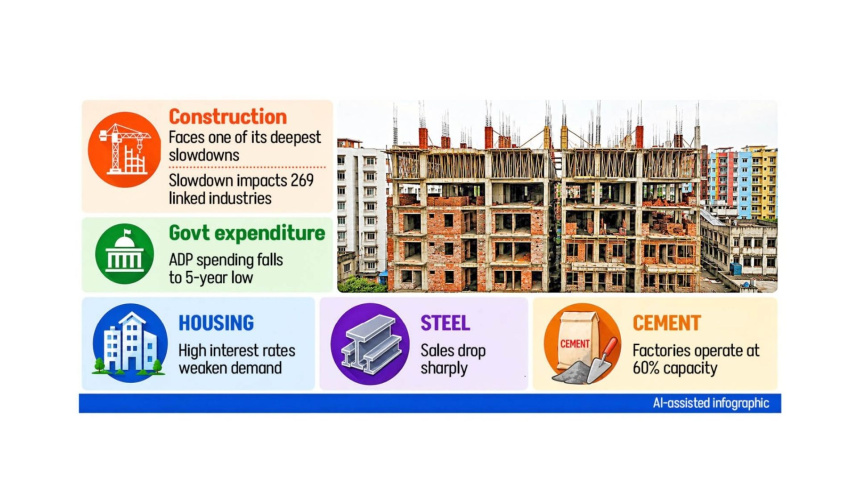
The country’s construction sector is facing one of its worst slowdowns in years as weaker public development spending, slower private investment and high borrowing costs reduce demand for housing and construction materials.
Once driven by mega infrastructure projects, rapid urbanisation and a booming housing market, the sector is now struggling with rising costs, financing constraints and policy uncertainty.

Industry leaders said the downturn has affected not only construction companies but also around 269 related industries, including steel, cement, ceramics, bricks, electrical equipment, transport and furniture.
Construction material manufacturers are cutting prices, absorbing losses and operating below capacity as sales decline and financial pressure rises.
Sector insiders said weaker public development spending is a major reason behind the slowdown. The implementation rate of the Annual Development Programme (ADP) dropped to its lowest level in five years in FY2025-26.
According to the Implementation Monitoring and Evaluation Division (IMED), ministries and divisions implemented projects worth Tk 100,764 crore during July-May, accounting for 48 percent of the revised ADP allocation.
Private investment has also slowed due to political uncertainty, high borrowing costs and weak business confidence, further reducing demand for construction work.
HOUSING MARKET UNDER PRESSURE
The housing sector has been hit hardest, with weaker sales and rising financing costs delaying projects. Developers focused on premium apartments are facing greater challenges as buyers remain cautious.
Anup Kumar Sarker, executive director (marketing) of Concord Group, said sales of premium apartments have weakened as buyers are adopting a wait-and-see approach.
Although transaction volumes have remained relatively stable, revenues have declined due to lower demand for expensive homes.
He said demand for mid-market apartments has remained comparatively stable, but smaller developers that depend heavily on bank loans are facing growing pressure.
“The slowdown is largely due to bank lending rates rising to around 14-15 percent from 9-11 percent previously,” Anup said.
“Most businesses depend on bank financing. With interest rates this high, it has become very difficult to generate enough profit to cover financing costs,” he added.
STEEL MAKERS CUT PRICES AMID FALLING SALES
The slowdown in construction has sharply reduced demand for steel products, forcing manufacturers to lower prices and sell below production costs.
Sumon Chowdhury, secretary general of the Bangladesh Steel Manufacturers Association, said producers initially offered discounts of Tk 500 to Tk 1,500 per tonne before reducing base prices as sales continued to fall.
Rebar prices in Dhaka have declined by around Tk 3,000 to Tk 4,000 per tonne, while MS rod sales have dropped by up to 45 percent due to lower public spending, weak private construction, high inflation and recent floods.
“Factories still have to operate to cover fixed costs such as loan repayments and electricity bills, even though sales have fallen sharply,” Sumon said.
He added that many mills are holding large inventories and selling below production costs to maintain cash flow. Some manufacturers are losing Tk 5,000 to Tk 7,000 per tonne as they struggle with higher electricity tariffs and other production costs.
 For all latest news, follow The Daily Star's Google News channel.
 CEMENT INDUSTRY OPERATING BELOW CAPACITY
Cement producers are also struggling as slower economic growth and reduced construction activity weaken demand.
Mohammad Amirul Haque, managing director of Premier Cement Mills PLC and president of the Bangladesh Cement Manufacturers Association, said government infrastructure work has declined by around 80 percent, while demand for urban housing has fallen sharply.
Although rural construction has provided some support, the industry is currently operating at around 60 percent of its installed capacity, rising to about 70 percent during stronger months.
Amirul said the sector has been hit by several challenges, including the Covid-19 pandemic, the Russia-Ukraine war, taka depreciation, financial sector problems and the recent Middle East crisis.
These factors have increased business costs and discouraged investment, he said.
“Without stronger economic growth, demand for construction materials such as cement, steel, tiles, glass and timber products will remain weak,” he added.
CERAMIC INDUSTRY ALSO HIT
High interest rates and falling purchasing power are further affecting developers and homebuyers.
Md Mamunur Rashid, additional managing director of X Ceramic Group, said high inflation, rising construction costs and weaker purchasing power have significantly reduced housing demand.
Many apartment buyers are struggling to repay loans as lending rates have climbed to 14-15 percent.
He estimated that apartment sales in Dhaka have fallen by 25-30 percent, affecting developers, especially smaller firms. Demand for ceramic products has also declined by 20-30 percent.
Manufacturers are cutting prices and, in many cases, selling below production costs to repay bank loans and avoid defaults.
Mamunur urged the government to withdraw supplementary duty on ceramic tiles, saying they have become an essential construction material rather than a luxury item.
He said reducing taxes on tiles would help lower construction costs and support a recovery in the housing market.
Comments