


Economy shows fragile gains
but households await tangible relief

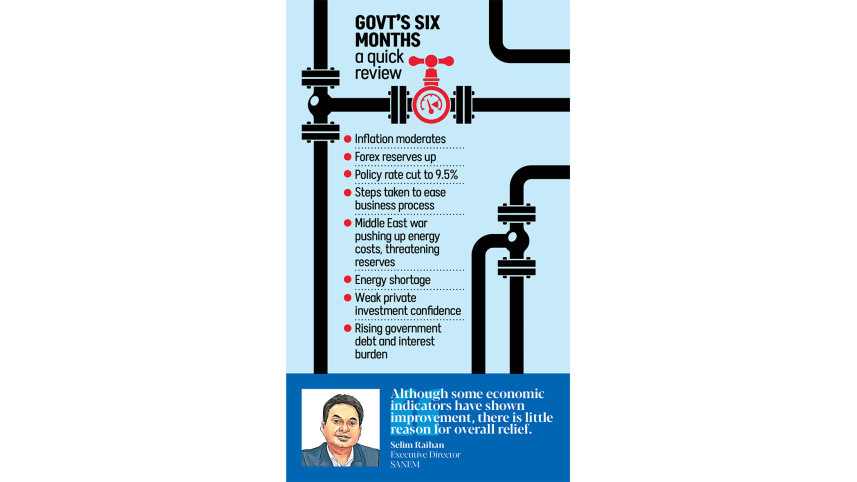
When the BNP government took office in February, several key economic indicators were flashing red.
Economic growth was weak, inflation had remained high for years, the banking sector was badly damaged, and private investment was at a historic low.

The newly elected government could have responded to political pressure by loosening monetary and fiscal policy, increasing public spending and chasing a quick recovery. But that could have blown up macroeconomic stability and made the problems it inherited worse.
Instead, the government accepted that the economy needed time to adjust. It focused on containing the deterioration and laying the foundations for recovery.
Six months into its term, the economy is showing some signs of recovery, according to economists and business leaders. But external shocks, such as the war in the Middle East and unfavourable weather affecting agriculture, threaten to undo those gains.
And despite the improvement in some indicators, the benefits have yet to reach ordinary households in a meaningful way.
For example, inflation has eased to 9.16 percent in June. The government listed the decline among its key achievements in a publication marking its first 180 days in office. Yet the prices of essential food and other goods remain beyond what many households can comfortably afford.
Foreign exchange reserves have also risen above $37 billion, helped by strong remittance inflows. But energy shocks linked to the Middle East war, which began about 10 days after the new government took office and shows no sign of ending soon, could put fresh pressure on the reserves.
The energy crisis could also slow the 44 percent growth in foreign direct investment Bangladesh recorded in 2025. The government publication highlights the rise in total FDI stock to $1,963 million and Bangladesh’s seventh-place ranking among LDCs in attracting foreign investment as signs of progress.
But several other indicators point to risks that could reverse these gains.
Private investment remains weak, the banking sector is still struggling, revenue collection shows little sign of improvement, and pressure from government debt and interest payments is mounting.
“Although some economic indicators have shown improvement, there is little reason for overall relief,” said Professor Selim Raihan, executive director of The South Asian Network on Economic Modeling (Sanem).
Mohammad Abdur Razzaque, chairman of Research and Policy Integration for Development, described the period as “a mixed one”.
He said the democratic transition has improved confidence in political stability, while the law-and-order situation has improved, although further progress is needed.
REMITTANCES LIFT RESERVES AMID FRESH RISKS
In the six-month period of the government, there has also been progress in macroeconomic stabilisation, particularly in foreign exchange reserves, largely because of strong remittance inflows.
As of August 12, foreign exchange reserves stood at $32.26 billion under the IMF’s BPM6 measure, up from $30.06 billion on February 19, according to the Bangladesh Bank data.
According to Razzaque, the US-Israel war on Iran threatens remittance inflows and could limit further gains in foreign exchange reserves as global oil prices remain volatile.
“Despite that, we have not seen any plan, policy, or action to address the long-standing challenges that the government was aware of even before the election,” he commented.
He said, “Although inflation has fallen slightly, it remains high, meaning prices continue to rise, and purchasing power is being eroded.”
 For all latest news, follow The Daily Star's Google News channel.
 The economist also pointed to a tension between monetary policy and the government’s approach to managing inflation.
While a contractionary monetary policy is being maintained, the government is pursuing expansionary measures on several fronts, including stimulus packages, he said.
WEAK PRIVATE INVESTMENT FACES ENERGY CRUNCH
The weakness in private investment is another major concern for the government.
Bangladesh has no shortage of investment summits, economic zones, tax incentives or new institutions.
But entrepreneurs make investment decisions based on practical conditions, including the reliability of gas and electricity supplies, borrowing costs, access to foreign currency, predictable tax and tariff rules, and the time needed to secure approvals.
When domestic investors are cautious, campaigns to attract foreign investment alone will not be enough. The deeper problem is confidence, which can be built only through consistent policies and predictable institutions.
Sanem’s Executive Director Prof Selim said the energy crisis has further worsened this.
The government’s e-book says it is working to drill and rework 150 gas wells by 2028, with 40 wells already underway. It has also invited bids for 28 offshore blocks under a revised production-sharing contract.
But business leaders say the energy shortage remains an immediate threat to industrial activity.
Mir Nasir Hossain, former president of the Federation of Bangladesh Chambers of Commerce and Industry (FBCCI), said the government has inherited a “very mismanaged energy sector” and needs to address it on a “war footing”.
The bigger test has been the war in the Middle East, which has pushed up gas, electricity and fuel costs, he said.
Nasir said inadequate planning and a failure to pursue gas exploration had compounded the problems facing businesses.
“If we had done those things, we would not have been in this situation today,” he said.
Meanwhile, Razzaque said the energy shortage could weaken manufacturing and undermine the country’s broader economic transformation.
“Manufacturing growth is turning negative, signalling a highly critical situation for Bangladesh’s economy. Unless the manufacturing sector recovers rapidly, the process of structural transformation [moving workers from less productive activities into more productive or formal sectors] will be seriously affected,” he added.
BANKING SECTOR SEES LITTLE PROGRESS
The banking sector is another major weakness, with economists warning that a massive load of non-performing loans (NPLs) could deepen the pressure on public finances.
Razzaque said no clear policy direction has emerged over the last six months regarding major issues like NPLs in the banking sector. “If these issues are not addressed now, the situation will deteriorate further in the future.”
Business leader Nasir said high lending rates are making it difficult for businesses to repay loans.
“It has to come down to a reasonable level. No one can repay business loans while paying 13-14 percent interest,” he said.
He welcomed the reduction in the policy rate to 10 percent but said there is scope for further cuts.
Nasir also criticised banks for relying heavily on government securities instead of lending to businesses. “Banks are in a comfort zone. They are trying to conduct their main business through Treasury bills because there is no risk there.”
He called for central bank guidelines on the balance between business lending and investment in government bonds, saying weak private-sector credit growth is another major concern.
The credit flow to the private sector fell to 4.7 percent, the lowest level in the history of Bangladesh. This is an area where we have to intervene, he said.
The government e-book mentions that the Bangladesh Bank has launched refinancing programmes worth Tk 19,000 crore, including Tk 5,000 crore for CMSMEs, Tk 10,000 crore for agriculture, Tk 3,000 crore for export diversification and Tk 1,000 crore for green industries.
It also lists separate Tk 500 crore funds for new entrepreneurs and start-ups.
REVENUE AND FISCAL PRESSURE
Revenue collection remains another weak point of the economy. The government e-book says it is using AI-based monitoring to detect corporate tax evasion and taking legal action against money laundering and asset smuggling.
It also identifies revenue management as a key part of its economic reform agenda.
But revenue collection has yet to show a convincing improvement, while government debt and interest payments are putting increasing pressure on the budget.
Razzaque said the government has made major promises on employment generation, but stronger measures are yet to emerge.
“The budget [national budget for FY27] mentions certain incentives, including a stimulus package, but it seems unlikely that this will suffice to generate the promised employment. Virtually no coordinated policy action is visible yet,” he said.
He said the government’s Tk 60,000 crore production incentive package could support activity, but the wider policy response needed to be better coordinated.
TRADE AND EXTERNAL RISKS
The external sector also faces fresh pressure.
Razzaque pointed to the trade agreement between Bangladesh and the US, as well as the recently signed Economic Partnership Agreement (EPA) with Japan and Comprehensive Economic Partnership Agreement (CEPA) with South Korea.
These deals are based on Bangladesh’s commitments to gradually liberalise markets.
“This is necessary because we must seek market access. However, if the economy is not strong, we will not be able to uphold these commitments in the future, which is a key area of concern for me. Here, coordinated policies and concrete actions remain the missing links,” said Razzaque.
Prof Selim also said that prolonged instability in the Middle East could push up energy import costs and inflation. Weak exports could put further pressure on foreign exchange reserves, while the cost of restructuring the banking sector could spill over into the budget.
Energy shortages and tight monetary policy could keep investment subdued, while LDC graduation, global trade uncertainty and climate-related risks to agriculture and food security could add to the pressure.
REFORM MUST REACH HOUSEHOLDS
The government’s e-book points to a series of measures intended to support investment and production, including reforms to the stock market, new financial instruments and refinancing schemes. It says the floor price system has been abolished and AI-based market monitoring introduced, while work has begun on a sustainable bond framework and the expansion of Sukuk, green bonds and exchange-traded funds.
But the success of these reforms will ultimately depend on whether they improve economic conditions for households and businesses.
Razzaque said targeted support for poor and vulnerable households could have a positive impact, but identifying those households remains a major challenge.
The government appears to be moving quickly with its Family Card programme, he said. But providing cards to 4.1 million households in a single year would be ambitious, particularly because accurately identifying eligible households is difficult.
“If the government can effectively target the poor and vulnerable populations, the impact will undoubtedly be very positive. However, poverty targeting is a remarkably difficult task.”
He also called for stronger social protection for workers, including unemployment, employment injury, maternity and sickness insurance.
For Prof Raihan, the immediate priority should be to reduce inflation further without unnecessarily weakening production.
Electricity and gas supplies should be prioritised for hospitals, irrigation, fertiliser production, food storage and export industries, he said.
In the medium term, domestic gas exploration, diversification of LNG sources, industrial energy efficiency, renewable energy and grid modernisation should move ahead together.
He also called for a full accounting of tax exemptions, the withdrawal of ineffective incentives and deeper banking reforms as part of efforts to revive investment.
Comments