


Float glass industry cracks under weak demand, excess capacity

Weak demand amid slower construction activity, excess production capacity, rising production costs and cheaper imports are putting growing pressure on the country’s float glass manufacturers, squeezing their profit margins.
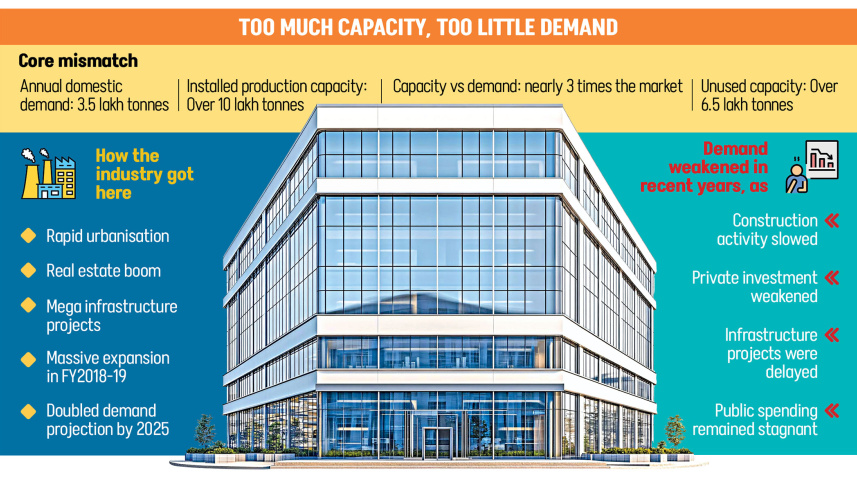
The industry expanded rapidly in 2018-19, driven by rapid urbanisation, a strong real estate market and a surge in mega infrastructure projects. At the time, manufacturers expected domestic demand for float glass to double by 2025.

Several large conglomerates invested heavily in the sector during this period. AkijBashir Group invested around Tk 3,200 crore, Meghna Group Tk 2,500 crore, and Nasir Glass Industries Ltd around Tk 250 crore in float glass production.
While demand has weakened, production costs have increased because of higher global raw material prices, a weaker taka, high energy costs, particularly gas prices, and persistent supply constraints
However, the market changed sharply after the Covid-19 pandemic in 2020, followed by global and domestic economic slowdowns. Construction activity slowed, private investment weakened, and several infrastructure projects were delayed, reducing demand for float glass.
“Glass demand has fallen significantly as construction activity has slowed. Public spending on infrastructure projects has also remained stagnant for the past two years, further weakening demand. As a result, business is very dull,” said Abu Jubaid Mohammad Russel, head of corporate sales at AkijBashir Glass.
Domestic demand for float glass is currently estimated at around 3.5 lakh tonnes a year, while installed production capacity has exceeded 10 lakh tonnes. This means capacity is nearly three times the size of the market, creating a major supply-demand mismatch.
Unlike many other industries, float glass factories cannot easily cut production or temporarily shut down. Once a furnace is ignited, it must operate continuously because shutting it down can cause permanent damage.
As a result, companies may have more capacity than the market needs but must keep producing even when orders are insufficient to fully utilise their plants. This increases pressure on profit margins as manufacturers compete for fewer customers while carrying the high fixed costs of large production facilities.
“Even if we incur losses, we are keeping the factory running,” said Alaol Kabir, assistant general manager of Nasir Glass Industries Ltd.
Nasir Glass has a production capacity of around 400 tonnes a day but is currently producing about 250 tonnes, leaving 150 tonnes of capacity unused every day. The company is operating around the break-even point rather than making a profit, Kabir said.
HIGH COSTS, CHEAP IMPORTS DEEPEN WOES
While demand has weakened, production costs have increased because of higher global raw material prices, a weaker taka, high energy costs, particularly gas prices, and persistent supply constraints.
“The industry is under pressure from both sides. Domestic demand has weakened, while excess capacity and rising raw material costs are making it increasingly difficult for manufacturers to remain profitable,” Kabir said.
The rapid expansion of the industry also brought new manufacturers into the market, intensifying competition, according to industry insiders.
At the same time, cheaper imported finished glass, particularly from China and India, has added to the pressure on local producers.
Changes in import duties have made the situation more difficult, as local producers have to bear the costs of energy, raw materials, labour and financing, while cheaper imported glass puts pressure on their selling prices.
Russel said the government’s decision to cut the customs duty on imported finished glass to 10 percent from 89 percent had made competition harder for local producers.
“We, the local manufacturers, are facing unhealthy competition. We are trying to sustain the industry through this difficult time without even thinking about profit margins,” he added.
Despite the broader weakness in the market, some established manufacturers say demand for their products remains relatively stable.
 For all latest news, follow The Daily Star's Google News channel.
 Nasim Biswas, managing director of Nasir Float Glass Industries Ltd, said demand for his company had remained largely steady, although there had been a slight slowdown after the new government came to power.
He described the slowdown as temporary and said Nasir Float Glass had remained the market leader, holding more than 50 percent of the country’s float glass market for the past two decades.
The company has a production capacity of around 600 tonnes a day and is currently operating close to full capacity, Biswas said.
He added that the company did not consider the current market environment particularly challenging, viewing the fluctuations as part of the normal business cycle.
With domestic demand remaining weak, manufacturers are increasingly turning to overseas markets to sell part of their production. Nasir Glass exports around 400 tonnes of glass annually, including customised products for markets with specific requirements, Kabir said.
However, export markets have different preferences and technical requirements.
“In India, for example, demand is higher for clear glass, while demand for coloured glass is relatively low,” Kabir said.
Exports provide an additional outlet for manufacturers, but overseas sales alone may not be enough to absorb the industry’s excess capacity while domestic demand remains weak.
Comments