


Garment factories can generate 1,768MWp from rooftop solar: CPD
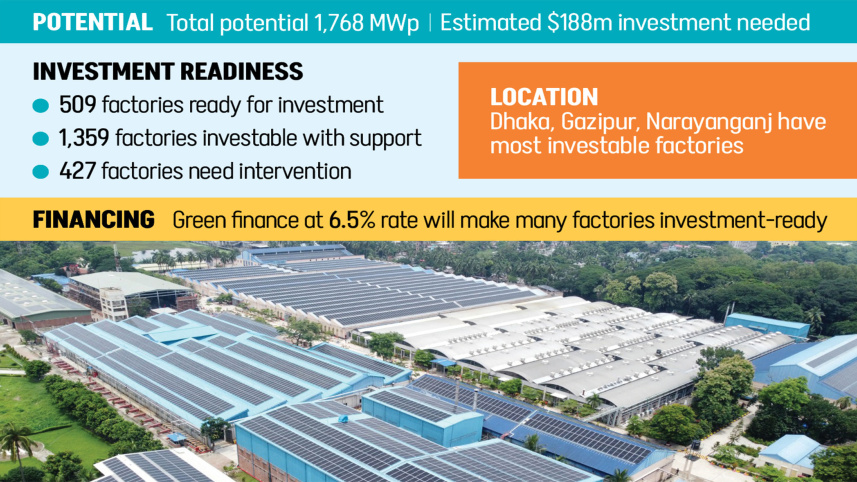
Bangladesh’s garment factories could generate up to 1,768 megawatt-peak (MWp) of electricity through rooftop solar, helping meet demand amid persistent power shortages, according to a Centre for Policy Dialogue (CPD) study.
The CPD presented the findings at a discussion on the potential for Chinese investment in rooftop solar in the RMG sector, held at the BRAC Centre Inn in Dhaka yesterday.

MWp measures a solar power system’s maximum theoretical output under ideal sunlight and operating conditions. It is expressed in megawatts (1,000 kilowatts), the same unit used to measure a power plant’s generation capacity. Real-world output is almost always lower, especially for solar, which only hits peak conditions briefly on the sunniest days.
The CPD finding comes as Bangladesh is grappling with an energy crisis and is looking to transition into renewables. The country has an installed power generation capacity of 29,500MW, but fuel shortages restrict actual generation to roughly half that amount. The shortfall has deepened over the past month after an accident at a floating LNG terminal in Cox’s Bazar cut gas supplies, forcing gas-fired power plants to scale back output.
Mapping nearly 9.7 million square metres of rooftop space across the sector, using a ratio of 5.5 square metres per kilowatt-peak (kWp) of capacity, the CPD found small factories could generate 485 MWp, medium factories 637 MWp, and large factories 646 MWp.
The study, presented by CPD researchers Abrar Ahammed Bhuiyan and Noor Yana Jannat, also assessed how much of each factory’s electricity demand rooftop solar could cover.
It found that for a typical large factory, rooftop solar could cover roughly 40 percent of electricity demand, compared with 38 percent for small factories and 33 percent for medium factories.
To estimate electricity demand, researchers trained a machine-learning model on actual monthly consumption data from 350 factories, using parameters including factory type, size, workforce, location and machinery.
They applied the model to the wider factory population, while using measured demand directly for 337 factories they could match.
The study identified 509 factories as “investment ready”, 1,359 factories as “investable with support”, and another 427 that “need intervention”. It also identified eight factories that are “not viable” for investment.
A total of $188.2 million is needed to install rooftop solar across the factories, the study report stated.
District-wise, Dhaka has the highest number of investment opportunities, with 176 investment ready factories and another 535 where investment can be made with support. Gazipur trails second with 173 factories ready for investment and another 354 that needs support to make the cut.
At the event, Khondaker Golam Moazzem, research director at the CPD, said renewable energy could help address the garment sector’s energy crisis, but high financing and investment costs remain major barriers.
He said affordable financing would be crucial to draw investment into renewable energy and energy-efficient technology.
“If green finance is available at around 6.5 percent (interest rate), many more factories (will) become investment-ready. But at around 12 percent under commercial lending, the number falls sharply,” he said.
“We therefore need subsidised credit or green finance, or single-digit commercial loans,” he added.
He also called for lower upfront investment costs. “The lower the investment cost, the greater the number of factories that will be interested. We need to address both the cost of financing and the capital cost.”
Dhaka, Gazipur and Narayanganj could be prioritised initially as they have the highest concentration of investment-ready factories, he added.
 For all latest news, follow The Daily Star's Google News channel.
Comments