


Gas crisis strikes paracetamol API, other industries

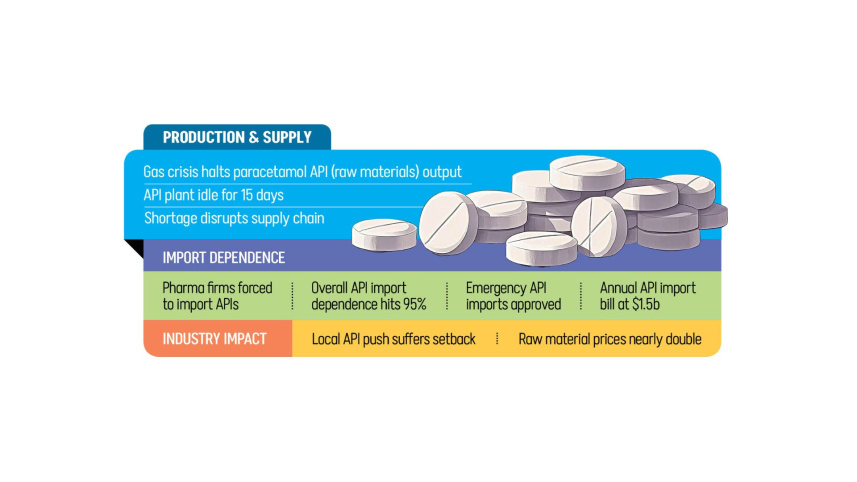
A worsening gas crisis has significantly slashed domestic production of paracetamol API (Active Pharmaceutical Ingredient) while also severely disrupting production at factories across Bangladesh’s manufacturing sector.
Although emergency imports are preventing medicine shortages, higher paracetamol API prices are raising costs for drugmakers and highlighting the country’s heavy dependence on imported pharmaceutical raw materials.

According to IQVIA (formerly IMS Health), medicines containing paracetamol are the fourth-highest-selling pharmaceutical product category in Bangladesh.
The prolonged gas shortage has brought production at Gonoshasthaya Basic Chemical Ltd, one of Bangladesh’s leading API manufacturers, to a standstill, said its managing director, ABM Jamal Uddin.
“Our boiler runs on natural gas. Without the boiler, none of the supporting equipment can operate,” Jamal told The Daily Star.
“The chiller, reactors and other processing units all depend on it. Once the boiler stops, the entire factory comes to a standstill.”
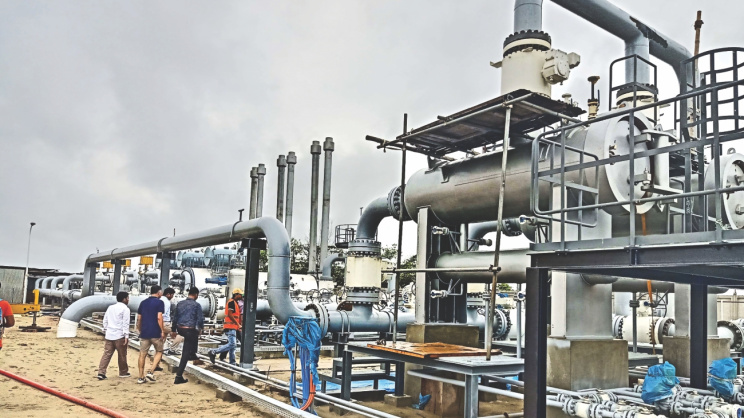
The Tongi-based company, a concern of Gonoshasthaya Kendra, has been unable to produce paracetamol API for the past 15 days, reducing output from four tonnes a day to virtually zero.
The disruption comes as manufacturers grapple with soaring raw material costs. Jamal said the price of the key precursor imported from China has nearly doubled, from about $2,300 a tonne to $4,300, amid global oil market volatility.
“The entire API sector is now under pressure,” he said.
As per industry insiders, Bangladesh’s monthly demand for paracetamol API is around 650 tonnes.
Before the shutdown, Gonoshasthaya supplied about 90 tonnes a month, with the remainder met through imports and other local manufacturers.
Jamal said the company supplies API to most leading pharmaceutical firms, including Beximco, Acme, ACI, Ibn Sina, Healthcare and Incepta. Square is the only major manufacturer that does not source from Gonoshasthaya, as it produces its own paracetamol API. He could not say when production would resume, saying it depends entirely on the restoration of gas supply.
Although Bangladesh manufactures about 98 percent of its finished medicines locally, it imports roughly 95 percent of the APIs used in production, mainly from China and India.
Despite the API Policy adopted in 2018 and the establishment of the API Industrial Park, meaningful import substitution has yet to materialise because of policy, financial, technological and regulatory constraints.
“If these bottlenecks are addressed through coordinated government support, Bangladesh can significantly reduce its dependence on imported APIs,” Jamal said. “The country currently imports around $1.5 billion worth of APIs annually. That bill could be brought down to about $1 billion.”
Md Shah Imran, executive director (procurement) of Beximco Pharmaceuticals PLC, said the company manufactures its own paracetamol API but occasionally buys supplies from Gonoshasthaya.
He said the gas crisis has disrupted Gonoshasthaya’s production, leaving Beximco to rely on its own facilities.
Beximco meets around 70 percent of the country’s paracetamol demand, and a prolonged halt in domestic API production could eventually tighten supplies, he added.
Muhammad Zahangir Alam, chief financial officer of Square Pharmaceuticals, said the company’s active pharmaceutical ingredient (API) plant in Pabna has not been affected by the ongoing gas crisis, as the factory continues to receive an adequate gas supply.
 For all latest news, follow The Daily Star's Google News channel.
 He said Square alone has the capacity to meet around 40 percent of the country’s demand for paracetamol API, helping ensure uninterrupted production of the essential medicine. However, he noted that the company cannot fully offset the supply shortfall caused by production disruptions at other local API manufacturers, forcing many pharmaceutical firms to rely on imports.
IMPORTS PREVENT SUPPLY DISRUPTION
Abdul Muktadir, president of the Bangladesh Association of Pharmaceutical Industries (BAPI) and chairman and managing director of Incepta Pharmaceuticals Ltd, said the government has been allowing emergency API imports to ensure uninterrupted medicine production.
Md Halimuzzaman, deputy managing director and chief executive officer of Healthcare Pharmaceuticals Ltd, said companies that normally source paracetamol API locally have already begun seeking import approvals.
Under existing rules, the Directorate General of Drug Administration gives priority to locally produced raw materials but allows imports when domestic manufacturers cannot supply them, he said.
Halimuzzaman said pharmaceutical companies typically maintain raw material stocks for two to three months and place import orders well in advance because importing APIs, conducting quality tests and processing them into finished products take considerable time.
“Companies have to strike a balance,” he said. “Importing too little risks disrupting supply, while importing too much can lead to losses if raw materials expire before use.”
GAS CRISIS SPREADS WIDER
One of Bangladesh’s two floating storage and regasification units (FSRUs) is out of operation, cutting gas supply by around 450 million cubic feet per day (mmcfd), or about 17 percent of the national supply.
The cause of the technical fault that shut down the US-based Excelerate Energy-operated terminal in Moheshkhali has yet to be identified.
According to Petrobangla, gas supply has fallen to around 2,150 mmcfd from 2,620 mmcfd over the past week, against an estimated daily demand of nearly 3,800 mmcfd.
The shortage has severely disrupted production across Gazipur’s industrial belt, preventing factories from operating at full capacity and delaying export shipments.
Factory officials in Bhogra, Chandana Chowrasta, Rajendrapur and Konabari said low gas pressure had significantly reduced production.
Rokonuzzaman, administration manager of Paragon Ceramics, said the factory has faced an acute gas shortage for more than a month.
“Around 50 industrial establishments in this area are facing the same problem,” he said. The company has resorted to buying compressed natural gas (CNG), although limited availability has made that difficult.
“We have failed to deliver orders on schedule and have already lost several major buyers.”
MM Mamun Ur Rashid, deputy inspector general of the Department of Inspection for Factories and Establishments in Gazipur, said no factory had officially shut down, although production at seven or eight factories had been severely affected.
Shafiul Alam, president of the Gazipur Metropolitan unit of the Bangladesh Garments and Industrial Workers Federation, said workers were already losing overtime income, while some factories could face layoffs if the crisis persists.
Vice-Chairman of Bengal Group Md Jashim Uddin said the company had temporarily shut down two readymade garment factories in Gazipur because of the gas shortage, despite the risk of losing a major denim export order from a European buyer.
“There is no option to switch to air freight because the shipping cost is too high. We have therefore decided to temporarily suspend production,” he said.
The gas shortage has also hit the Narayanganj industrial belt, said Md Fazlul Hoque, managing director of Plummy Fashions Ltd.
“Crisis is there, but we cannot do anything to overcome this. We could use expensive fuel, diesel and industrial LPG, but we will incur huge losses,” said Hoque, also former president of the Bangladesh Knitwear Manufacturers and Exporters Association.
Mohammed Amirul Haque, president of the Chattogram Chamber of Commerce and Industry, said the gas shortage had disrupted production at factories across the country, including in Chattogram.
He said Delta Agrofood Industries Limited, Premier Cement Mills PLC and National Cement Mills Limited had suspended production because of the gas shortage.
“Without gas, there is simply no way to continue production. If this situation persists, it will be impossible for manufacturing industries in the country to survive,” he said.
Comments