


LDC exit in 2026 could deepen economic woes: govt report

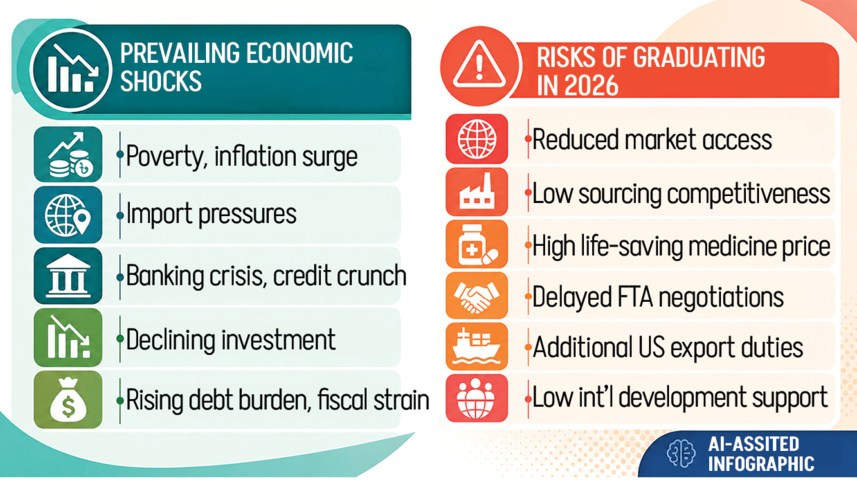
Bangladesh’s economy is in crisis due to domestic and external shocks, and graduation from the category of Least Developed Countries (LDCs) this year will worsen the situation due to several risks, according to a government document.
The paper identified the risk of disruptions to oil supplies, higher prices amid the ongoing Middle East conflict, and export losses due to the signing of Free Trade Agreements (FTAs) between Bangladesh’s competitors and the European Union and the United Kingdom, two key export destinations.

Ongoing investigations by the US Trade Representative (USTR) targeting Bangladesh on overcapacity and the enforcement of policies restricting imports of products made with child and forced labour may result in additional duties on Bangladesh’s exports in the US market, its single largest export destination, said the paper.
The government prepared the document ahead of the meeting of the UN Economic and Social Council (ECOSOC) next week.
A team, led by Commerce Minister Khandakar Abdul Muktadir, is already in New York to persuade other nations to support Bangladesh’s bid to extend its graduation schedule by another three years to allow more time to prepare for competition in the post-LDC period.
Bangladesh, along with Nepal and Lao PDR, is scheduled to graduate from the LDC category in November. However, due to unprecedented political, macroeconomic, environmental and external shocks, Bangladesh and Nepal have requested a three-year extension of their preparatory period until November 2029.
The UN Committee for Development Policy (CDP) had earlier recommended approving Bangladesh’s request to defer its graduation from the least-developed country (LDC) category from November 2026 to November 2029.The recommendation now awaits formal ratification by the UN General Assembly.
The finance ministry report said high inflation, falling exports, and rising energy and fertiliser bills amid the war in the Middle East have heightened risks to the Bangladesh economy, which has been experiencing sluggish growth, rising poverty and mounting bad loans.
At this stage, graduation from the LDC category and the resulting loss of export preferences will deepen economic vulnerability.
According to the report, International Support Measures (ISMs), especially in exports and pharmaceuticals, have played a critical role in Bangladesh’s economic development.
The loss of ISMs after graduation will increase the risk for the country.
Bangladesh’s reliance on ISMs has been identified as one of its vulnerabilities during and after graduation by UN Trade and Development (UNCTAD), it said.
The finance ministry said investor confidence has weakened due to political instability in recent years and will take time to restore.
It said more time is required to conclude FTA negotiations with trading partners to reduce the risks of losing preferential market access.
The report also cited the end of the waiver on compliance with intellectual property rights, along with increased poverty caused by persistent inflation, and warned that the prices of life-saving drugs may rise, putting further strain on public health.
“Given the strong role of ISMs in the Gross Domestic Product and employment, graduation under the current uncertainty could further destabilise the macroeconomy, which will impede a smooth and sustainable graduation,” it said.
The finance ministry said Bangladesh’s economy, which grew by over 6 percent annually in the five years before 2021, has since slowed. Inflation has remained above 8 percent since 2022, while poverty is projected to rise in 2025, pushing more people into extreme poverty.
Due to the significant increase in the prices of essential commodities, including oil, in recent years, the import bill for these items has risen substantially, accounting for over 25 percent of total import payments.
The import bill for oil and fertiliser has increased by 72 percent and 44 percent, respectively, during July-May of fiscal year 2025-26, exerting considerable pressure on foreign exchange reserves.
The finance ministry said current circumstances do not show any evidence that the situation will improve before the present graduation timeline.
 For all latest news, follow The Daily Star's Google News channel.
 The report also mentioned record-high non-performing loans in the banking sector and said there was a severe and systemic shortage of funds available for lending and investment.
“Rising international borrowing costs and debt servicing are shrinking fiscal space, limiting public investment in key sectors like infrastructure, health, education and social protection.”
Exports have been declining in recent times despite duty-free and quota-free (DFQF) access due to global trade uncertainty and rising domestic business costs stemming from higher interest rates and energy prices.
Delays in the repatriation of Rohingya refugees have placed additional pressure on government expenditure.
“The government requires at least two years to stabilise the economy and move towards smooth and sustainable graduation within the next three years.”
Comments