


Not tech, strong institutions key to economic success

For developing countries like Bangladesh, the key to economic success is not simply how quickly they adopt new technologies or attract investment. The deeper challenge is building strong institutions that create certainty, enforce contracts and support productive economic activity, said Professor Jean-Louis Arcand, president of the Global Development Network (GDN).
“Institutions are the single most important determinant of which countries get rich and which countries stay poor,” he said.

In an interview with The Daily Star recently, he said, “Without strong economic and political institutions, even countries rich in natural resources can remain poor, while countries with fewer resources can prosper.”
Jean-Louis said developing countries need to pay particular attention to institutions, the rule of law and how their economies function.
He also discussed the potential impact of artificial intelligence (AI), digital public infrastructure, linguistic sovereignty and investment in girls’ education.
Jean-Louis is a Canadian economist born in Cameroon. He grew up in different parts of the world and earned his PhD from MIT in the United States. The GDN was initially created within the World Bank under Nobel laureate economist Joseph Stiglitz to strengthen research capacity in developing countries.
Jean-Louis said its core principle is that researchers from the Global South should identify local problems and formulate policies, rather than relying on consultants from Western countries.
Over 25 years, the GDN has supported more than $1 million in research by Bangladeshi researchers and is exploring Bangladesh’s membership.
He said the GDN is also studying whether digital public infrastructure, including digital IDs and mobile money, reaches marginalised groups. It is researching open transaction networks, inspired by India’s Open Network for Digital Commerce, and their potential in Bangladesh.
AI WILL ONLY REDIRECT LABOUR
On AI, Jean-Louis said that there is currently “a lot of hype” surrounding the technology. He said the GDN is studying how AI will affect labour markets.
Rather than simply asking whether AI will replace workers, researchers should examine which tasks AI can perform better than humans, he said.
He explained this using what economists call an “O-ring” production function. If a product depends on several tasks and one task fails, the entire product can lose its value. AI is therefore more likely to be adopted for tasks where the probability of human failure is high.
According to Jean-Louis, AI can substitute for workers in some high-risk tasks while increasing demand for workers performing other tasks.
“What AI does is it doesn’t so much eliminate labour; it redirects it to other tasks,” he said.
He said this could happen in sectors ranging from manufacturing to medicine.
In medical diagnosis, for example, AI can assist radiologists in identifying problems in X-rays. In other tasks where humans perform well, there may be less reason for companies to adopt expensive AI systems.
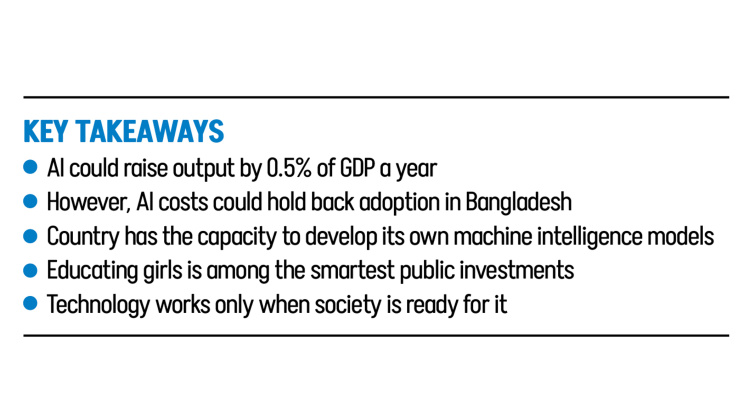
Jean-Louis said research suggests AI adoption could increase output by around 0.5 percent of GDP every year as firms adopt the technology. His simulations also suggest that poor countries could gain slightly more than rich countries from AI adoption.
“It won’t be a huge narrowing of the gap between poor countries and rich countries,” he said, but AI could still narrow the gap slightly.
The major constraint, however, is the cost of AI.
 For all latest news, follow The Daily Star's Google News channel.
 Jean-Louis said AI adoption remains very low in poor countries because the technology is still expensive. He said Chinese open-source models could change this by reducing the cost of adoption.
BUILD LOCAL AI CAPACITY
For Bangladesh, he said the economics of adoption will be particularly important. If an AI system costs much more than the labour it replaces, companies have little incentive to adopt it.
“I suspect that the cost of AI relative to the benefit is still very high in Bangladesh,” he said.
Jean-Louis also raised concerns about linguistic sovereignty.
He pointed out that there are very few large language models available in Bengali, with similarly limited resources for many other languages in the Global South.
“The linguistic sovereignty issue is actually very important for the Global South,” he said.
Developing countries, he argued, should not become so dependent on foreign AI models that access could eventually be restricted. He said there are economic reasons for countries in the Global South to develop their own large language models.
For Bangladesh, Jean-Louis said the country has enough talent and scale to develop its own models.
EDUCATING GIRLS A SMART INVESTMENT
The economist also highlighted another policy priority: educating girls.
The single most important determinant of development may be institutions, but when it comes to government investment, he said educating young girls can be one of the smartest investments a country can make.
Meanwhile, he said technology alone cannot solve development problems.
Jean-Louis said he has spent increasing amounts of time with technologists and found that many of them underestimate the importance of society, incentives and human behaviour.
“You could have the best technological solution for a problem. It will never get implemented if society and incentives are not taken into account,” he said.
Technology, he argued, is only the supply side. Understanding how people respond to it is equally important.
“The technology is supply, but then the demand has to do with human reactions,” he said.
Comments