


NPLs up by Tk 31,487cr in just three months

Highlights
- NPLs jump by Tk 31,487cr in three months
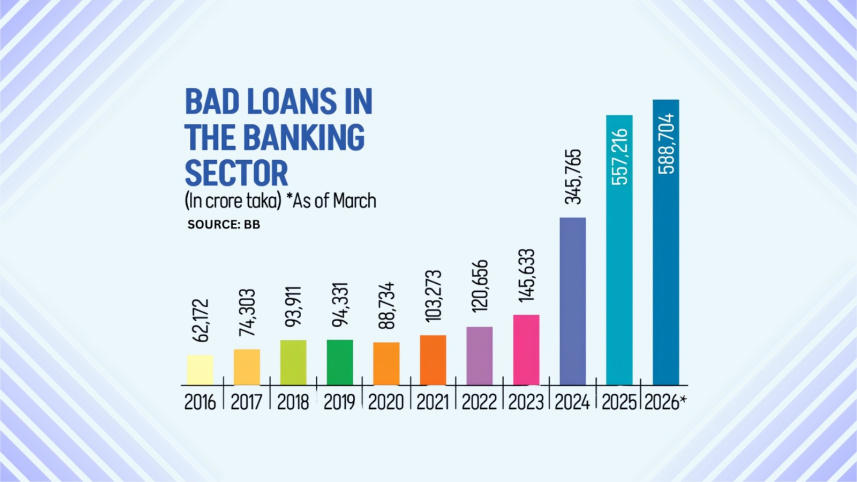
- Total defaulted loans hit Tk 588,704 crore
- Bad loans form 94 percent of NPLs
Non-performing loans (NPLs) in the banking sector jumped by Tk 31,487 crore in the first three months of this year after a slight decline owing to the reclassification of rescheduled loans, lacklustre recovery, and overall economic slowdown.
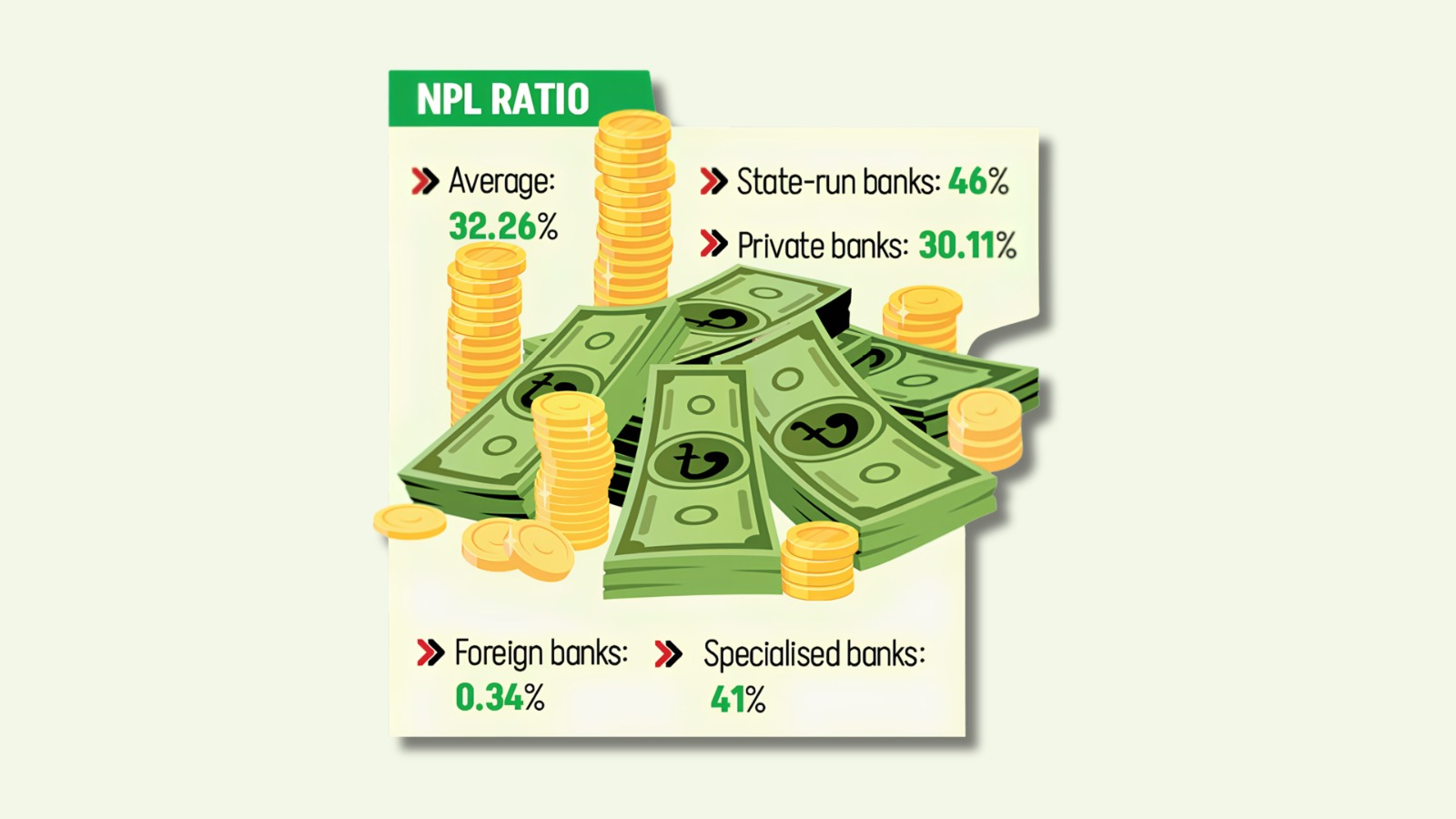
At the end of March this year, total NPLs in the banking sector stood at Tk 588,704 crore, accounting for 32.26 percent of the total Tk 1,824,668 crore in disbursed loans, according to the latest data from Bangladesh Bank.

By the end of last year, the ratio of classified loans had dropped to 30 percent from 36 percent in September 2025, thanks to large-scale loan rescheduling under a special policy support programme by the BB.
Of the total NPLs, 94 percent falls into the bad and loss category, a level that economists say reflects not just economic stress but a breakdown of financial discipline among the country’s most powerful borrowers.
“Loan defaulting has emerged as a damaging culture in the country,” said Mustafa K Mujeri, executive director at the Institute for Inclusive Finance and Development (InM) and former BB chief economist.
“We are now seeing that even some of the country’s largest business conglomerates have become loan defaulters,” he said.
“These groups have received various forms of policy support from the government and Bangladesh Bank over the years, yet they still fail to repay their loans,” added Mujeri.
The economist blamed the rising volume of NPLs on a lack of strict action against defaulters, pointing out that these conglomerates cite a range of global and domestic challenges to obtain policy support, but they do not use those facilities to settle their debts.
“Under loan rescheduling schemes, many of these borrowers have been granted up to 10 years to repay their loans, yet a number of them eventually default again,” he said.
Instead of continuing to provide concessions to these defaulting borrowers, the authorities must take strict action against them immediately, Mujeri suggested, adding that otherwise the country’s banking sector will face serious consequences.
Meanwhile, bankers also point out that some top borrowers and businesses have suffered losses due to weak demand amid high inflation and the economic slowdown caused by the war in the Middle East.
Many good loans are showing signs of stress, and the overall banking sector is going through a downturn, which is why NPLs may have increased, said Mashrur Arefin, chairman of the Association of Bankers, Bangladesh (ABB).
Arefin, also the managing director and CEO of City Bank, said when discussing the reasons for the spike in NPLs, either the policy support cases were overhyped, many borrowers could not make the required down payments, or external auditors did not agree with many of the weak cases during annual profit audits.
He added that some weak banks with newly formed boards decided to take higher provisioning hits once and for all, which also contributed to the increase.
According to BB, compared with a year earlier, bad loans increased by Tk 168,370 crore. At the end of March 2025, NPLs stood at Tk 420,334 crore, with a ratio of 24.13 percent.
Due to the high volume of defaulted loans in the banking sector, the provision shortfall stood at Tk 205,665 crore as of March this year, data shows.
A provision shortfall in banking refers to the gap between the funds a financial institution is legally required to set aside to cover potential losses from bad loans and the amount it actually has in reserve. When borrowers fail to repay, banks must absorb these losses by drawing on current profits or core capital.
NPLs in the banking sector have continued to rise since the fall of the Awami League-led government on August 5, 2024, as many businessmen fled the country and many of their businesses shut down, pushing up bad loans.
Large borrowers such as S Alam, Beximco, AnonTex, Abdul Monem, Nassa Group, and Sikder Group defaulted on a large scale after the fall of the Awami League government in August 2024, causing an unprecedented rise in bad loans.
Central bank data states that NPLs at state-run banks stood at Tk 149,785 crore, accounting for 46 percent of their disbursed loans. Bad loans at private commercial banks stood at Tk 416,482 crore, representing 31.1 percent of their disbursed loans.
 For all latest news, follow The Daily Star's Google News channel.
 NPLs at foreign banks stood at Tk 3,263 crore, or 5 percent of their outstanding loans.
NPLs at specialised banks stood at Tk 19,175 crore, or 41 percent of their disbursed loans, the data shows.
Comments