


Over 90% of economic units have no TIN

Abul Kalam Azad runs a small grocery shop, about thirty-five square feet, next to his home at Ratankandi union in Sirajganj Sadar upazila. Like many village shops, it stocks almost everything from rice and biscuits to soft drinks and bakery items.
During a recent conversation with Kalam, it took about five minutes to explain what a taxpayer identification number (TIN) was and ask whether his shop had one.

Over the phone, he said he had never heard that his grocery shop needed a TIN.
“I have never faced the need for it, and nobody has ever asked me to get one,” said Kalam.
His case is not unusual, as more than 90 percent of the country’s economic units have no TIN, according to the Bangladesh Bureau of Statistics (BBS).
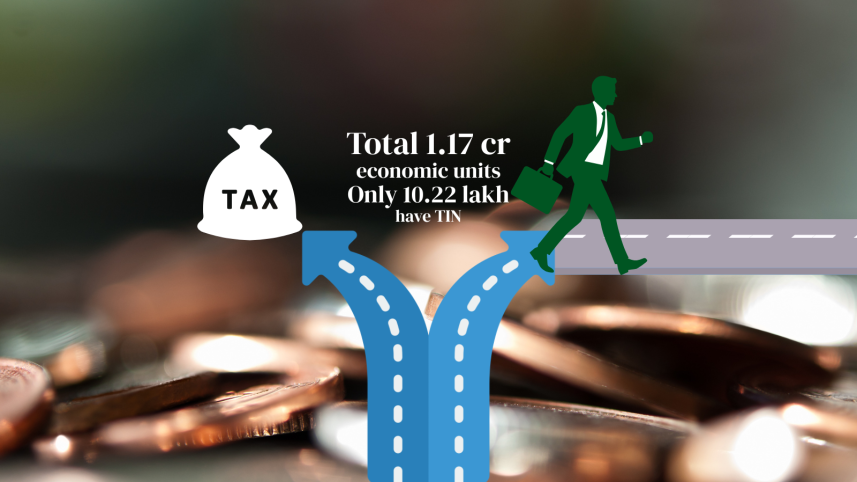
The BBS Economic Census 2024 estimates that the country has 1.17 crore economic units. Only 10.22 lakh, or about one in 12, have a TIN.
The census defines an economic unit as a single establishment or economic household engaged in economic activities for profit, household gain, or indirect benefit to the community.
The more than 90 percent figure does not mean that all 1.07 crore units without a TIN have taxable income and are evading tax. A TIN is an identification number, and tax liability depends on factors such as income and the nature of the activity. A business may have a TIN but owe no tax while still being required to file a return.
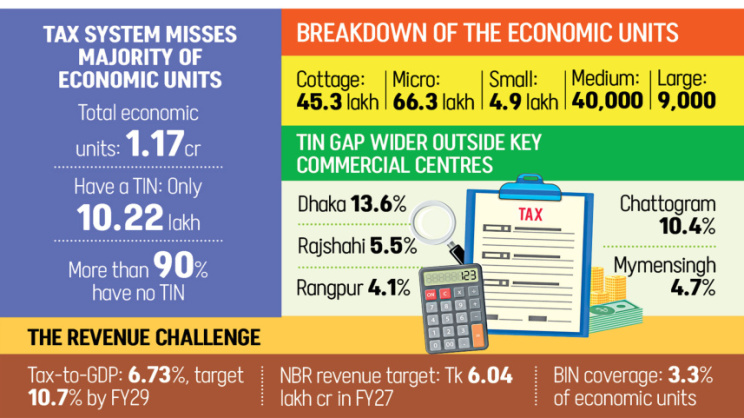
According to the census, 45 lakh of the country’s economic units are cottage enterprises, 66 lakh are micro ventures, about 5 lakh are small businesses, and only 40,000 are medium-sized enterprises.
According to the BBS, the low TIN coverage reflects the sheer number of small and household-based businesses. Besides, a large chunk of the economic units is based in rural areas, making the reach of the revenue authority even more challenging.
“The data point to a significant gap in the tax net, although not every economic unit is required to have a TIN or BIN,” said Towfiqul Islam Khan, additional director (research) at the Centre for Policy Dialogue (CPD).
“The major issue is whether the NBR can identify those eligible and bring them into the tax net,” he added.
That challenge comes as Bangladesh struggles with one of the lowest tax-to-GDP ratios among comparable economies. The ratio fell to 6.73 percent in FY2024-25 from 7.38 percent a year earlier. The government wants to raise the revenue-to-GDP ratio to 10.7 percent by FY29.
Towfiqul said the absence of a BIN did not always mean value-added tax (VAT) went uncollected. Some products, such as cigarettes, are taxed at the factory gate before reaching retailers. For products such as biscuits, however, VAT may not be collected separately at the point of sale, leaving gaps across the value chain.
Compared with TIN, business identification number (BIN) coverage is even lower. Only 3.82 lakh, or 3.3 percent, of the total economic units have a BIN. Among permanent establishments, 5.9 percent are BIN-registered, while only 5,781 of the 5.73 lakh temporary units have one.
According to the census, TIN coverage varies across the country. Dhaka has the highest rate, followed by Chattogram. Rangpur, a northern district, has a TIN coverage rate of just 4 percent among its economic units.
The NBR says it is stepping up efforts to identify taxpayers and improve compliance through field-level monitoring.
“Our work to expand the tax base is continuously going on. There are always activities under way. We may not always see the results immediately, but numerous things are happening simultaneously,” said Md Rafiqul Islam Chowdhury, NBR member for tax survey and inspection.
He said the NBR is strengthening verification of taxpayers’ Proof of Submission of Return (PSR), which is required for around 40 types of services and activities.
“We are now pursuing this work very strongly so that the verification of PSRs and whether people have submitted their returns can take place at different stages,” Chowdhury said. The NBR recently issued a nationwide order to strengthen such verification through banks and other institutions, he said. It is also expanding field-level efforts, including setting up new tax offices in three districts in Chattogram and planning surveys to identify taxpayers outside the tax net.
 For all latest news, follow The Daily Star's Google News channel.
Comments