


Patenga terminal hikes delayed cargo storage fees fourfold

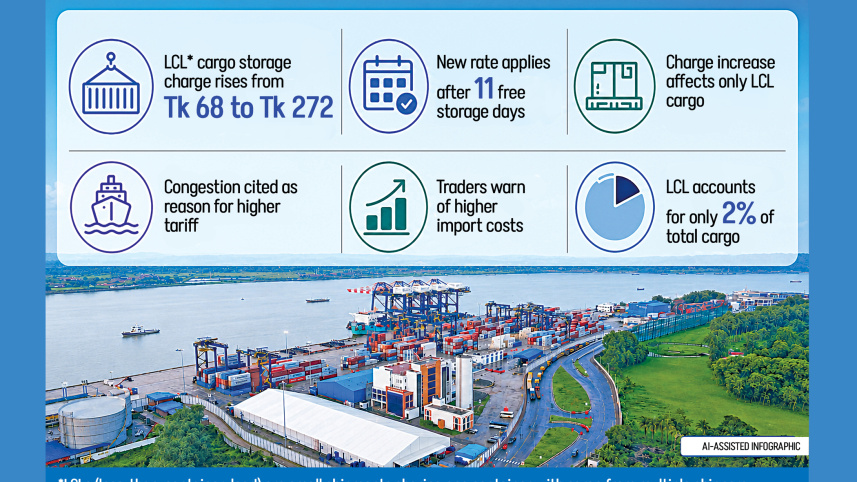
The operator of the Patenga Container Terminal has raised storage charges fourfold for less-than-container-load (LCL) cargoes that remain at its container freight stations beyond the free storage period.
According to Saudi Arabia’s Red Sea Gateway Terminal (RSGT), the port’s operator, the revised tariff took effect on July 1.

The storage charge for LCL cargoes -- shipments that are too small to fill a standard ocean shipping container -- has been increased from Tk 68 to Tk 272 per tonne per day. The revised rate applies to each day the cargo remains at the terminal after the 11-day free storage period expires.
RSGT says the move was prompted by chronic congestion at its warehouses, as a significant number of importers have been using the freight stations as low-cost storage facilities instead of taking delivery of their goods in a timely manner.
Meanwhile, port users fear the steep increase will add to import costs.
Md Showkat Ali, general secretary of the Chittagong Customs Agents Association, said the association had formally objected to the decision.
“We believe such a sharp increase in storage charges will ultimately increase import costs. We have already conveyed our concerns to the terminal operator and requested a review of the decision,” he said.
An importer of industrial raw materials, who requested anonymity, said delays in cargo clearance are not always intentional.
“Many importers face delays because of customs procedures, banking formalities or factory-related issues. Imposing a fourfold storage charge without considering these practical challenges will increase the cost of doing business,” he said.
He added that importers generally try to clear cargo as quickly as possible because delays involve multiple costs.
“Nobody wants to keep goods at the port unnecessarily,” he said.
Syed Aref Sarwar, head of commercial and public affairs at RSGT Bangladesh, told The Daily Star that the higher charge applies only to LCL cargoes, which account for less than 2 percent of the terminal’s total cargo volume.
“Around 25 to 30 percent of importers do not clear their goods within the stipulated time because storing cargo here costs only about Tk 68-69 per tonne per day,” he said.
“As a result, our warehouses remain occupied, leaving little room to handle newly arrived cargo. Despite issuing several notices and formal notifications, the situation did not improve.”
Sarwar said the revised tariff was introduced in line with the Chittagong Port Authority’s tariff rules, which allow terminal operators to charge up to four times the standard storage rent for cargo left beyond the permissible period.
He said importers can store LCL cargo free of charge for up to 11 days after it is unpacked at the container freight stations. The additional charge is intended to discourage importers from using the terminal’s limited warehouse space for long-term storage.
“Our objective is not to earn more from storage charges,” Sarwar said. “We want to facilitate trade by ensuring faster cargo delivery. When our limited warehouse space is occupied unnecessarily, it disrupts normal terminal operations and affects other importers waiting to receive their goods.”
RSGT became Bangladesh’s first foreign container terminal operator after taking over the Patenga Container Terminal in 2024. On June 19, four ship-to-shore cranes arrived at the port, completing the deployment of the terminal’s main cargo-handling equipment.
Since July, the terminal has been operating at full capacity, sources at the RSGT said.
 For all latest news, follow The Daily Star's Google News channel.
Comments