


Remittances hit record $35.5b in FY26, but growth slows
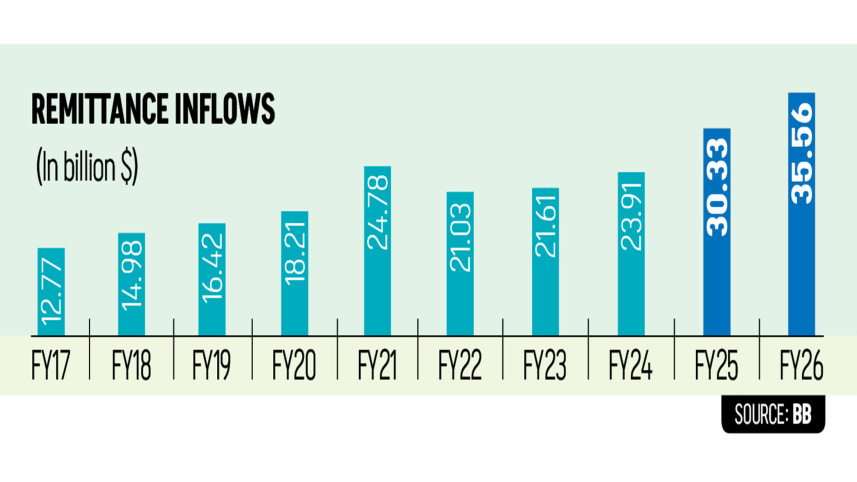
Remittance inflows reached a record high of $35.5 billion in fiscal year 2025-26 as Bangladeshis working abroad sent more money home, according to provisional central bank data.
The inflow grew 17.30 percent year-on-year from $30.3 billion in FY25.

The growth helped offset a widening trade gap and narrowed the current account deficit amid declining exports, said Bangladesh Bank.
The rate of growth, however, slowed sharply from FY25, when remittances had jumped 27 percent, the fastest pace in five years.
The data is set to be revised later as 11 banks had not submitted information because of a bank holiday yesterday.
BB attributed the FY26 boost to a market-oriented, competitive exchange rate, tighter oversight of informal transfer networks, and wider access to formal financial services, according to its Monetary Policy Statement (MPS).
“Ultimately, this influx helped offset the trade gap and brought the current account deficit closer to balance,” said the BB.
MIGRATION DRIVES THE SURGE
The rise in remittances tracks a surge in Bangladeshi workers going abroad for jobs. More than 50 lakh people have migrated for work since FY22, mostly to Middle Eastern countries, according to official data.
In the July-April period of FY26, 8.57 lakh workers went abroad, up 5 percent year-on-year, as per BB data.
“Remittance inflows have emerged as one of the principal stabilising forces in Bangladesh’s external sector,” the Finance Division said in its medium-term macroeconomic policy statement (MTMPS) for FY27-29.
The Finance Division said the FY25 surge was driven by a shift toward formal banking channels, following the May 2024 crawling-peg adoption and the May 2025 move to a market-based exchange-rate regime, which narrowed the informal-market premium.
GROWTH PROJECTED THROUGH FY29
The MTMPS projects remittances will keep rising through FY27, reaching an estimated $38.72 billion this fiscal year and nearly $49.2 billion by FY29.
“The medium-term outlook reflects the rising income-earning capacity of the existing diaspora, and a continued preference for formal transfer channels,” the Finance Division said, adding that remittance growth has become less tied to short-term swings in the number of workers leaving the country.
Sustaining that momentum will depend on continued policy support, the division said, including expanding migrant support services such as the Probashi Lounge initiative, maintaining a competitive exchange rate, and improving diaspora workers’ access to financial services.
“At the same time, the outlook remains sensitive to developments in the Middle East, which hosts the majority of Bangladesh’s overseas workforce,” it said.
The BB’s monetary policy flagged the potential for remittance growth to decelerate following the recent surge. The Finance Division’s medium-term policy’s baseline projections assume regional stability is restored by June 2026.
“A prolonged crisis could weaken labour demand, slow worker recruitment, reduce wage growth, and adversely affect remittance inflows over the medium term, thereby reducing one of the principal structural offsets to the trade deficit,” the Finance Division said.
It added that this underscores the need to diversify overseas labour markets alongside strengthening exports and FDI inflows to build long-term external resilience.
 For all latest news, follow The Daily Star's Google News channel.


Comments