


Will ‘Invest Bangladesh’ make investing easier?

For years, investors in Bangladesh have been voicing their grievances about navigating a maze of regulators, tax authorities and utility providers, rather than the lack of an investment promotion agency.
Invest Bangladesh -- about to become the country’s sole investment promotion agency -- may simplify part of that journey, but it cannot remove every roadblock on its own.

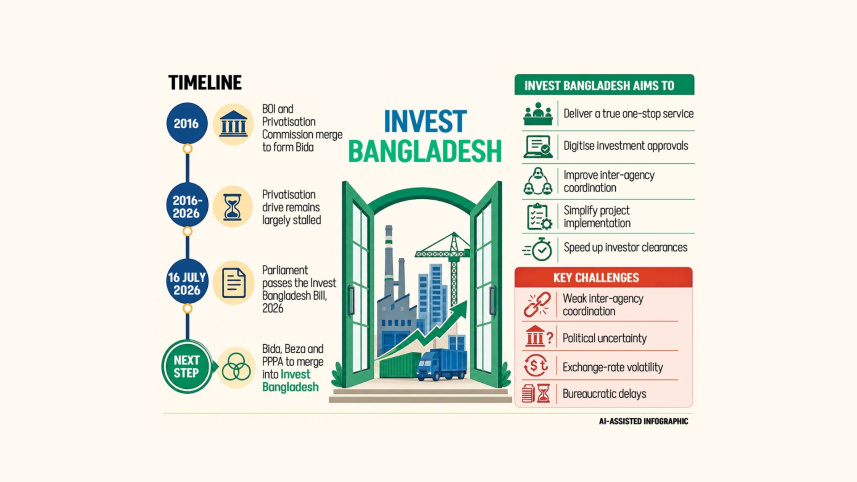
Parliament on Wednesday passed the Invest Bangladesh Bill, 2026, clearing the way for the merger of the Bangladesh Investment Development Authority (Bida), the Bangladesh Economic Zones Authority (Beza) and the Public-Private Partnership Authority (PPPA) into a single agency, Invest Bangladesh.
The law will take effect on a date to be announced in the official gazette.
The Privatisation Commission and the Board of Investment (BOI) were merged into a single agency, the Bida, on September 1, 2016 under the Bangladesh Investment Development Authority Act, 2016.
Despite this move, which aimed to liven up the country’s stagnant investment scenario, privatisation remained stalled thereafter.
Now, the goal behind forming Invest Bangladesh is clear. The new authority promises a genuine one-stop service through integrated digital platforms, statutory timelines for approvals and a single-window clearance system.
If the reforms are implemented well, investors will no longer have to approach multiple agencies for approvals, land, incentives, licences and project implementation.
Bringing investment promotion and industrial land management under one roof may also eliminate many of the coordination problems that existed between Bida and Beza.
The bigger question, however, is whether the merger will significantly improve Bangladesh’s investment climate.
Many experts believe it will help, but only to a certain point.
Former Bida executive chairman Md Sirazul Islam said the agency’s success will depend less on the merger itself than on how it is managed and whether it has enough authority to solve investors’ problems.
That reflects a deeper reality. Many of the obstacles investors face do not originate within Bida, Beza or PPPA. They lie with institutions such as the National Board of Revenue (NBR), customs, the Department of Environment, utility providers, land administration and other regulators responsible for taxation, customs clearance, environmental approvals, utility connections and numerous other permissions.
Unless Invest Bangladesh can effectively coordinate with these agencies -- or compel action where necessary -- it may struggle to resolve the issues investors care about most.
Businesses also face broader challenges. Political uncertainty, exchange-rate volatility and an unpredictable policy environment continue to deter long-term investment. Bureaucratic delays, overlapping regulations, corruption and unreliable gas and electricity supplies add to business costs and uncertainty.
Foreign investors and multinational companies also cite dealings with the NBR and customs as major obstacles. Complex tax laws, inconsistent interpretation of regulations, repeated audits, prolonged tax disputes, unpredictable tax assessments and slow customs clearance raise compliance costs and discourage new investment.
Exporters face similar problems. Delays in clearing imported raw materials disrupt production and increase costs, while work stoppages at the NBR have slowed customs operations, delaying cargo clearance and affecting export commitments.
These administrative bottlenecks cannot be resolved by restructuring investment promotion agencies alone.
Mustafizur Rahman, distinguished fellow at the Centre for Policy Dialogue (CPD), argues that while integrating investment agencies can improve efficiency, it cannot substitute for wider reforms across government.
Investment decisions depend on the entire business environment. Efficient customs, transparent taxation, timely company registration, reliable logistics, uninterrupted energy supplies and predictable regulation all matter. Weakness in any of these areas undermines the investment climate regardless of how efficiently investment promotion is organised.
 For all latest news, follow The Daily Star's Google News channel.
 M Masrur Reaz, chairman and CEO of Policy Exchange Bangladesh, notes that investment-related services remain spread across more than 50 public institutions. Merging three agencies simplifies only one part of the regulatory process. Investors will still need approvals and services from numerous ministries, departments and regulators.
In his view, Bangladesh would benefit more from eliminating unnecessary licences, registrations and approvals than from institutional restructuring alone.
The government’s rationale nevertheless has merit. A unified agency can provide a clearer institutional identity, reduce overlapping mandates and improve accountability. It should also strengthen Bangladesh’s international investment promotion by giving investors a single point of contact.
If digital one-stop services and statutory timelines are fully enforced, approvals should become faster and more predictable.
Still, these gains will remain limited unless broader governance problems are addressed.
Bangladesh’s investment challenge is no longer just attracting investors but creating a predictable, efficient and transparent business environment. Investors value policy stability, fair taxation, dependable public services and reliable infrastructure as much as incentives.
Invest Bangladesh should therefore be seen as an important institutional reform, not a complete solution. Its success will depend on its ability to coordinate across government and on complementary reforms in agencies such as the NBR, customs, the Department of Environment and utility providers.
The merger may simplify investors’ entry point. Whether they stay will depend on how efficiently the rest of the government functions. Without wider administrative and regulatory reforms, Invest Bangladesh risks becoming a better-organised institution operating in the same difficult investment environment.
Ashik Chowdhury, executive chairman of Bida and Beza and chief executive officer of PPPA, welcomed the merger, saying investors have long sought a unified agency capable of delivering a genuine one-stop service.
“To attract the investment Bangladesh needs for growth and job creation, investors need a true one-stop service framework,” he said.
He added that the merger had been recommended by local and foreign investors as well as the United Nations Conference on Trade and Development (UNCTAD) following its review of Bangladesh’s business climate reforms. According to him, the new agency will be better positioned to support investors and present Bangladesh more competitively as an investment destination.
Comments