


Women’s participation in agent banking grows
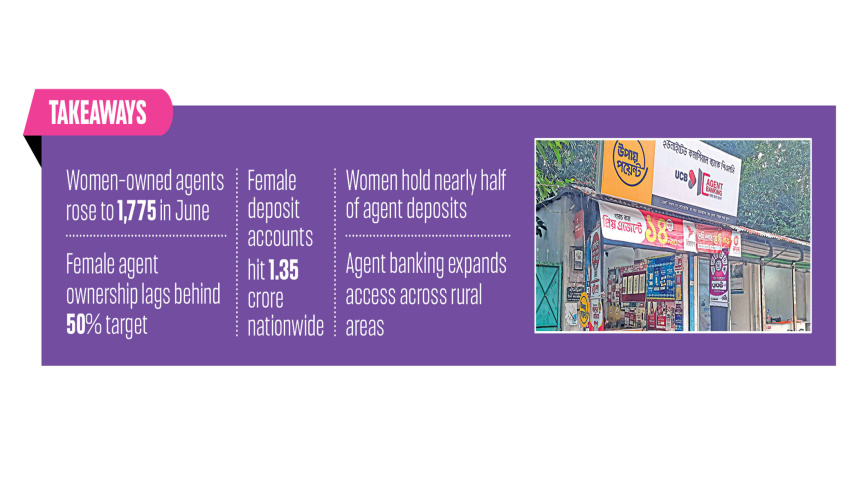
Women are playing a growing role in Bangladesh’s agent banking system, with female-owned agents and accounts continuing to increase, particularly in rural areas.
Women now own 11.5 percent of all agents and hold 48.6 percent of deposit accounts through the channel, according to a Bangladesh Bank (BB) report.

The number of women-owned agents rose 23.8 percent year-on-year to 1,775 in June 2026, up from 1,434 a year earlier.
Women-owned agents grew faster in rural areas, rising 26.1 percent, compared with 14 percent in urban areas.
“This shows a positive trend towards greater financial inclusion for women, especially in rural areas, while urban areas are quickly catching up,” BB said in its Agent Banking Statistics report for April-June 2026.
Women-owned deposit accounts increased 12.8 percent year-on-year in June, with growth stronger in urban areas than in rural areas.
Women’s loan accounts also increased, rising 6.1 percent year-on-year, with growth slightly stronger in urban areas than in rural areas.
“Overall, the data reflects growing financial opportunities for women in both urban and rural areas, with particularly strong progress in rural participation,” the central bank added.
STILL FAR BELOW TARGET
Despite the growth, women’s ownership of agents remains well below the target set by BB in a Banking Regulation and Policy Department circular letter dated May 8, 2025.
The circular requires women to own 50 percent of all agents. As of June 2026, women-owned agents accounted for only 11.5 percent of the total, although the share had increased from 10.3 percent in March.
In June 2026, 30 scheduled banks were providing agent banking services through thousands of outlets across the country, most of them in rural areas.
Agent banking has become an important channel for financial inclusion, helping banks reach underserved and unbanked people, particularly in rural areas, BB said.
In June 2026, each agent banking outlet served an average of 8,487 people nationwide, compared with 15,132 per traditional bank branch.
“The success of agent banking depends on effective regulation, strong agent management and continued efforts to address challenges such as digital literacy and agent sustainability,” the report said.
 For all latest news, follow The Daily Star's Google News channel.
Comments