


ADB cuts Bangladesh's economic growth forecast to 4.5%
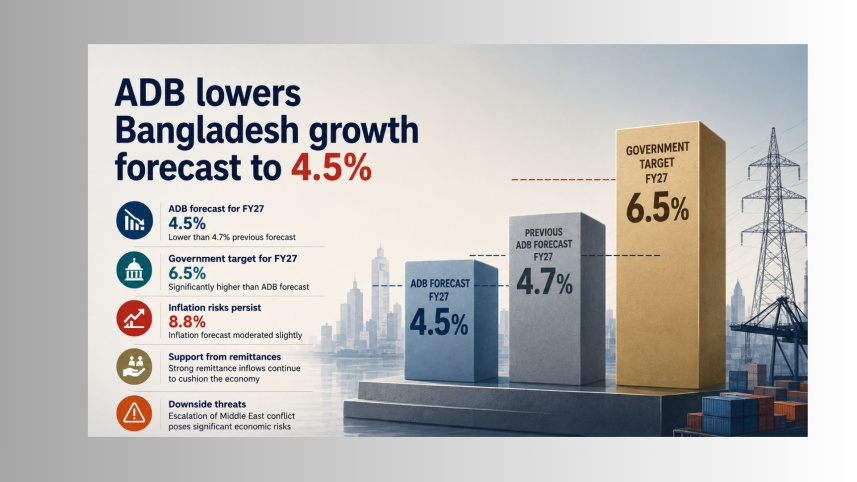
Bangladesh's gross domestic product (GDP) is forecast to grow by 4.5 percent in the current fiscal year (FY2026-27), according to the Asian Development Bank's (ADB) latest report released today.
The Asian Development Outlook (ADO) July 2026 said the economy grew 3.7 percent in FY26, lower than the provisional estimate of 4.14 percent released by the Bangladesh Bureau of Statistics.

Earlier, the Manila-based multilateral lender projected 4 percent economic growth for FY26 and 4.7 percent growth for the current fiscal year.
The government targets a 6.5 percent GDP growth rate for this fiscal year.
The ADB said the revised outlook reflects weaker export performance, subdued private investment, high energy prices, persistent inflationary pressures, and a more adverse external environment.
High inflation continues to erode real purchasing power and constrain private consumption.
Weak export performance and moderate import growth point to soft external demand and subdued private investment.
On the supply side, export-oriented manufacturing is likely to remain under pressure from high energy prices, subdued external demand, and structural bottlenecks, while agriculture faces risks from fertiliser shortages.
Services are expected to provide some support to growth, helped by remittance-backed household income.
"Bangladesh's economy continues to show resilience amid a difficult global and domestic environment, supported by strong remittance inflows and steady services activity," said Akira Matsunaga, officer-in-charge of the ADB's Bangladesh Resident Mission.
The ADO July 2026 update said growth in FY26 was supported by strong remittance inflows, steady services activity, and targeted credit easing measures for priority sectors within a generally tight macro-financial environment.
It said recent adjustments to domestic petroleum, gas, and electricity prices are expected to continue to pass through to transport, utilities, and other consumer prices.
Inflation is forecast to moderate to 8.8 percent in FY27, higher than the 8.5 percent projected in April, as second-round effects from higher energy and transport costs, exchange-rate pass-through, and persistent food and services inflation are likely to slow the pace of disinflation.
In FY27, moderate inflation, simplified business regulations, improved governance, tax administration reforms, and continued remittance incentives are expected to help strengthen consumption and investment.
However, banking sector vulnerabilities, energy constraints, and weak competitiveness are likely to keep the pace of expansion gradual rather than strong, it added.
"Downside risks to the outlook remain significant. A further escalation of the Middle East conflict could raise energy and shipping costs, intensify external pressures, weaken growth through higher inflation, and soften remittance inflows," it said.
Higher global oil prices could widen the import bill and increase fiscal pressures through higher energy-related subsidy requirements, the ADB said.
Higher tariffs, broader trade restrictions, or weaker growth in major economies could further depress export demand and prolong weakness in manufacturing activity.
 For all latest news, follow The Daily Star's Google News channel.
 Persistent exchange-rate pressures, tight external financing conditions, and climate-related shocks also remain important risks.
Comments