


BSEC proposes easier margin loans even for low-dividend shares

The stock market regulator has proposed making it easier for investors to borrow money to buy shares, believing the move could increase trading and improve market liquidity.
However, market experts say that easier access to borrowing could encourage riskier investing and make the market more vulnerable to sharp swings later.

With the proposals, the Bangladesh Securities and Exchange Commission (BSEC) published draft amendments to the Bangladesh Securities and Exchange Commission (Margin) Rules last week and invited comments from stakeholders.
A margin loan is money borrowed from a broker or merchant bank to buy shares. Investors pay part of the purchase price from their own funds and borrow the rest, allowing them to buy more shares than they otherwise could.
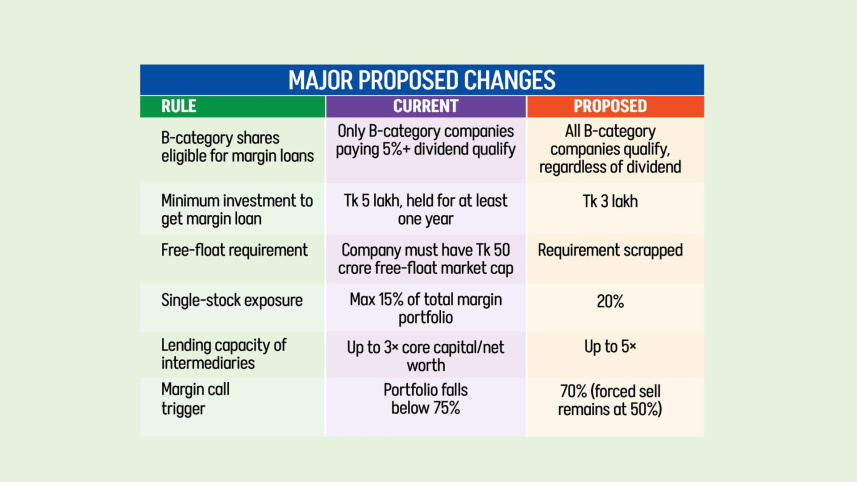
Among the seven major changes proposed by the BSEC, one of the most significant is expanding margin loans to more B-category companies.
B-category companies generally pay lower dividends than A-category companies and are considered riskier investments.
Under the current rules, investors can obtain margin loans only to buy shares of B-category companies that pay at least a 5 percent dividend. The draft rules would remove that requirement, allowing investors to borrow to buy shares even if those companies pay less than a 5 percent dividend.
According to market experts, margin loans are generally intended for relatively stronger shares because borrowing magnifies both gains and losses. Extending margin finance to weaker companies could encourage speculation and increase risks for both investors and lenders.
Faruq Ahmed Siddiqi, a former chairman of the BSEC, said companies that pay very low dividends or are fundamentally weak should not be eligible for margin loans.
“Instead, the level of dividend payment could be incorporated as a criterion for determining the margin loan ratio,” he said.
In other words, companies that pay lower dividends should qualify for lower margin financing. There should be some form of restriction on companies with poor dividend records.
Saiful Islam, president of the DSE Brokers Association of Bangladesh (DBA), said, “Under the proposed rules, even a company that pays only a 0.5 percent dividend would be eligible for margin lending; that should not happen.”
“While it is true that lenders will assess the risks before providing loans, such a provision should not exist in the first place. The proposal suggests that margin lending may be made more flexible,” he said.
The draft amendments also propose lowering the minimum investment required to qualify for a margin loan.
At present, investors must hold at least Tk 5 lakh worth of shares in their BO accounts for at least one year before they become eligible for margin finance. The proposed rules would reduce the threshold to Tk 3 lakh, allowing more investors to qualify.
The BSEC also wants brokers and other intermediaries to lend more.
At present, they can provide margin loans worth up to three times their core capital or net worth, whichever is higher. Under the proposed rules, that limit would rise to five times.
For example, a lender with Tk 100 in core capital can currently lend up to Tk 300. The proposed rules would allow it to lend up to Tk 500.
The draft amendments also seek to remove the minimum free-float requirement for companies whose shares qualify for margin loans.
Free float refers to the shares that are available for public trading. It excludes shares held by founders, sponsors and other long-term owners that are not normally traded.
 For all latest news, follow The Daily Star's Google News channel.
 Currently, a company must have at least Tk 50 crore in free-float market capitalisation for its shares to qualify for margin lending. The proposed rules would remove that requirement.
The BSEC has also proposed increasing the maximum exposure to a single stock to 20 percent from 15 percent. This would allow brokers to concentrate a larger share of their lending in one company.
Another proposed change would revise maintenance margin requirements. A margin call would be triggered when the value of an investor’s portfolio falls below 70 percent, compared with the current 75 percent threshold.
The compulsory forced-sale threshold would remain unchanged at 50 percent.
Former BSEC chairman Faruq said the regulator may be relaxing margin lending rules to support the capital market. One argument in favour of such a move is that the risks associated with margin lending should be borne by the lender and the borrower.
“However, this assumption holds true only if investors behave rationally.”
Given the investment behaviour typically observed in Bangladesh’s stock market, he said regulators need to exercise great caution when setting margin lending requirements.
“It is better for the rules to remain relatively stringent in the interest of investors.”
During a rising market, many investors become eager to borrow while intermediaries are equally willing to extend credit. But when the market corrects, excessive margin lending can create significant risks, he added.
DBA President Saiful said expanding the market through margin lending is not sustainable. Instead, it could create significant risks.
“In a market where a large number of companies are underperforming, using leverage to inflate the market would be suicidal. Greater use of leverage may be appropriate when the market is dominated by institutional investors, but in a retail-driven market, excessive reliance on margin loans is not desirable.”
Moreover, for the market to grow in a sustainable manner, the mutual fund industry needs to become much larger, he added.
The draft amendments also revise the valuation criteria for companies eligible for margin loans.
For most companies, the price-to-earnings (P/E) ratio must remain below 30. For banks and other financial institutions, lenders would instead use the price-to-book (P/B) ratio because book value is generally considered a more appropriate measure for financial companies.
As per the proposal, banks and financial institutions with a P/B ratio above 3 would not qualify for margin lending. For insurance companies, the limit would be 1.
Md Sayeed Ahmed, a veteran chartered accountant and former executive director of the Financial Reporting Council, said using the price-to-book ratio as the primary or sole valuation criterion for financial sector securities, while relying on earnings-based measures for other sectors, appears “inconsistent” with well-established valuation principles.
He said a going concern business derives its economic value primarily from its expected future earnings and cash-generating capacity rather than merely from the historical carrying value of its net assets.
Book value is fundamentally an accounting measure representing historical net assets after applying accounting standards. It does not necessarily reflect a company’s future profitability, competitive strength, franchise value, management quality, business model, technological capability, or long-term growth prospects, he added.
Comments