


Top 5 economic developments of last week
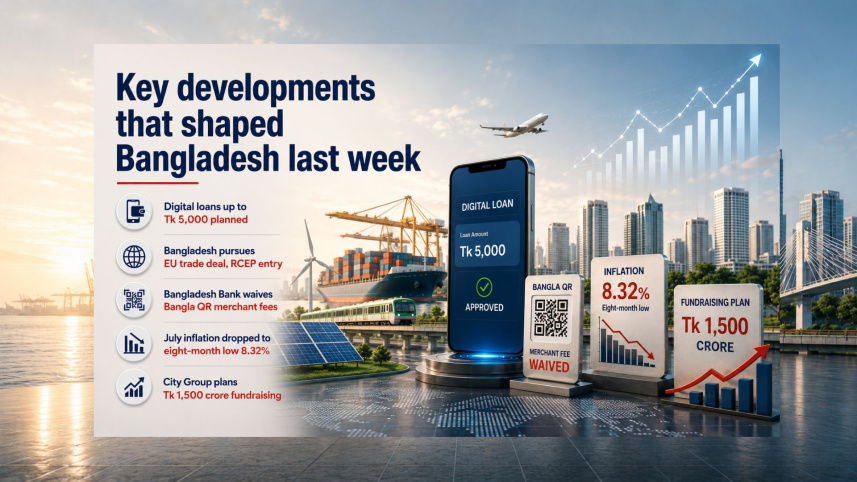
Bangladesh's economy last week revolved around a new interest-free digital loan facility for utility bills, a push for trade deals with the EU and the Regional Comprehensive Economic Partnership (RCEP), and waived merchant fees to boost Bangla QR adoption.
In addition, inflation eased to an eight-month low, while City Group's plan to raise capital from the stock market rounded up the week.

The following is a recap of those major stories as covered by Star Business.
Digital loans up to Tk 5,000 coming for utility bills (Aug 9)
People will soon be able to take interest-free digital loans of Tk 50 to Tk 5,000 to pay utility bills and top up mobile phones under a draft Bangladesh Bank policy that includes fixed service fees and a 30-day repayment window.
Bangladesh pushes for EU trade deal, RCEP entry (Aug 10)
Dhaka is preparing for formal free trade negotiations with the European Union while pursuing membership in the 15-nation RCEP, seeking long-term preferential market access for Bangladeshi exports across major global economic blocs.
BB waives merchant fees to boost Bangla QR adoption (Aug 11)
Bangladesh Bank has waived merchant fees for small traders and introduced incentives for financial institutions to process digital payments of up to Tk 2,000 through Bangla QR codes, effective October 1, in a bid to boost nationwide adoption.
Inflation falls to eight-month low of 8.32% in July (Aug 12)
Overall inflation fell to an eight-month low of 8.32 percent in July, down from 9.16 percent in June, driven by declining food prices, according to Bangladesh Bureau of Statistics data, though economists cautioned against interpreting it as evidence of sustained easing.
City Group plans to raise Tk 1,500 crore from stock market (Aug 14)
City Group plans to raise up to Tk 1,500 crore from the capital market to cut its reliance on bank loans, appointing LankaBangla Investments as issue manager to explore options including an IPO, private equity, preference shares or bonds as part of its debt restructuring efforts.
 For all latest news, follow The Daily Star's Google News channel.
Comments