


How students can use their mistakes to learn better

“You got this wrong again!”
Sounds familiar?

Once in your lifetime, you must have heard something like this. I heard something similar a while ago.
Just as I was penning this article, “A four-step module to never make mistakes”, a student of mine spoke out, “Make that: A guide to using mistakes.” That left me thinking: can teachers actually help students benefit from mistakes?
Mistake-making is nothing unusual, so treating it as an injury is not helpful. But how many students actually flip through pages to study their mistakes? For many, only marks matter.
Mistakes happen for many reasons: lack of content clarity, minimal practice, and the like. But one thing that is to be noted with urgency is that mistakes also happen because our minds think differently.
There goes a saying: “It’s good to learn from your mistakes. It’s better to learn from other people’s mistakes.” But would you agree if I said, “You can learn better from your mistakes"?
Let’s take penicillin, for example. Fleming left unwashed culture plates out on his bench before going on a two-week summer vacation. Upon his return, he noticed a fuzzy mould colony had grown on one dish. And the rest is history. Now, it is termed an accidental discovery.
In a classroom filled with a sea of students, how can we learn from others’ mistakes? Pinpointing a student’s mistake in front of the entire class would perhaps corner the student. In the modern-day classroom, there is little time to dwell on mistakes. We don’t like to sing our errors to others, so that leaves us with learning from our own failures.
Most importantly, this is where the teacher must walk in. They can be the inspiration for a child to turn mistakes into marvels. To begin with, they must set the mood for acceptance. A classroom culture which encourages mistake correction is more likely to thrive, for making mistakes shows attempt and initiative, and that must not go unnoticed.
Just like a connecting bridge, the teacher turns mistakes into methodology: a methodology to expedite learning. It also opens windows to understanding mindset.
Let’s consider this meme for a second. A question asks to "find x”. The student draws an arrow pointing directly to the letter “x” on a triangle and writes, “Here it is.” This has me rolling on the floor all the time. Tell me, is this thought wrong? There are times when the naive mind thinks differently, but we cannot single that out as wrong. Did you, for a second, ever think that this could be a possible answer for locating “x”, standing next to that isosceles triangle, who always finds a way to get lost?
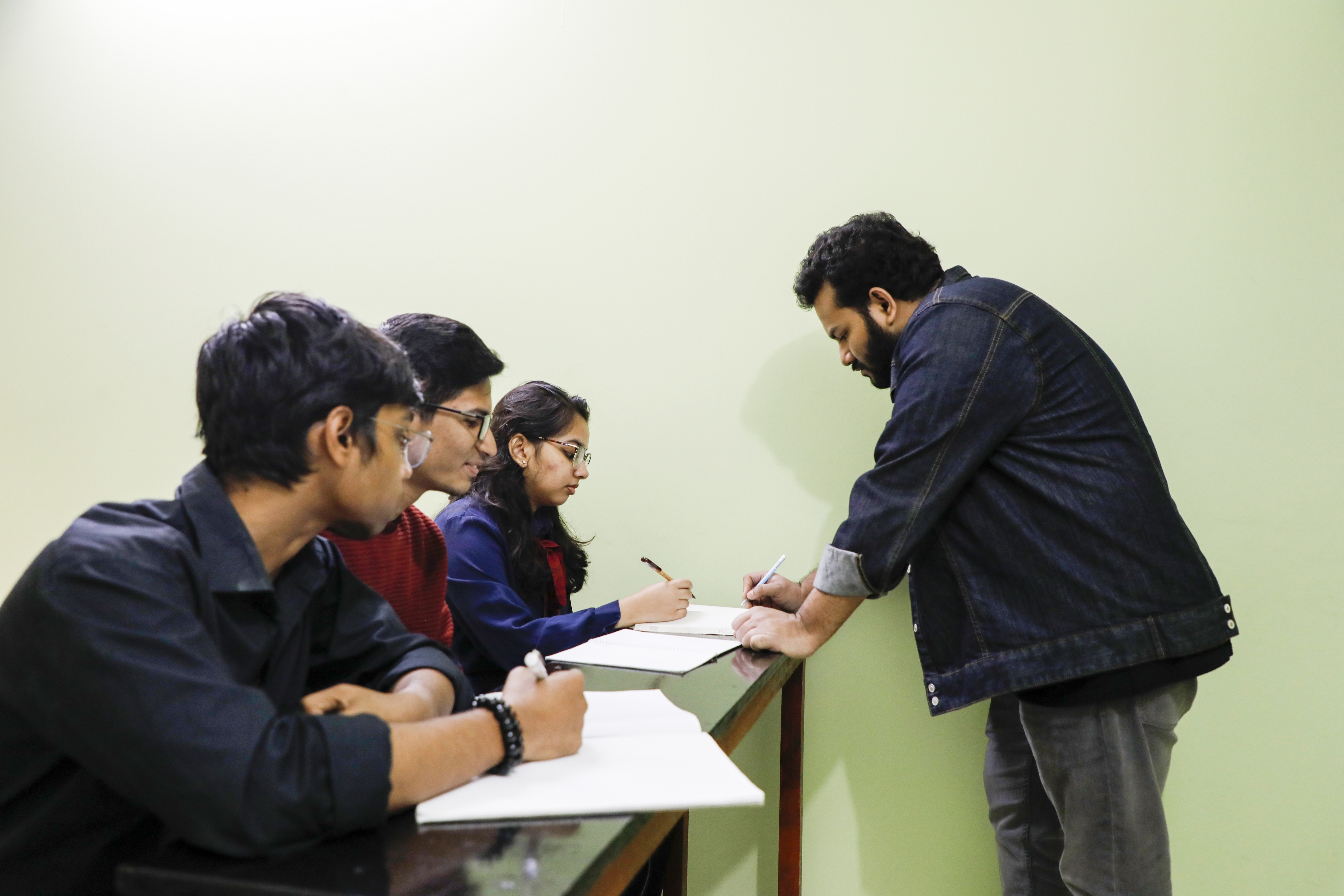
Making students doubt their questions or question their own thoughts are two things a teacher mustn’t do. If your student says the sky is pink, let it be. Feedback always helps; correction may not.
Having said this, there exists the “protégé effect”. Psychological studies show that people learn information more deeply when they have to teach or correct someone else rather than simply consume it.
You may have experienced this at some time: a teacher intentionally or unintentionally makes strategic mistakes in class to pique students’ attention. Funnily enough, students just love finding their teacher’s errors. That should not be embarrassing; that should be liberating. This move encourages students to make mistakes because the teacher makes them too.
Now that the classroom culture has created space to breathe, let’s develop a four-step model that makes the best of mistakes.
First, sense it. Give your intuitions some credit. When things don’t seem to fit, or you think you are making a mistake, your senses are likely to kick in. Prioritise that. Revisit the question if you are in the hall, or reread the verse during practice time if a doubt settles in.
Next, retrace it. As you write the formula down or practise an experiment in the lab and make a blunder, note it down and recheck the step at home. Even though for students getting marks might be the most important aspect of learning owing to our marks-centric upbringing, we must keep in mind that you study to learn, not to score.
Then, chalk it up to experience. At least for five minutes every day, go back in time and think about how things could have been done better. Then, the next day, be the preacher—share what you have learnt.
 For all latest news, follow The Daily Star's Google News channel.
 Finally, find the other way. Have a plan B for how the situation could be dealt with differently. Parents have an important role to play here. They’ve seen you grow: the good and the bad. Allow them the space to help. Parents must also emphasise less on marks and more on understanding to create a more conducive environment for learning.
Now, if you are making mistakes, here is your chance to learn. Make the best of them.
Salma is a contributing writer at Campus. She is a teacher by profession but a student at heart: curious, questioning, and learning. Mail her at: im.salma.baker@gmail.com.
Comments