


A historian’s vision vis-a-vis Hindutva mythmaking
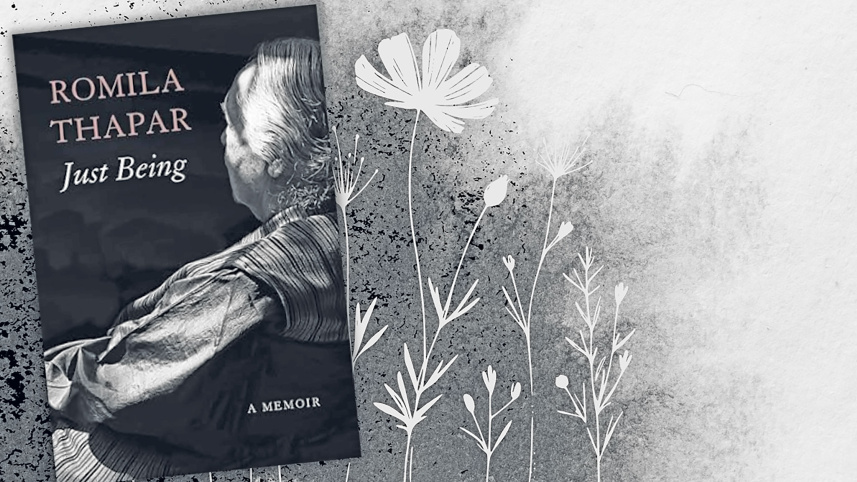
Illustrious historian Romila Thapar’s monumental memoir, Just Being, explores many subjects: her childhood days in Lahore, exciting archaeological expeditions, enunciation of the historiography she has followed, etc. But what perhaps stands out in this fascinating book is her sustained confrontation with Hindutva, which is still continuing unabated.
“I am simply appalled. First, there has been a blatant confusion of categories, to use an element of philosophical logic. Irreconcilables like ‘terrorist’ and ‘academic’ cannot be coupled. Romila Thapar is one of our outstanding historians from whose texts I myself have learnt a lot. I hope that the HRD Minister will withdraw this condemnation and apologize without a moment’s delay,” stated Amartya Sen in an interview, on hearing that his friend has been branded “anti-Indian”, “anti-Hindu”, and an “academic-terrorist whose practice is to maim the minds of the people, especially the young”.

The fearful rumblings had begun even before 2002, the year mentioned in the epigraph, when the first non-Congress Janata Party government was voted to power in 1977, after the crucial election which had followed the Emergency. The BJP, then known as Bharatiya Jana Sangha, was an influential partner in this governance and it raised its well-nurtured protest against the kind of history that had been disseminated and taught till then. The Prime Minister, Morarji Desai, was not merely sympathetic to the clamour raised but also “asked that the history textbooks prescribed by the NCERT be banned, a stunning surprise.”. The impending conflict, an outcome of the radical change in policy, degenerated to the level of virulent, personal attack when the affluent NRIs of USA, obviously encouraged by their mentors in Delhi, sneeringly remarked “I (Romila Thapar) was incompetent as a historian, inept as a scholar, and should never have been appointed to the position I held.”.
The short span of the regime headed by Morarji Desai did not lead to any dramatic change in favour of history manufactured by the advocates of Hindutva. It had to wait till the first NDA government captured power in 1998. Though the please-all and amiable Prime Minister Atalbehari Vajpayee declared “India was secular, is secular, and will be secular”, he did not move even an inch to curb the full scale rampage initiated by his HRD Minister Murali Manohar Joshi, who regarded everyone from Irfan Habib to Sarvepalli Gopal, as his bête noire, especially Romila Thapar.
I sometimes wonder why the adamant Hindutvadis heaped such vitriolic enmity on Romila Thapar. In her own words, “Death threats that started in the 1980s were more often made at midnight over the phone”. Moreover, they “regarded me as a threat that had to be silenced.” I guess, two far-reaching reasons explain this hatred. One, Thapar’s favourite area was Ancient India or the so-called Hindu and pre-Muslim India which the neo-Aryans considered as their sacred, exclusive territory. According to them, this busybody questioned impertinently the glory and grandeur, peace and harmony that had flourished before the Muslim invaders arrived. Both Romila Thapar and Richard M Eaton, the celebrated American historian, destroyed this moth-eaten myth of Hindu India, the ‘wonder that it was’, irrevocably. While Thapar incessantly exposed the bitter disputes even leading to bloodshed and carnage that raged between the Brahmanas and the Shramanas in one text after another, (particularly in her 2020 book Voices of Dissent), Eaton narrated the furious battles waged by Hindu kings against one another, who not only plundered the victims’ kingdoms but also destroyed their temples and deities (Temple Desecration and Muslim States in Medieval India, 2004). Well, temple-bashing then had begun in our Sanatani soil much before Mahmud of Ghazni dawned on the scene! Finally, how could the Hindutvadis challenge Thapar’s claim that not she but the revered grammarian, Patanjali, had labeled the relationship between Brahmanas and Shramanas as one between ‘the snake and the mongoose.’
The second reason was evidently more palpable, even understandable. Thapar had written the history textbooks for school students and thereby she had, as they said, “caught them young!” Her testimony on this crucial aspect bares it all: “I was viewed by Hindutva as an unacceptable historian not so much because of my academic books but mainly because of the textbooks that I wrote for middle schools. Textbooks are pivotal to controlling the popular interpretation of history or any body of knowledge.”
The building blocks of Hindutva-history rest on several core ideological pillars, including the reverence of a pre-Muslim Sanatani past as a period of social harmony and peace despite the existence of caste oppression and the war-filled narrative of the Mahabharata. This exclusionary civilisation is presented as the pinnacle of culture, while the subsequent five centuries of Muslim rule are characterised as a Dark Age marked by devastation and unworthy monarchs. The Hindutva interpretation of British colonialism remains contradictory, often obscuring the absence of Hindutvavadis from the freedom struggle. Central to this narrative is the worship of Mother India, a feminine figure defined by Hindu characteristics, envisioned as rising again after a period of decline.
Standing in firm opposition to this populist, propagandist history—which relies on myth and fancy—is “the Other”, whether you define it as secular, Marxist, or progressive. And the most eloquent representative of this “Other” stream is Romila Thapar. How and why, (i) she challenged the Hindutvavadis on their own ground, that is ancient history. Her very first book Ashoka and the Decline of the Mauryas (1961) is still regarded as the most enlightened text on the subject. (ii) She lambasted Hindutva as a perversion of Hinduism. Indeed, this denunciation runs like a refrain in her writings, especially in her memoir. Her no-nonsense comments like “If Hindutva is Hinduism, then it has demonstrated that it was as violent and intolerant as any other religion”; “Hindutva is not a religion and it is not Hinduism. I label Hindutva as ‘Syndicated Hinduism’”; and many such evaluations are peppered in this book which the authorities dare not ban, for that would cause a worldwide outrage. (iii) She has claimed that we have our own history in our epics and discourses, edicts and monuments, even in excellent chronological narratives like Rajatrangini. In other words, the “Other” school has not gulped the pill offered by colonial historians. Indeed, The Sanatanis themselves have done so and regurgitated their pernicious, colonial thesis of endless animosity between Hindus and Muslims.
Finally, her concept of culture and civilisation, like that of Rabindranath, is sublimely universal and inclusive where Bharat and Vishwa (the world) coexist in resounding harmony. Firmly opposed to the Saffron’s compartmentalised concept of culture and civilisation, she speaks “of civilization not as a closed entity but rather as being essentially a porous condition, shaped by the interface of multiple cultures.” Her thoughts on this crucial subject recall Dante’s multifoliate rose in Paradiso whose several petals congregate to create something multifaceted and multilayered.
Subhoranjan Dasgupta is an academic and author of several books in English and Bengali, based in Kolkata.
 For all latest news, follow The Daily Star's Google News channel.
Comments