


‘Tomar Chokhe Shilpi SM Sultan’ revisits the artist’s world through young eyes

For generations, SM Sultan's paintings have offered a distinctive way of looking at the people, landscapes and rhythms of rural Bengal.
Broad shoulders, weathered fields and bodies shaped by labour—the farmer remained one of the most recognisable figures in SM Sultan's artistic world. More than three decades after his death, a group of children and teenagers were invited to encounter that legacy through their own artistic perspectives.

Marking the 103rd birth anniversary of the legendary Bangladeshi painter, Charuputhi organised a special children's art exhibition titled “Tomar Chokhe Shilpi SM Sultan” (Artist SM Sultan Through Your Eyes) at Safiuddin Shilpalay in Dhanmondi.
Held from August 7 to 10, the four-day celebration brought together paintings by children and teenagers alongside cultural performances, dance, puppetry and film, expanding the commemoration beyond the walls of a conventional exhibition. The programme was organised as a tribute to Sultan's life, artistic philosophy and long-standing engagement with rural Bangladesh.
Sultan, born in Narail on August 10, 1923, developed an artistic language in which farmers, labourers and the rural landscape occupied the centre of the canvas. His later paintings became particularly known for their exaggeratedly muscular agricultural workers, transforming people often pushed to the margins into monumental figures.
It is this relationship with Bengal's farmers that formed the foundation of “Tomar Chokhe Shilpi SM Sultan”.
Rather than asking the young participants simply to reproduce SM Sultan's paintings, the exhibition's theme allowed them to consider the artist through their own imagination and visual language. In doing so, the programme placed one generation of Bangladeshi artists in conversation with another—between Sultan's enduring images of agrarian life and the ways children understand that world today.
The exhibition opened at Safiuddin Shilpalay on August 7 with an inauguration and cultural programme. The following evening featured a dance presentation, while the children's artworks remained at the centre of the programme throughout the four days.
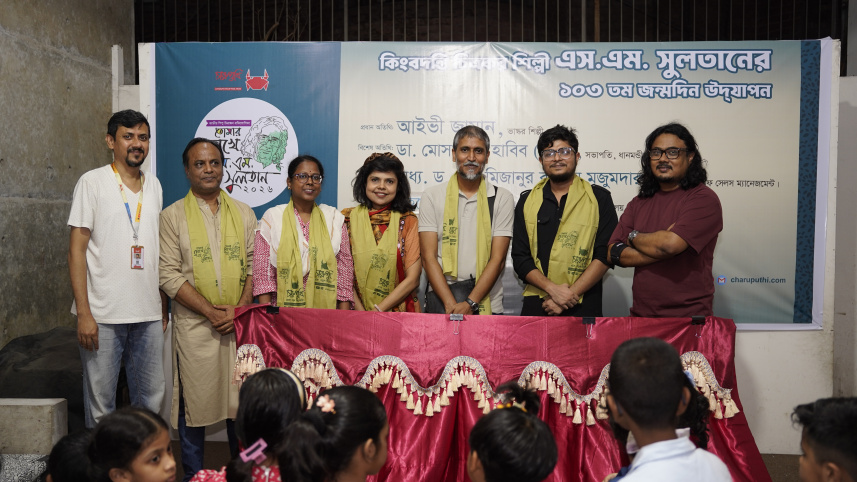
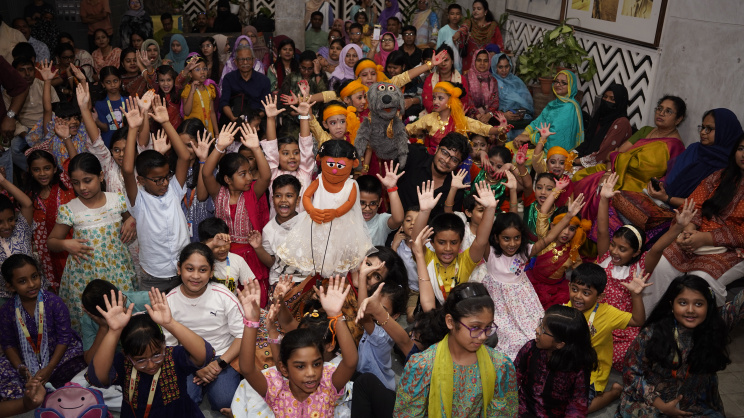
The photographs from the event show a space distinctly shaped around its younger audience. Children sat closely together before a puppet stage as colourful characters appeared above its curtain, while parents and visitors gathered around them. Another photograph from the opening shows participating guests standing before a banner commemorating SM Sultan's 103rd birth anniversary, with children filling the foreground.
Puppetry, song and dance were also incorporated into the celebration, allowing Sultan's legacy to be approached through forms beyond painting. Charuputhi's programme announcements described an arrangement combining music, dance and a puppet show, while the exhibition itself remained centred on artwork by children and adolescents.
The final day, August 10—the artist's birth anniversary—featured a screening of Tareque Masud's documentary “Adam Surat”, followed by a prize-giving and closing ceremony.
Masud's documentary is particularly connected to Sultan's relationship with rural Bengal. Filmed over several years, “Adam Surat” follows Sultan and the people and landscapes surrounding him, with the Bengali peasant ultimately emerging as a central presence rather than merely a backdrop to the artist's life.
The programme continued beyond the Dhaka exhibition, with a visit to Sultan's birthplace in Narail scheduled for August 14 as part of the commemoration.
Across the four days at Safiuddin Shilpalay, children were not merely introduced to the name SM Sultan as a figure from Bangladesh's art history. Through their own drawings, as well as dance, film and puppetry, they encountered the people who occupied so much of his canvas.
 For all latest news, follow The Daily Star's Google News channel.
Comments