


‘Roid’ emerges from a sense of disappearance: Mejbaur Rahman Sumon

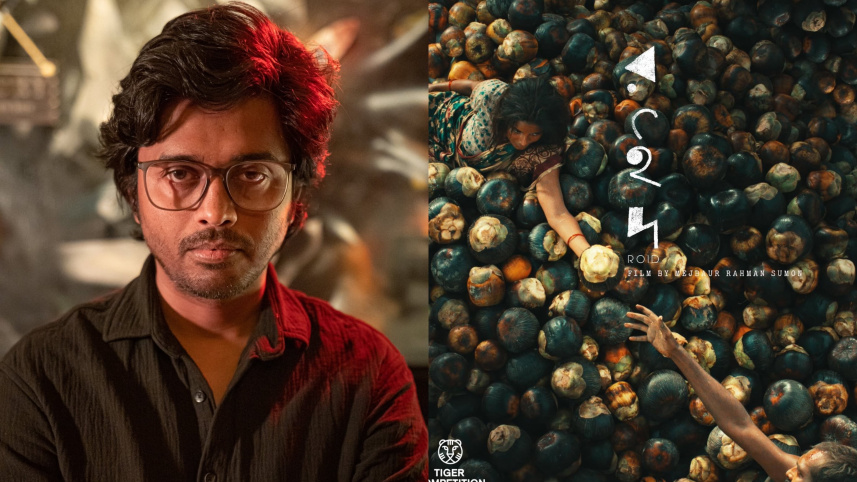
After the massive cultural impact of “Hawa”, expectations surrounding Mejbaur Rahman Sumon’s upcoming release “Roid” have only continued to grow. Describing the film, he shares that it is not merely a love story, but an attempt to rediscover emotional depth, silence, and fading cultural identities in contemporary life.
Though this marks only his second Eid release, Sumon appears calm amid the mounting anticipation. “We finished the film quite some time ago, as it completed its festival run,” he explained. “Most of the post-production work was done earlier as well. Now the pressure is mainly around promotion — releasing songs, posters, and preparing everything for the audience.”

The film’s promotional campaign has already included music releases and even a concert event. According to Sumon, the musical identity of “Roid” is central to the way they want audiences to connect with the film.
“We’re trying to reach people both online and offline,” he said. “We had bigger plans, but many things become difficult in practice. Still, we arranged a concert recently, and we have more activities planned even after the film’s release.”
Unlike mainstream Eid entertainers built around spectacle and formula, “Roid” seems to occupy a more emotionally reflective space. Sumon believes the film speaks directly to the people and culture of this region, while remaining accessible to all audiences.
“I make films for everyone,” he said. “But I want to tell stories about our people, our region, our realities.”
The director acknowledged that “Hawa” managed to transcend the limitations often associated with alternative cinema, partly due to its music, audience engagement, and organic popularity. Yet he insists “Roid” will offer something emotionally different.
“We are trying to tell a story of love,” he said. “But whether audiences call it a love story or not — I’ll speak about that after they watch the film.”
For Sumon, modern life has slowly stripped away emotional stillness and intimacy. “I feel like we are losing silence in our lives,” he reflected. “The depth of love is disappearing. We see many love stories now, but not many deeply emotional love stories.”
That emotional absence became one of the starting points for “Roid”. Much like “Hawa” explored disappearing cultural identities through the mysterious gypsy community (Bede community), Sumon says his new film also emerges from a sense of loss.
“In ‘Hawa’, I spoke about a fading culture through the character of the Bedeni (gypsies),” he recalled. “This time too, I wanted to explore something disappearing from our lives.”
The filmmaker repeatedly returned to the idea of silence — not as emptiness, but as emotional space. “Silence is very important in our lives,” he said. “Depth is important too. Some emotions cannot simply be expressed through words. They have to be felt through a story.”
Despite growing audience excitement surrounding the cast — particularly actor Tushi, who has already generated significant online buzz — Sumon remained reluctant to market the film through conventional commercial promises.
His understanding of “commercial cinema” differs sharply from industry norms. “For me, commercial success simply means people connect with the film and enjoy watching it,” he explained. “If audiences do not watch a film, then calling it commercial means nothing.”
He openly admitted that “Roid” does not contain many of the familiar ingredients associated with mainstream entertainment. “There are songs in the film,” he said, “but not in the way audiences usually expect. There are no big dance numbers or action sequences.”
Instead, he hopes the already released teaser, trailer, and songs will speak for themselves. “If audiences watch those materials and feel the film deserves to be seen, then they’ll come,” he said. “Beyond that, I don’t want to make promises I cannot honestly give.”
Even amid a crowded Eid release season featuring several major productions, Sumon says he intends to support Bangladeshi cinema as a viewer as well.
“I always watch films during Eid,” he said. “I watched films last Eid too.”
Still, he prefers private appreciation over public commentary. “If I like someone’s film,” he added with a smile, “I usually call the filmmaker personally and tell them I liked it. I don’t really post them publicly.”
 For all latest news, follow The Daily Star's Google News channel.
Comments