


Watching Dhaka assemble from above

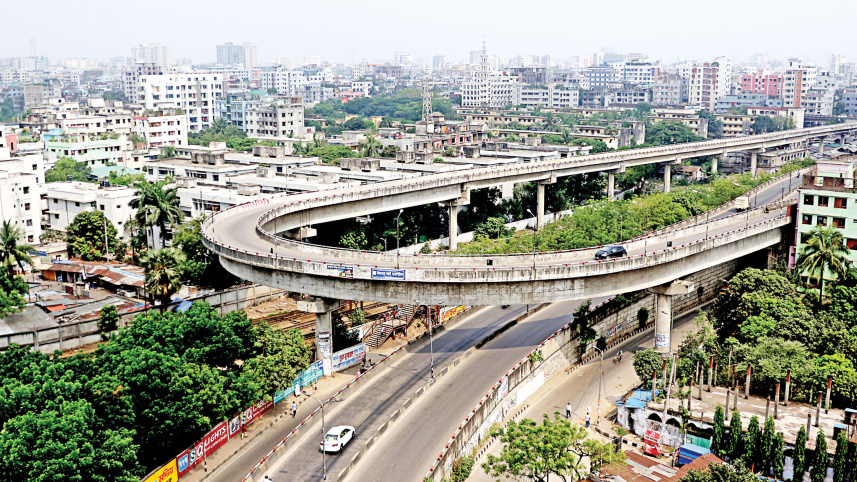
Most cities give you a designated place to stand, sigh, and pretend you are contemplating your life choices while gazing at the skyline. Be it from an elevated riverfront, a public observation deck, a fort, a cliff, a mountain, an iconic tower, or a knoll. Anything, really!
Even neighbouring Kolkata has the Howrah Bridge and Vidyasagar Setu sweeping across the Hooghly, offering the river and skyline a genuine chance to show off.

And Dhaka? Dhaka has -- how shall I put this politely -- nothing. We don’t even have a natural rise in the landscape to witness the sheer totality of the city’s existence.
Sure, we have private high-rises that somewhat offer a view. But height in Dhaka rarely rewards you with a horizon. Stand on a 15th-floor balcony in Dhanmondi or Banani, and instead of a sweeping cityscape, you are likely to receive an uncomfortably detailed view of someone else’s living room on the 16th floor, just a few metres ahead of you. Every building rises only to discover that another one has risen faster, taller, and directly in front of it.
And yet, being Dhaka, the city has accidentally found a solution to a problem it never officially acknowledged.
We may not have hills, viewing decks, or cliffside lookouts, but we do have flyovers, elevated roads, and a Metro Rail system -- not built as viewpoints, of course, but accidentally becoming them.
Take the Mayor Mohammad Hanif Flyover, for instance. It was built with strictly bureaucratic intentions: to carry vehicles over the relentless choke points of Jatrabari and Sayedabad. Still, as the road rises and curves, the city suddenly opens beneath you -- rooftops, markets, lanes, buses, buildings, and people woven together into one enormous, restless organism. Of course, you have to peer through the gaps in the solid concrete guardrails, which are there to interrupt your view, but even through those structural breaks, what remains visible is more than enough to witness the horizon.
Similarly, Kuril Flyover offers another spectacle. From its loops, you catch the Kuril railway line, the long road towards Purbachal Expressway, Nikunja, and Khilkhet. It is beautiful -- until you discover that your correct exit disappeared two loops ago.
Even the Moghbazar-Mouchak Flyover, born out of years of agonising construction dust and existential dread, grants a rare, treetop-level peek over Ramna Park from its Kakrail arm.
And then there is the Dhaka Elevated Expressway.
Slicing through the sky from Kawla, near the airport, down to Farmgate, it isn’t just a toll road; it is a surreal, uninterrupted sky-chute. Flying over Tejgaon’s industrial sprawl, high above the Bangladesh Railway tracks and the perpetually gridlocked streets of Banani and Mohakhali below, you are suddenly severed from the noise. For a few, breathtaking minutes, you aren’t fighting the city -- you are gliding above its scalp, catching glimpses of an uninterrupted sky that we rarely get to see from the ground.
However, to me, the Metro Rail remains the most democratic viewpoint of them all. Moving south towards Motijheel, the train charts a physical tour through our history: from the concrete symmetry of the Parliament grounds, past Suhrawardy Udyan and the Swadhinata Stambha, to the Mausoleum of Three Leaders, the quiet grace of Chummery House, the high arches of the Supreme Court, and the red brick of Curzon Hall. Up here, all these landmarks suddenly connect and make sense — offering a spatial clarity completely denied to pedestrians fighting for space on the sidewalks below.
And that, really, is the whole scam. Dhaka never built the Metro or flyovers to offer us an urban awakening; it built them because the pavement was choked, the commuters were furious, and the gridlock was threatening to swallow the entire city whole.
So, the view was never a master plan -- it was just an accidental, unscripted bonus in a city that usually demands your very soul!
 For all latest news, follow The Daily Star's Google News channel.
Comments