


AL wounding AL
BNP men no longer seem to be major political rivals of leaders and activists of the Awami League. Members of main opposition Jatiya Party and even the Jamaat-e-Islami men do not pose any threat to the ruling party either.
The ruling AL men now fight none but their own party colleagues.

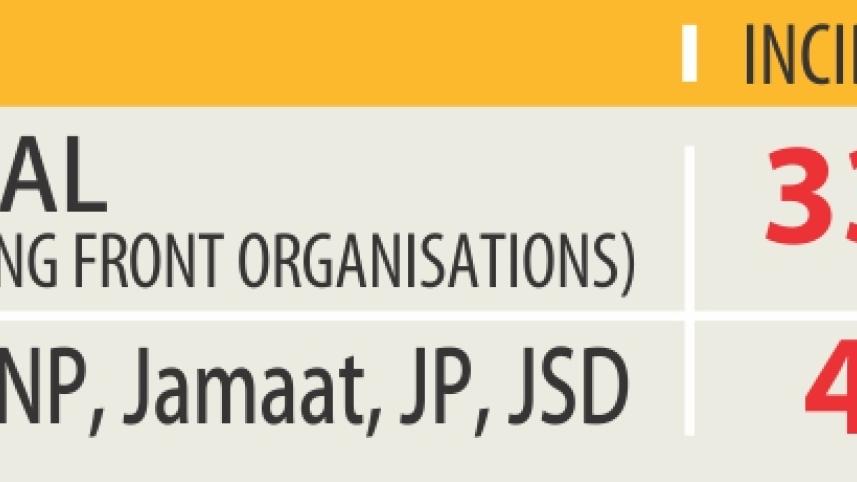
At least 52 AL men were killed and nearly 3,500 injured in 334 incidents of internal clashes from January last year till October this year, according to Ain o Salish Kendra (ASK), a leading rights body. The ASK statistics are based on newspaper reports and its own investigation.
The death toll rose to 56 following Monday's Narsingdi clash in which four people were killed.
Over the same period, 35 clashes took place between AL and BNP men, leaving five people dead and around 350 injured. AL men were locked in clashes with Jamaat-Shibir activists twice, leading to death of two.
Establishing supremacy in areas appears as the major factor behind the internal conflicts at grassroots level of the AL.
And making money in unlawful ways like extorting, tender manipulation and influencing the government's development work is the main cause behind their frantic efforts to establish supremacy or retain control over a particular area, shows an analysis of the incidents of clashes.
The party's front bodies Jubo League and Chhatra League also engaged in infighting in the last two years.
Intra-party feuds at the grassroots level took place also when dissidents defying the party high command's order contested the last union parishad elections held in phases in the first quarter of this year.
Many AL dissidents were expelled from the party but punitive actions could not contain dissidents.
In many areas, AL men appeared as the main challenger of party nominated chairman candidates. Their supporters also engaged in clashes in many areas. However, the ASK statistics mentioned in this report does not include casualties in polls violence.
The incidents of internal conflicts have made the AL high command worried. AL chief Sheikh Hasina has directed grassroots leaders to resolve internal feuds, party insiders said.
Contacted, AL Joint General Secretary Mahbubul Alam Hanif, however, said AL is the biggest political party in the country with millions of leaders and activists.
"So there might be some differences of opinions and feuds inside the party," he said.
He said the organising secretaries have been directed to visit different areas and talk with local leaders to know about the reasons behind it.
“They [organising secretaries] will recommend steps so that such incidents do not recur,” he told The Daily Star last night.
Nur Khan Liton, acting executive director of ASK, however, thinks that when democratic space shrinks, political opponents become weaker and do not get necessary environment to perform due roles. This situation is prevailing in the country now.
In the absence of strong opponents, leaders and activists of ruling party get involved in an unethical competition within themselves.
To be benefited economically, they want to establish supremacy inside the party and also in their localities, leading intra-party feud, said Nur Khan.
The situation was, however, different earlier.
 For all latest news, follow The Daily Star's Google News channel.
 Main political rivalry in Bangladesh was between the AL and the BNP -- the two major parties that have been governing the country in turns since restoration of democracy after the fall of autocratic Ershad regime in 1990.
The January 2014 parliamentary election and its aftermath have gradually changed the political landscape, creating a situation in which AL is left alone to dominate, said political analysts.
The BNP-Jamaat-led alliance boycotted the elections and waged violent means to resist the polls, but failed.
The alliance waged violent agitation for the first three months in 2015 to topple the government, but failed again. Numerous cases were filed against its central and grassroots leaders.
Law enforcement agencies have launched crackdown several times on BNP leaders and activists. Many were put behind bars.
The party has apparently become dysfunctional. Some of its central leaders participate in some discussion programmes in the capital at best.
The BNP could not come up with any major political programme in the last two years. It also could not reorganise despite some efforts.
Jamaat-e-Islami, a key component of BNP-led alliance, has been facing biggest crisis since it resumed activities in independent Bangladesh as most of its top leaders were executed on charges of committing war crimes in 1971.
The party has been labelled as a criminal organisation in several judgments delivered by the international crimes tribunal.
The Jatiya Party became the main opposition in parliament following BNP's boycotting the last parliamentary election. But as the main opposition party, it could not challenge the AL in parliament as some of its MPs were inducted in the cabinet.
SOME CLASHES
On Monday, at least four people were killed and 50 others injured in fierce clashes between the supporters of current and former union parishad chairmen over establishing supremacy in a remote char of Narsingdi's Raipura upazila.
Police and locals said there had been a longstanding rivalry between AL-backed Nilokkha UP Chairman Tajul Islam and former chairman Abdul Haque, who is also a ruling party leader.
On October 18, AL leader and freedom fighter of Shailkupa in Jhenidah Moktar Mridha was seriously injured by his rivals within the party over tender dropping, said party sources and locals.
On October 30, ruling party men allegedly backed by a local lawmaker assaulted Tarash Upazila Parishad Chairman and local AL leader Abdul Haque in his office.
On September 17, Rizvi Hasan, a Jubo League leader, was shot dead, following internal feud over control of the Motijheel AGB Colony and its adjacent areas.
On March 29, Nasim Ahmed Sohel, a member of Chhatra League's Chittagong city unit and also a student of Premier University, Chittagong, was killed by allegedly his rivals in BCL.
Comments