


Cameron profited from father's fund
David Cameron has admitted he did have a profitable stake in his father's offshore investment fund, before selling it for around £30,000 before he became prime minister.
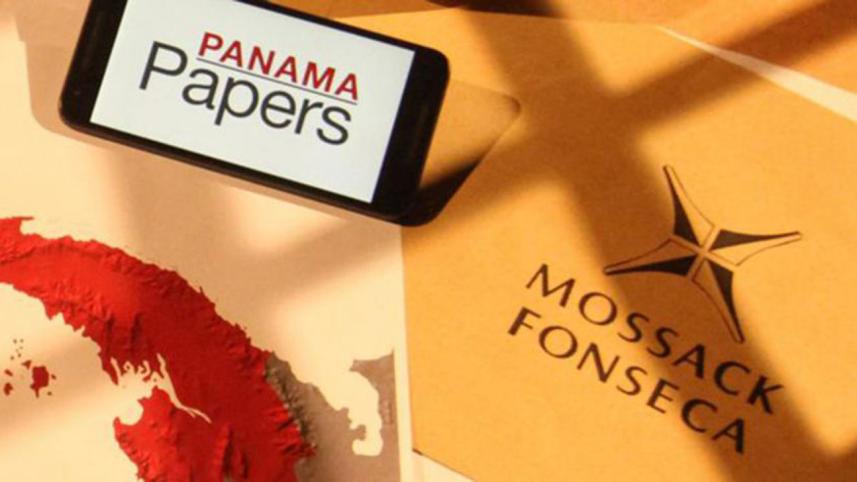
The admission comes five days after a huge cache of documents were leaked -- dubbed the Panama Papers -- detailing the tax affairs of thousands of individuals of worldwide.

The leak has exposed financial arrangements of public figures including friends of Russian President Vladimir Putin, relatives of the prime ministers of Iceland and Pakistan, and the president of Ukraine.
In his reaction, President Putin has denied "any element of corruption" over the Panama Papers leaks, saying his opponents are trying to destabilise Russia.
Putin was speaking for the first time since the leak.
The papers revealed a number of offshore companies owned by close associates of Putin.
The UK prime minister's father, Ian Cameron, who passed away in 2010, was exposed as running a fund under the name of Blairmore Holdings in the papers.
Downing Street staffers initially said that it was a “private matter” whether or not Cameron had benefited from the fund. It later issued a series of statements denying the prime minister currently benefited from offshore funds, or stood to do so in the future. Though, despite the clarifications, a number of questions still remained.
Labour has condemned the way information about Cameron's financial affairs was revealed with “drip, drip” statements, and the revelations will raise questions about why Cameron did not admit to personally profiting until five days after the Panama Papers were leaked.
But in an interview with ITV News, he insisted that it was a "fundamental misconception" that Blairmore Holdings, set up by his father Ian Cameron the 1980s and run from the Bahamas, was set up to avoid tax. He said his father was being "unfairly written about".
He said that his and Samantha Cameron's profit from the scheme was "subject to all the UK taxes in the normal ways".
Number 10 said Mr and Mrs Cameron bought their holding in April 1997 for £12,497 and sold it in January 2010 for £31,500.
"I paid income tax on the dividends, but there was a profit on it but it was less than the capital gains tax allowance, so I didn't pay capital gains tax, but it was subject to all the UK taxes in all the normal ways," Mr Cameron told ITV.
"So I want to be as clear as I can about the past, about the present, about the future, because frankly, I don't have anything to hide.
"I'm proud of my dad and what he did and the business he established and all the rest of it.
"I can't bear to see his name being dragged through the mud, as you can see, and for my own, I chose to take a different path from my father, grandfather and great-grandfather, who were all stockbrokers, and I've got nothing to hide in my arrangements and I'm very happy to answer questions about it."
'INFORMATION PRODUCT'
Putin, speaking live on TV, said Russia's Western opponents "are worried by the unity and solidarity of the Russian nation... and that is why they are attempting to rock us from within, to make us more obedient".
He said that because they could not find Putin in the Panama papers "they've made an information product".
"They've found a few of my acquaintances and friends... and scraped up something from there and stuck it together."
 For all latest news, follow The Daily Star's Google News channel.
 The papers name Putin's long-time friend and godfather to his daughter, the cellist Sergei Roldugin, as the owner of two offshore firms, International Media Overseas and Sonnette Overseas.
According to the papers, the firms were involved in a number of suspicious deals, including one in which International Media Overseas received a loan of $6m in 2007, which was written off three months later for just $1.
Putin said he was proud of people like Roldugin who he said had spent nearly all the money he had earned on musical instruments and donating money to state institutions.
AMERICANS IN PANAMA PAPERS
The names of hundreds of Americans have surfaced in the Panama Papers, including a handful of US businessmen accused or convicted by US authorities for ties to financial crimes or Ponzi schemes.
Some appear to be retirees purchasing real estate in places like Costa Rica and Panama, according to the consortium. But there are at least a few Americans in the leaked files who have faced charges for serious financial crimes in the US.
Here are some of the Americans who have been charged or convicted of financial crimes that have surfaced in the massive data leak, according to the media consortium. Their identities were first reported by McClatchy Newspapers.
Benjamin Wey, a Wall Street financier, was charged in September with securities fraud, wire fraud, conspiracy and money laundering for using family members to help him stealthily amass ownership of larger blocks of stock in companies through so-called “reverse merger” transactions between Chinese companies and US shell companies.
Igor Olenicoff, the Russian-born billionaire and commercial real estate mogul, was listed as a shareholder of Olen Oil Management Limited in the leaked data. He was sentenced in 2007 to two years of probation for tax evasion.
Robert Miracle was sentenced in 2011 to 13 years in prison and three years of supervised release for mail fraud and tax evasion for his part in a $65 million Ponzi scheme involving an Indonesia oilfield.
John Michael “Red" Crim was convicted in Philadelphia in 2008, along with two associates, for being part of a plot in which he recruited investors to use phony trusts to cheat the IRS out of $10 million in revenue.
GENEVA PROBE
Swiss banks must clamp down on money laundering, the country's financial watchdog said yesterday as the Geneva prosecutor opened a criminal probe following the massive document leak.
"Do I think we are where we should be in fighting misuse in the financial system? No," FINMA Chief Executive Mark Branson told Reuters following its annual news conference.
"We think in some ways the risks in Switzerland have risen, not fallen, and that there is more that can be done. We don't want to see large scandals involving Swiss banks."
Switzerland is the world's biggest international wealth management centre with around $2.5 trillion in assets and has taken on more wealth of late from emerging markets, from which it is harder determine the origin of assets, Branson said.
Branches of Swiss lenders including UBS and Credit Suisse were mentioned in the leaked documents as being among the main banks that requested offshore companies for clients. Both banks have denied wrongdoing in connection with the practice.
[From AFP, Reuters, BBC, USA Today, Independent.co.uk]
Comments