


Climate Change: WB commits $2b fund in 3 years
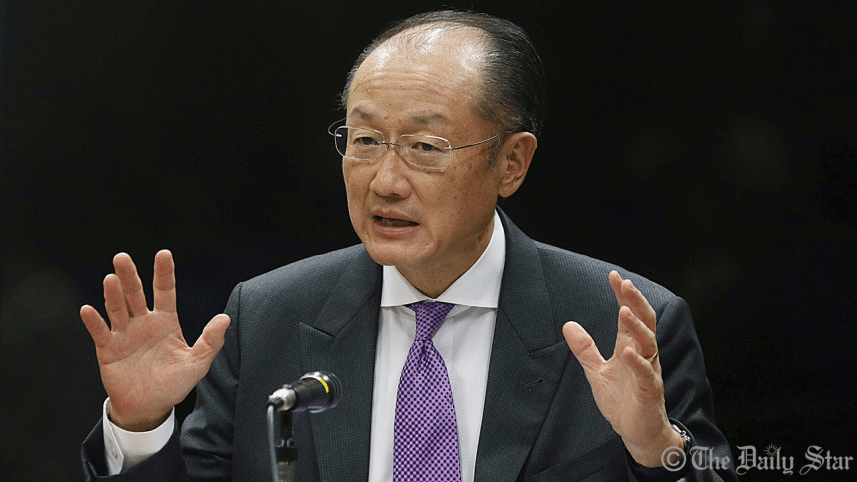
The World Bank (WB) yesterday committed to providing Bangladesh with $2 billion over the next three years in fresh funding to help the nation tackle and adapt the negative impacts of climate change.
“Bangladesh is one of the most vulnerable countries in the world to climate change and we must do all we can to support the government in its efforts to adapt to this growing threat,” said WB Group President Jim Yong Kim making the announcement at a press conference.

The WB, which provided Bangladesh more than $24 billion in financing in the last 45 years, organised the press meet to share Kim's experience during the two-day visit in Bangladesh, first by a WB president in nearly a decade.
During the visit, Kim marked the End Poverty Day in Dhaka on October 17 and met with top policymakers, including Prime Minister Sheikh Hasina and Finance Minister AMA Muhith.
In his first trip to Bangladesh, Kim also visited rural communities, schools cum cyclone shelters and some rural houses lighted by solar power in the southern region.
“I met with people today [yesterday] who talked about the threats of cyclones and flooding,” he said making the pledge of financing for tackling climate change.
The $2 billion pledge for climate change mitigation is in addition to $1 billion pledged by Kim on October 17 to end childhood stunting in Bangladesh.
Both amounts are contingent on a successful replenishment of the International Development Association, the World Bank's fund for the poorest countries, which should be agreed in December, said the WB.
At the press conference, Kim said he is very impressed to see Bangladesh's innovation in fighting poverty, empowering women and battling climate change.
He also praised the security measures provided to him and his colleagues during his visit and said every country faces the threats of terrorism.
“There is no single country in the world, no matter how wealthy it is, that is free from threats of terrorism,” he said.
“We see it in the United States, Belgium and France and of course there was a great tragedy that occurred here last summer in Bangladesh. I can just tell you that the security I received during my visit was extremely impressive,” said Kim, responding to a question from the media.
“Terrorism is one of the great unfortunate realities of the society today. And no country is going to be immune to it,” he said, stressing the need for continuous and vigorous monitoring and screening.
“It takes just constant vigilance in being able to prevent terrorist attacks. Literally, they are popping up everywhere,” Kim observed.
Kim also said he sees a bright future for the people of Bangladesh.
Despite progress in various areas, Kim said the country still faces many obstacles to reaching its goals to move from low-middle-income status to middle-income status and to end extreme poverty by 2030.
The WB president suggests that the government should focus on three areas in order to become successful.
The first is policy reforms that improve the business climate, he said, citing that foreign direct investment in Bangladesh lags behind that of its neighbours.
“If the country attracts more investment from the private sector, it will mobilise funds necessary for infrastructure projects,” added Kim.
Secondly, Bangladesh needs to strengthen its institutional capacity, and thirdly the country should strengthen governance, he told the press conference.
 For all latest news, follow The Daily Star's Google News channel.
 He said the government correctly points out in its 7th Five-Year Plan the need to strengthen institutional capacity and governance which includes building a strong civil service, judiciary, public banks, tax collection system and the anti-corruption watchdog.
“We share Bangladesh's zero tolerance towards corruption, believing strongly that any fund diverted from beneficiaries amounts to stealing from the poor,” he said, adding that the WB is willing to support Bangladesh's development priorities, reducing poverty further, creating more and better jobs, and working to build a more vibrant private sector.
He said the WB would also expand its engagement with Bangladesh in infrastructure particularly, renewable energy, improving inland waterways and logistics and regional integration through Bangladesh, Bhutan, India and Nepal (BBIN) and urbanisation.
Citing his meeting with Prime Minister Sheikh Hasina, he said he offered to make partnership with Bangladesh. What they really want to do is to bring experiences from all parts of the world to Bangladesh, he added.
Kim also said a real opportunity exists to attract capital because of low interest rate now.
It is a real opportunity to launch infrastructure projects that will attract private sector investment. The key to that, of course, is to give private sector investors a sense that business environment is conducive to getting involved and coming to Bangladesh, he observed.
He further said he made a commitment to Hasina that the WB would provide as much technical assistance as Bangladesh would like to improve its business environment.
He added the WB will be paying very special attention to ensure that Bangladesh becomes more resourceful to battle climate change.
“Bangladesh has a great threat from climate change and funding from many donors has not been flowing as quickly as we think it should, especially as Bangladesh tries to adapt to the climate change,” he noted.
Replying to a query on interest rate on WB Group loans for Bangladesh as it becomes a low-mid-income country, he said Bangladesh would receive more concessional funds and start borrowing from non-concessional funds.
On a question regarding conditions for the loans, he said every loan is negotiated directly with the government.
“We are very clear about requirements we impose when a loan is being taken,” he said, citing an example that one has to abide by environmental and social safeguards, which were agreed upon by the 189 member countries including Bangladesh, to get loan from the WB Group.
He said the WB is not an institution that thinks secretly. “We are an institution where everyone plays a role and everyone has a voice. The conditions on the loans that are imposed are agreed upon by the countries,” he said.
“We do not force countries to do something they do not want to do,” he added.
Kim recommended that Bangladesh looks outward, saying that countries cannot become successful by looking inward, no matter how wealthy they are.
“You cannot look inward and be successful. My strong suggestion is that Bangladesh should look outward even more aggressively.”
Comments