


Obama 'a very good man'
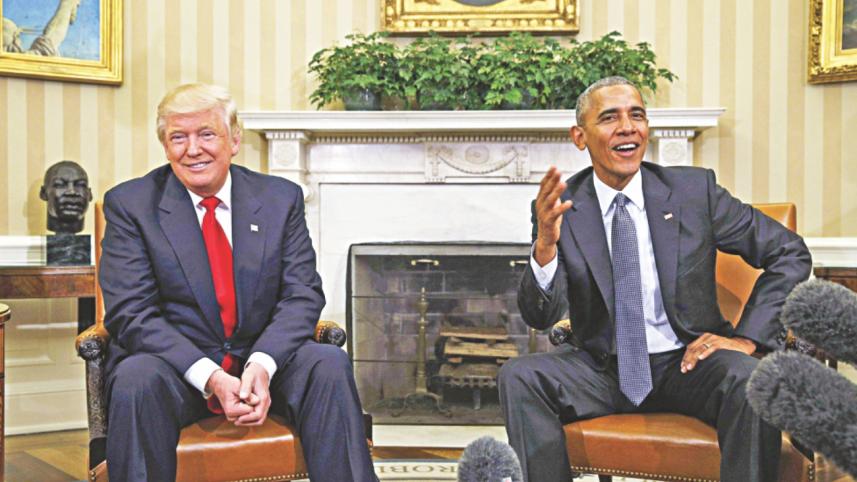
Barack Obama and Donald Trump put acerbic rows and profound differences aside in a 90-minute transition meeting at the White House yesterday, hoping to quell fears about the health of the world's pre-eminent democracy.
The meeting, which came less than 36 hours after Trump's shock election victory over Democrat Hillary Clinton, had the potential to be awkward. The two had traded barbs during the heated battle for the White House.

The outgoing president and his successor met one-on-one and sat in high-backed chairs before the Oval Office fireplace, for what Obama characterised as an "excellent conversation."
Trump, who spent years pursuing Obama over false claims he is not a natural-born American and accused him of being the founder of IS on the campaign trail, called Obama a "very good man" and said he would seek his counsel in future.
Three days after mocking Trump as not fit to control the codes needed to launch nuclear weapons, Obama told his successor that he wanted him to succeed and would do everything he could to ensure a smooth transition.
The extraordinary meeting was a reflection of the swift and sudden change in the political mood between the frenzied last days of an election campaign and the reality of government and the transition of power between two administrations that follows.
"My No 1 priority in the next two months is to try to facilitate a transition that ensures our president-elect is successful," Obama said.
The two men ended the improbable and historic White House encounter with a handshake and refused to take questions.
"Here's a good rule. Don't answer questions when they just start yelling," Obama told Trump, referring to the press.
Trump thanked Obama for the meeting which he said had originally been scheduled for 10 minutes and went on for 90.
"Mr President, it was a great honor being with you and I look forward to being with you many, many more times," Trump said, adding that he and Obama had spoken about some wonderful and difficult things and "some high-flying assets."
It was not immediately clear about what he meant.
As the pool of reporters were led out, Trump told them several times that Obama was "a very good man."
White House officials said that the two men had discussed a range of issues including Obama's meetings with leaders from Germany, Greece and across the Asia-Pacific during foreign travel next week.
On that trip, Obama is likely to be inundated with panicked questions about America's role in world affairs.
HINTS OF NEW CABINET
The Obama-Trump meet came as first hints of the new US cabinet emerged.
On Wednesday, Trump huddled at Trump Tower in New York with a group of advisers, planning a transition strategy to take over stewardship of the world's largest economy.
Trump's early list of potential appointments to top positions appears to reward people who were loyal to him after a campaign in which many Republican Party leaders kept their distance.
Jeff Sessions, an Alabama senator who was one of Trump's most fervent supporters in the US Congress, is said to be under consideration for a prominent role, perhaps defense secretary, sources familiar with transition planning said on Wednesday.
Retired General Michael Flynn emerged as a possible pick for Trump's national security adviser, the sources said.
 For all latest news, follow The Daily Star's Google News channel.
 Flynn, a former director of the Defense Intelligence Agency, played a prominent role during the campaign, often serving as an introductory speaker at campaign rallies and has provided private counsel on foreign affairs.
In addition, former House of Representatives Newt Gingrich and US Senator Bob Corker of Tennessee were also considered potential selections for secretary of state, the sources said. Corker chairs the Senate Foreign Relations Committee.
Both Corker and Gingrich had been under discussion as potential vice presidential picks for Trump, a position that eventually went to Indiana Governor Mike Pence.
These same sources said Republican National Committee Reince Priebus, who has emerged as a trusted adviser to the New York businessman, was being talked about as a potential White House chief of staff.
A Priebus deputy, RNC senior strategist Sean Spicer, was a possibility for White House press secretary.
Trump's campaign manager, Kellyanne Conway, who helped bring about a more disciplined approach to the candidate, was seen as potential White House senior adviser.
Retired neurosurgeon Ben Carson, who endorsed Trump after dropping out of the 2016 Republican presidential nomination fight, was a possible education secretary.
Richard Grenell, a former spokesman for the United States at the United Nations, was a potential US ambassador to the United Nations, as was New York Republican Representative Peter King.
Mike Rogers, a former chairman of the House Permanent Select Committee on Intelligence, was in the mix for CIA director, the sources said.
Late Wednesday, anger over the Republican property mogul's upset election win over Clinton spilled out onto the streets of US cities as chanting protesters lit bonfires and snarled traffic.
After Trump's shock election win, which virtually no poll had predicted, both sides spoke of healing the deep divisions sown in a bruising two-year campaign.
Trump's vanquished Democratic rival Clinton, holding back the bitter disappointment of not becoming America's first female president, urged the country to give Trump a chance.
"We owe him an open mind and the chance to lead," she said Wednesday in a concession speech.
Obama, addressing disconsolate staff in the White House Rose Garden on Wednesday, played down Trump's win as part of the messy "zig-zag" movement of a democracy.
"Sometimes you lose an argument," he said, adding that all Americans should now be "rooting" for Trump's success.
In the battle for the soul of America, those who helped elect its first black president now appear to be in retreat and pondering whether his eight years in power have come to naught.
Both Obama and Clinton issued a faint -- but clear -- warning that Trump must respect institutions and the rule of law if a modicum of goodwill is to hold.
That "likely" observance of rule of law may not suffice for Washington's partners and allies, who see an entire global political order built around US leadership cast into doubt.
German Chancellor Angela Merkel was quick to underscore the importance of shared democratic values.
"On the basis of these values, I offer close cooperation to the future president of the United States of America," she said.
Europe, already beset by financial and social crises and internal divisions, now faces existential questions about its own security. Trump has questioned the US-led Nato's key collective defense guarantee.
The leaders of America's neighbors, Canada and Mexico, quickly made clear their willingness to work with the new president.
President Enrique Pena Nieto of Mexico, a prime target of Trump's anti-immigration campaign rhetoric, reached out to congratulate the incoming leader and announced they would soon meet.
The Republican Party leadership, too, embraced their newfound champion.
House Speaker Paul Ryan, who had distanced himself from Trump in the final month of the campaign, pledged to "hit the ground running" and work with him on conservative legislation.
The two, along with Vice President-elect Mike Pence, met on Capitol Hill for lunch after Trump's talks with Obama.
During a bitter campaign that tugged at America's democratic fabric, the tycoon pledged to deport illegal immigrants, ban Muslims from the country and tear up free-trade deals.
Those campaign messages were embraced by a large section of America, grown increasingly disgruntled by the scope of social and economic change under Obama.
But they were passionately rejected by Clinton supporters.
Thousands of protesters -- in New York, Los Angeles, Boston, Chicago, Philadelphia, Portland and other cities and school campuses -- rallied Wednesday to express continued opposition to the incoming leader they accuse of racism, sexism and xenophobia.
In Los Angeles, a giant Trump head was burned in effigy.
Comments