


Rohingyas keep trying to get in
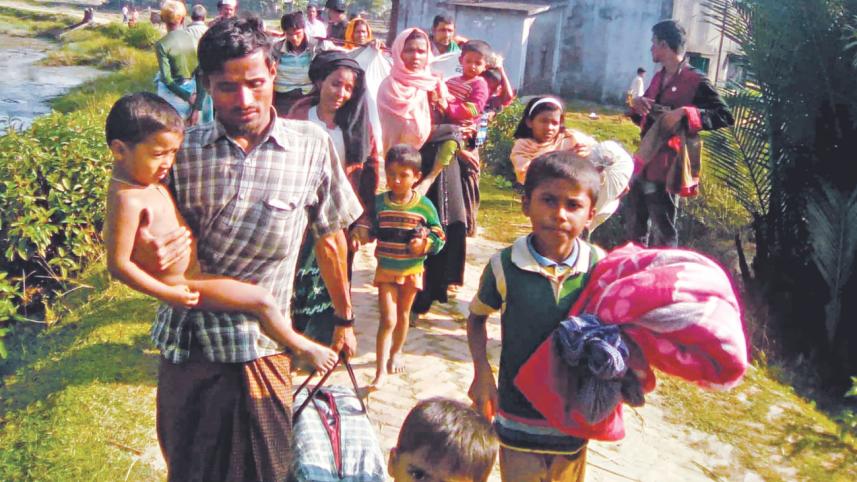
Hausher Dweep. It's an island in the middle of the Naf river, which marks the Bangladesh border with Myanmar.
There is a shrimp farming project with an embankment around it. Shrimp farmers go there by small boats.

On Monday morning, over 500 Rohingyas took shelter on this island.
Visiting the place yesterday afternoon, this correspondent found around 300 of them near the embankment's sluice gate-1 and another 200 near gate-5. BGB was guarding them.
It is being widely reported that Rohingyas, often dubbed one of the most persecuted minority groups in the world, are trying to flee the military crackdown in Rakhine state of Myanmar.
Though Bangladesh officials say patrolling has been increased, Rohingyas keep arriving, mostly by crossing the Naf river at night, many with horrific tales of troops killing people and burning villages.
Md Salam, from Khiaripara of Myanmar, said he crossed the river along with 300 others and reached Hausher Dweep on Monday morning.
Abdul Monaf and Nurjahan Begum from Naisaprang said they were planning to go first to unregistered camps in Leda, a village housing a settlement of about 25,000 undocumented Rohingyas, and then to a Kutupalong slum.
But BGB stopped them, they said, adding they would try to go to the mainland whenever they get a chance.
The island is 500 metres off the shore and under Hoyaikong union in Teknaf upazila of Cox's Bazar.
BGB was providing the Rohingyas with cooked food, as many came with young children. Some people from different villages of Hoyaikong were also helping the Myanmarese nationals in distress.
Around 6:00pm yesterday, 294 of those Rohingyas were sent back, said Md Ibrahim, company commander of Hoyaikong BOP under BGB Battalion-2.
They were given humanitarian assistance before being sent back, added the border force official.
In another development, BGB held 125 Rohingyas after searching vehicles on Cox's Bazar-Teknaf highway from Monday night till yesterday afternoon.
They were pushed back through Ghumdhum and Tombru points of Bandarban, according to Lt Col Imran Ullah of BGB Battalion-34 in Cox's Bazar.
Meanwhile, Teknaf police said they have recovered the body of a Rohingya floating in the Naf. On Sunday night, a boat sank with Myanmarese people trying to cross the river.
Mohammed Ali, local union parishad member, said the boat capsized in Zadimura area of Hnila.
"The boat was carrying 15 Rohingyas trying to cross the river with the help of a local broker," he said, adding that the brokers rescued a few Rohingyas and they were given treatment at local clinics.
Some eight people are still missing, he added.
Colonel Abu Zar Al Zahid, commander of Battalion-2 of BGB in Teknaf, told journalists yesterday that around 20 to 25 boats full of Rohingyas attempted to get into Bangladesh territory in the morning. But the border guards sent them back.
 For all latest news, follow The Daily Star's Google News channel.
 A top official from the Cox's Bazar deputy commissioner's office, citing an “intelligence report”, said thousands of Rohingyas were waiting on the Myanmar side just to enter Bangladesh.
'HORRIFIC STORIES'
Myanmar troops have poured into a strip of land that is home to the stateless Rohingya minority since a series of attacks on police border posts last month, AFP reports.
State media reports in Myanmar say security forces have killed almost 70 people and arrested some 400 since the lockdown began six weeks ago, but activists say the number could be far higher.
Witnesses and activists have reported troops killing Rohingyas, raping women, and looting and burning their houses.
"We're hearing horrific stories from them," said an international rights worker visiting the area, speaking to AFP on condition of anonymity.
Zohra Khatun, 25, sneaked into Bangladesh late Monday with her seven children after their village back home was burned to the ground, and has been helped by a relative already living in a refugee camp.
"I waited two days before I had the chance to cross the river to come here," Khatun told AFP by phone.
Mohammad Amin, 17, said he and 15 others fled their homes in Rakhine five days ago and reached Bangladesh by swimming across the Naf river that divides the two countries.
"The [Myanmar] army killed my father and elder brother. I hid on a hill and then walked and swam across the river, and took refuge at a mosque [in Bangladesh]," he told AFP by phone from Cox's Bazar near the border.
"Where I looked I saw only burnt houses. I don't know what happened to my mother and sister."
[With inputs from AFP]
Comments