


Saarc Summit: Pakistan faces regional isolation
Pakistan faces isolation in South Asia after Afghanistan, Bangladesh, Bhutan and India have refused to attend the Saarc summit scheduled for November in Islamabad.
The announcements by the four nations, all on Tuesday, mean that the summit will have to be postponed, which will put further strain on the three-decade-old, almost dysfunctional regional body to turn around.

The 19th summit was due on November 9-10 in the Pakistani capital, where heads of state and government of the eight-member nations were to attend.
The four members conveyed their inability to Nepal, the current chair of the South Asian Association for Regional Cooperation, to attend the summit.
Under the rules, the summit has to be postponed if even one member nation pulls out.
Kathmandu has received communications from the Saarc secretariat transmitting the diplomatic notes from the four countries, Nepal's foreign ministry said in a press release late last night.
“We have taken this development seriously. As the current chair of Saarc, the government of Nepal strongly urges that a conducive environment be created soon to ensure the participation of all member states in the 19th Saarc summit in line with the spirit of the Saarc Charter,” it said.
Nepal has yet to make a formal announcement about the fate of the summit.
But Kathmandu Post, a leading English daily of Nepal, yesterday reported that the summit had been called off after India announced its inability to take part in it.
Radio Pakistan reported yesterday that Sartaj Aziz, adviser to the Pakistan prime minister on foreign affairs, said the summit could be postponed given the latest development, but the Saarc secretariat did not officially inform Islamabad yet.
Tensions between India and Pakistan mounted in recent weeks, after militants suspected to have entered from Pakistan stormed an Indian army base in Uri on September 18, killing 18 soldiers.
In efforts to isolate Pakistan in the region, India pulled out of the summit citing “growing interference in the internal affairs of member states by one country creating an environment that is not conducive to the successful holding of the summit.”
About Bangladesh's decision, State Minister for Foreign Affairs Shahriar Alam said, "It [the decision to boycott] has no relation with other countries' decisions. It's our own decision."
“The continuous interference of a member state in Bangladesh's internal affairs prompted us to pull out from the summit,” state-run news agency BSS quoted him as telling reporters at the foreign ministry yesterday.
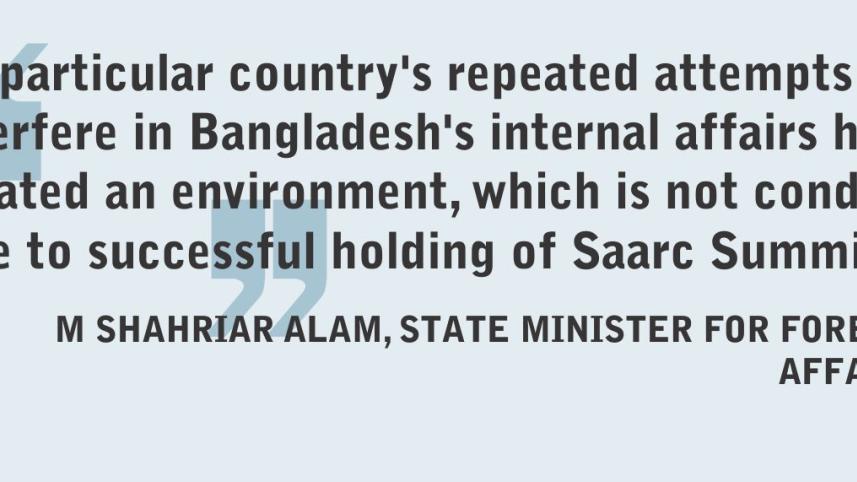
Without naming any country, he said a particular country's repeated attempts to interfere in Bangladesh's internal affairs have created an environment not conducive to the successful holding of the summit.
"When time and scope will be available, Bangladesh will attend such events," he added.
Afghanistan said due to increased level of violence and fighting as a result of imposed terrorism on Afghanistan, the country's president will not be able to attend the event.
Bhutan expressed its inability to participate, citing deterioration of regional peace and security due to terrorism.
Sri Lanka meanwhile said the summit would not be possible without India's participation.
Sheel Kant Sharma, who was Saarc secretary general from 2008 to 2011, has termed India's decision “extraordinary and unprecedented”.
 For all latest news, follow The Daily Star's Google News channel.
 “This is the first time that India has said that it will not attend a summit,” Sharma told the Wire, a Nepalese media outlet.
In the past, India adopted “stalling” tactics -- which then led to the deferment of the summit, but there were no statement which baldly castigated the would-be host or explicitly stated a reason, he added.
In the wake of the Kargil war and General Mosharraf's military coup in Pakistan, India prevaricated over Atal Bihari Vajpayee attending the summit in November 1999 in Kathmandu, which eventually led to its cancellation.
Sharma pointed out that when Pakistan was supposed to host the Saarc summit in January 2004, India had similarly conveyed its reluctance to be a participant.
“Vajpayee was not keen to attend, but there were a lot of requests through the back channel from President Musharraf. The PM went only after there was a clear undertaking from Pakistan that Musharraf will make a statement about Pakistani soil not being used to support terrorism,” he said.
In February 2005, Prime Minister Manmohan Singh pulled out of the summit in Dhaka over security concerns and King Gyanendra's Royal coup in Nepal. The meeting was, however, held later in November.
Commenting on the latest development, a Bangladesh foreign ministry official who has long been involved with Saarc, said now it would be very difficult for the current Saarc chair to revive the summit as the four countries seem determined not to go Pakistan, which clearly shows the regional body would be dysfunctional for an indefinite period.
The official said if there were no initiatives by Pakistan to address the concerns of the four members, the Saarc will see a long-term stagnation.
Asked how the situation can be improved to bring the summit back on track, former Bangladesh ambassador to Pakistan FA Shamim Ahmad said Nepal as current chair of Saarc must take initiatives to resolve the issue.
“It will take time for normalcy to return, as the deadlock has been created with serious deterioration of India-Pakistan relations.”
Security and foreign affairs expert Maj Gen (retd) Abdur Rashid said Pakistan had to come clean about its current role and stop cross-border terror activities, like that in Uri.
“Pakistan must prove that it is not patronising terrorism and militancy, and stop allowing using its territory to attack other countries. And Pakistan's change must be visible,” he told The Daily Star yesterday.
Saarc came into being in December 1985, with the adoption of its charter in Dhaka. The objectives were to promote the welfare and improve the quality of life of the people of South Asia by accelerating economic growth in the region and building up mutual trust among member states.
The Saarc charter requires holding its summit every year. In the three decades, however, only 18 summits were held.
One fundamental weakness of the body is lack of trust among some members. As a result, many major decisions remain unimplemented.
Comments