


Marooned with scanty relief
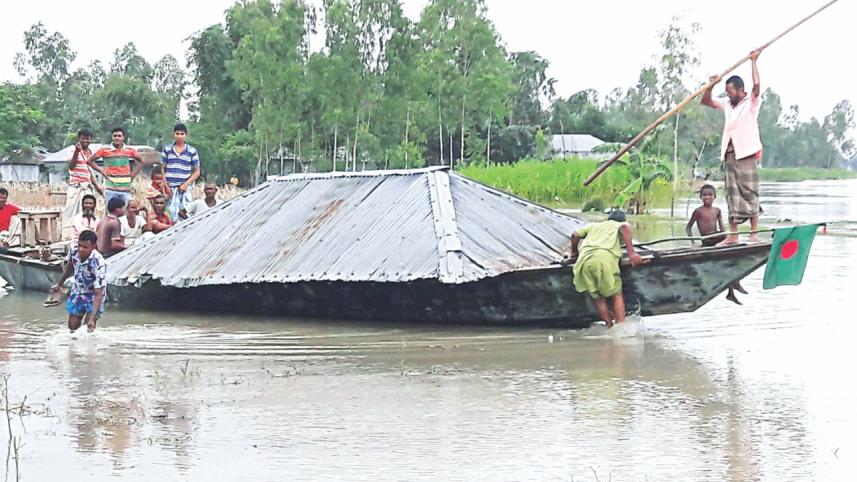
Flood situation in several northern districts has remained grave for three-four days, with the Teesta and Jamuna rivers flowing above the danger level even yesterday due to the onrush of water from the upstream across the border.
As a result, several lakh people have been left surrounded by water with lack of food and pure drinking water. Many educational institutions are closed and hectares of cropland inundated. At some places, river erosion has taken a serious turn threatening to wash away homes.

People living in the affected areas have complained that the relief food allocated by the government is highly inadequate.
Around one lakh people at 85 villages of five upazilas in Lalmonirhat are badly affected by floods triggered by a sudden rise in the water level of the Teesta.
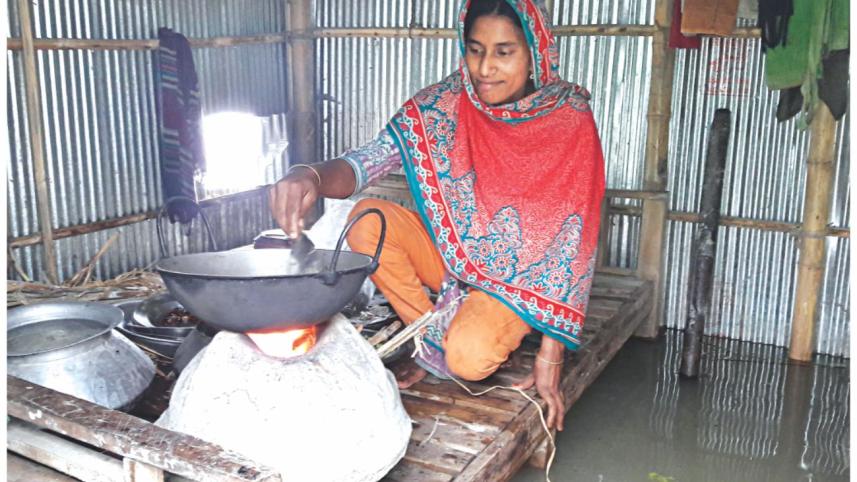
Water was flowing 38 centimetres above the danger level yesterday at the Teesta Barrage point in Hatibandha upazila, reports our correspondent.
Water in the Teesta began increasing on Sunday midnight and crossed the danger level early yesterday, said Mostafizur Rahman, executive engineer of the Water Development Board.
As the pressure of water from the upstream increased, the authorities opened all the 44 gates of Teesta Barrage in the morning.
"All gates of Gajoldoba Barrage near Shiliguri in India are kept open due to the onrush of water from hills. Therefore, the water level on our side is increasing alarmingly," Mostafizur said.
"We've told people living near the shore to go to safe places."
Nazma Begum, 44, a housewife at Bagdora village in Lalmonirhat Sadar, said there was floodwater everywhere inside her house, and so she could not cook food. "We need dry food immediately. But we cannot afford it.”
Finding pure drinking water has also become a concern as, villagers said, most of the tube-wells went under water.
Mofazzal Hossain, chairman of Rajpur union parishad in Lalmonirhat Sadar upazila, said the authority could not distribute relief materials to all the flood-affected people as “we didn't get any allocation."
AFM Alauddin Khan, deputy commissioner of Lalmonirhat, said a total of 400 packets of dry food, 100 tonnes of rice and Tk 1 lakh cash had been allocated, which would be distributed today.
Meanwhile, the flood situation in Jamalpur worsened since the Jamuna was following 37 centimetres above the danger level at the Bahadurabad Ghat point yesterday.
A vast low-lying area in seven unions in Islampur upazila, four in Dewanganj, three in Sarishabari, two in Melandah and two in Madarganj upazila has been inundated, leaving as many as 50,000 people marooned, said officials of the district administration.
Some upazila chairmen claimed that the relief materials were scanty.
"In the last three days, only 250 packets of dry food were distributed among the flood-hit families though nearly 2,500 families are affected in my union," said Abdul Malek, chairman of Belgachha UP.
Ninety primary schools, nine high schools, six madrasas and one college had to be shut down.
In Gaibandha, around 30,000 people were stranded in chars of Jamuna basin as the river was flowing 17 centimetres above the danger level at the Balashi point in Fulchhari upazila, the worst hit in the district, reports our correspondent.
 For all latest news, follow The Daily Star's Google News channel.
 River erosion took a serious turn at Erendabari union in Fulchhari, pushing 130 families to move to safety after their homesteads were eroded within the course of the last three days.
WDB engineers of Gaibandha identified several vulnerable points along 70 kilometres of the flood control embankment from Shaghata to Sundarganj upazila.
Precautionary measures were being taken to repair the dyke on emergency basis, said Mahbuber Rahman, executive engineer of the WDB, Gaibandha.
Gautom Chandra Pal, deputy commissioner of the district, said the government allocated 125 tonnes of rice and Tk 10 lakh in cash.
The flood situation in three upazilas of Bogra didn't improve as the water level was still flowing 25 cm above the danger level yesterday, reports our Bogra correspondent.
Local upazila and WDB sources said the low areas of the Jamuna basin at 35 villages in Shariakandi upazila, five villages in Sonatola upazila and four villages in Dhunat upazila were hit by flood. Nearly 20,000 people were affected.
Pratul Chandra Sarkar, deputy director of the Department of Agriculture Extension, said about 4,065 hectares of cropland were inundated, affecting 17,350 farmers in the three upazilas.
In Sirajganj, the Jamuna river was flowing 30cm above the danger level yesterday.
The increasing water level raised the risk of erosion of the flood protection embankment, according to the Sirajganj district administration.
The district's flood protection embankment is 16 meter high from the river while the water was flowing 13.65 meter above the usual water level yesterday.
“The water level is still increasing, which may put the embankment at risk,” said Hasan Imam, executive engineer of the WDB, Sirajganj.
Several hundred villages of five upazilas in the district are affected by flood, said Abdur Rahim, district relief and rehabilitation officer.
In Kurigram, academic activities of 67 government primary schools were suspended due to floods, reports our correspondent.
The Brahmaputra river was flowing eight cm above the danger level at Chilmari Ghat point in Chilmari upazila yesterday noon, WDB officials said.
Comments