


Strengthen democracy, governance
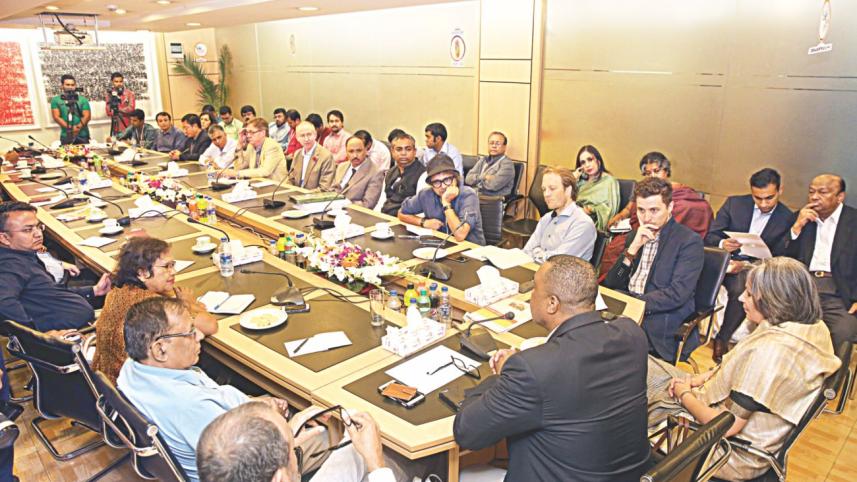
Editors and media rights advocates from home and abroad yesterday called for stronger collaboration and solidarity among journalists to promote democracy, good governance and freedom of speech.
Journalists across the globe are facing new kinds of challenges from authoritarian governments, corporations and religious fanatics, which hamper the growth of core values of democracy and secularism, they noted at a discussion.

Bangla daily Prothom Alo organised the event at its office in the capital on the occasion of its 18th anniversary.
“We need to continue to stand together… work hard. In any society, freedom of speech is very important,” said John Yearwood, executive board chairman of Austria-based International Press Institute (IPI).
Referring to legal actions against journalists and other intimidations from Bangladeshi authorities, he said the IPI had been observing the situation of media freedom in Bangladesh “so we can stand with you to protect the press freedom”.
Prakash Dubey, group editor of Indian newspaper Dainik Bhaskar, said though media freedom was enshrined in the constitution of India, it was hardly implemented.
Referring to the Indian government's ordering shutdown of NDTV for a day for revealing “strategically sensitive details during the attack on Pathankot airbase” in January, he said the Indian Press Council was there, but the authorities did not consider its role.
Mukund Padmanabhan, editor of The Hindu, said certain laws on defamation, contempt of court and sedition in the Indian sub-continent seriously affected media freedom.
He suggested that journalists take initiatives to change such laws.
Sudheer Sharma, editor-in-chief of Nepal's daily Kantipur, said media there faced pressures from political parties, corporate houses and anti-graft commission.
“Corporations are investing in TV stations for business interests … so there is a clash of interests between business and journalism,” he said.
Esben Q Harboe, programme manager at the Denmark-based International Media Support, said space for journalism was narrowing with the rise in conflicts around the world, and deaths of more journalists.
“Lies are being accepted … people seem to accept lies,” he said, suggesting solidarity among journalists and media houses.
Rinzin Wangchuk, editor of Bhutan's daily Kuensel, said self-censorship there was a problem in journalism. Most reports there are event-based, not in-depth or investigative stories.
Swati Bhattacharjee, a senior assistant editor at Ananda Bazar Patrika, said media nowadays hardly paid attention to the issues outside the main cities.
“We don't have setups to cover stories of the grassroots,” she said, stressing the need for basic reporting on people in the peripheries.
Patricia Mukhim, editor of The Shillong Times in Meghalaya, criticised the role of media for not voicing women's freedom of speech properly.
She suggested that women in journalism be recruited in reporting to promote gender development in South Asia.
Referring to the US media coverage of Donald Trump during the campaign, Raj Kamal Jha, chief editor of The Indian Express, said there was a lack of investigative journalism about him.
He said with the rise of social media, there is a lot of falsehood spreading in the public domain. Journalism should be more people-centric, investigative in nature, instead of bites of the TV stars and views.
 For all latest news, follow The Daily Star's Google News channel.
 Bernat Armangue, South Asia News Director for The Associated Press, said social media was a reality that cannot be bypassed to reach the masses.
Therefore, the core values of journalism have to be practised in effective ways, he said and suggested solidarity among different media houses.
Magdoom Mohamed, managing director of World Association of Newspapers and News Publishers in South Asia, recommended having social media editors to deal with the issues of social media.
Freelance Indian journalist Jyoti Malhotra suggested doing reporting on regional issues and reaching the regional audience through digital platform to promote regional identity and solidarity.
The Daily Star Editor and Publisher Mahfuz Anam, who moderated the discussion, said journalism faced three major challenges -- qualitative, environment within the country and global challenge.
Elaborating on global challenges, he said Islamophobia, anti-immigrant stance, rise of racism, nationalism and warmongering have become real challenges in the West.
He said legal actions under defamation cases and rise of fanaticism created psychological impacts on media freedom.
Journalism being a global profession requires global fraternity to promote the rights of people, democracy and good governance, Anam said.
Barbara Trionfi, executive director of IPI, said journalism in Europe was losing its values.
“People go to the politicians for solutions,” she said, adding people in this region still go to journalists to seek help while facing problems.
Shuvodeep Dutta, general secretary of Indo-Bangla Moitree, said repressive measures like legal actions and stopping advertisements on Prothom Alo and The Daily Star is the medal of success of the newspapers.
This manifests that the newspapers are on the right track, he said.
Prothom Alo Editor Matiur Rahman welcomed the foreign journalists and thanked them for attending the daily's anniversary programme.
Slovakian journalist Matus Krcmarik, Finis journalist Kari Huhta, Managing Editor of the North East and Northern Isles BBC Scotland Sandy Bremner, Indian journalist Gautam Das, Editor of Dainik Samayik Prasanga in Assam Taimur Raja Choudhury and Bhutanese journalist Ugyen Penjor also spoke.
Comments