


Way is women, men alliance
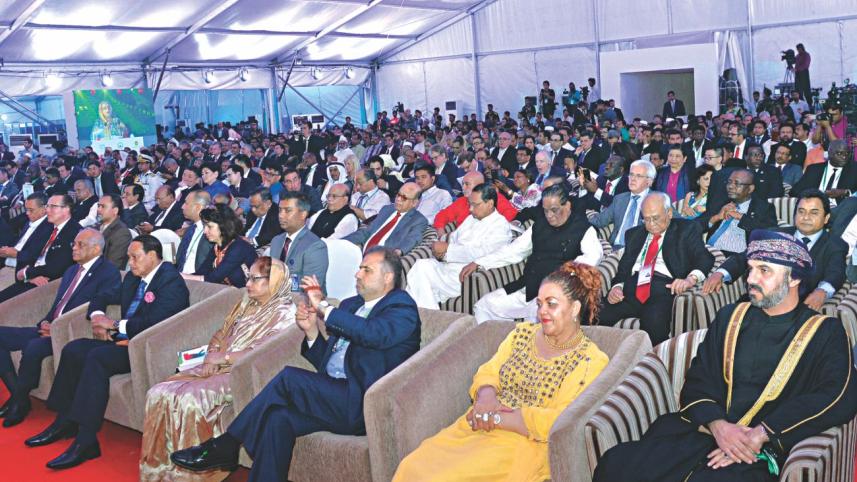
Women MPs from different corners of the globe called for building strong parternship between men and women in economy, in parliaments and in society to achieve gender equality and ensure equal access to financial services.
They called for actions to curb harassment of female MPs by their political rivals in different countries as they spoke in a debate on women's political participation organised in Dhaka on the first day of five-day-long assembly of Inter-Parliamentary Union.

Referring to a study that revealed more than 81 percent of women parliamentarians experienced some form of psychological violence in and outside the parliaments, they expressed concern.
According to the study carried out by Inter-Parliamentary Union (IPU) in October 2016, Sexism, harassment of women lawmakers and violence against them are global problems that impede gender equality and undermine the foundations of democracy.
Of the women MPs who suffer violence in one form or another, some 44 percent said they had received threats of death, rape, beating or abduction during their parliamentary tenure. They had even been told that their children would be killed or kidnapped, said Zeina Helal, head of the gender partnership programme, during the debate.
IPU's study is based on in-depth interviews with 55 women MPs from 39 countries covering five regions of the world.
The study is an eye-opener that women in politics and in parliament face violence, said Salma Ataullahjan, a lawmaker in Canadian parliament.
“It had a great impact on the global parliamentary community and was given great attention in the media.”
Participants in the debate organised by Forum of Women Parliamentarians pointed out the wide gender gap in political positions.
As many as 207 women MPs joined the debate styled "Women's political participation: A new impetus to break the glass ceiling" at Bangabandhu International Convention Centre.
According to the Women in Politics Map 2017, only 23.3 percent global parliamentarians are women who represent half of the world's population. Women hold only 18 percent of the ministerial positions.
The speakers stressed the need for improving women's political empowerment for a fairer world where peace and prosperity would be ensured for all.
According to IPU, women's political empowerment and equal access to leadership at all levels are fundamental to achieving Sustainable Development Goals.
"With limited growth in women's representation, advancement in gender equality and the success of SDGs are jeopardised," observes IPU in the global map of women in politics.
SDGs call for actions to end poverty, protect the planet and ensure that all people enjoy peace and prosperity.
Referring to what is shown in the Women in Politics Map, women parliamentarians said the progress in women's gaining parliamentary positions is very slow.
As per the IPU study, the worldwide average of women in parliament rose to 23.3 percent in 2016 from 22.6 percent a year before.
In December 2006, women held 16.8 percent parliamentary seats across the world, which was a gain of 6.5 percentage point over the last decade.
Presiding over the debate, Dipu Moni, an MP of the Jatiya Sangsad, said the figure of 23 percent is smaller than expected.
Speaker Shirin Sharmin Chaudhury said, “We need to comprehend women empowerment in a comprehensive way encompassing social, economic, political and legal empowerment to end the historic marginalisation of women in every sector including the political process and representation.”
 For all latest news, follow The Daily Star's Google News channel.
 It is important to economically empower women. Economic empowerment gives them voice, and that is essential in the decision-making process that affects their lives fundamentally, said Shirin who is president of the 136th assembly of IPU.
"Women are agents of change. Women bring in different ways of thinking a cooperative spirit, passion, a gift of reading people, empathy, networking abilities, negotiating skills, drive to nurture family children as caregivers. All these invaluable traits help build a better society.
“If ever the world sees a time when women shall come together purely and simply for the welfare and benefit of humankind, it will be a power such as the world has never known before,” the Speaker said.
IPU President Saber Hossain Chowdhury said, “We know that lot has been done and lot has to be done with regard to girls. And we know that investing in girls brings dividends' to all. It must be our number one priority --make no mistake about that.”
The century-old forum, IPU, has been working to establish gender equality globally at the parliaments, Saber said.
“Equal representation in positions of power is a fundamental precondition for truly effective and accountable democracy,” said IPU Secretary General Martin Chungong.
In the debate, women parliamentarians also spoke of the need to establish a strong partnership between women political leaders, women in the business sector, and women from civil society.
They called for gender balance in parliaments and in key parliamentary committees such as budget and finance committees.
They suggested that parliaments must be equipped to ensure women's financial inclusion.
Hoda al-Helaissi, member of the Consultative Council of Kingdom of Saudi Arabia, spoke about the misery of women refugees.
"I would like to pause a while and give a thought to all the young women and girl refugees who have no voice to speak here today, no education and very little hope of being part of decision making.”
So women, who have power, should find a sustainable way to help those unfortunate women and girls and ensure their most basic rights, she said.
Comments