


Dengue deaths, cases surge in July
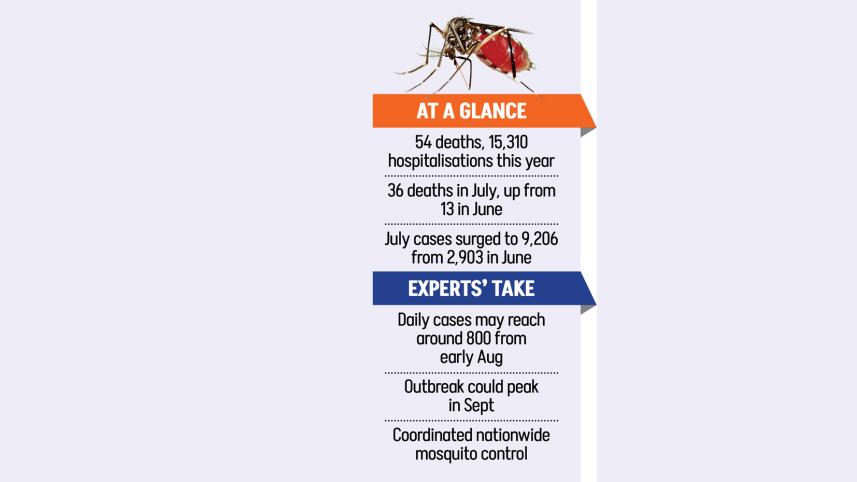
Dengue infections and deaths rose sharply in July, raising fears that the outbreak could worsen in the coming months unless the authorities adopt a coordinated nationwide mosquito control strategy.
As of yesterday, 54 people died and 15,310 were hospitalised this year, according to the Directorate General of Health Services.

Of the total dengue fatalities, 36 occurred in July, up from 13 in June. Dengue infections also surged, with 9,206 cases recorded in July compared with 2,903 in June.
The surge is also being reflected in hospitals.
For instance, dengue admissions at Bangladesh Shishu Hospital and Institute increased significantly in July, according to hospital records.
The hospital admitted 45 dengue patients in July, up from 25 in June. As of July 30, 13 dengue patients were undergoing treatment at the hospital, while total admissions this year have reached 118.
The hospital has yet to open a dedicated dengue ward, as the patient load has not reached that stage, said one of its physicians. If dengue admissions rise further, such a ward could be set up, he said.
Entomologist Kabirul Bashar warned that dengue infections are likely to continue increasing through August and may remain on an upward trend into September.
The daily reported cases, which have recently ranged between 400 and 550, could reach around 800 from early August.
“The peak may not occur in August. It is possible that this year’s peak will come in September. What we can say is that the upward trend is likely to continue through August and into September.”
Although heavy rainfall has temporarily reduced mosquito density in the capital, the situation is unlikely to last, according to Bashar.
“The Breteau Index has been slightly lower than usual over the past two weeks because of the rain. Once rainfall decreases, mosquito breeding is expected to increase again,” he said, adding that the findings are based on surveys conducted in Dhaka.
Bashar stressed that the government’s priority should be source reduction and breeding-site management.
“The main strategy is eliminating mosquito breeding sites. Where breeding sites cannot be removed or destroyed, long-lasting insecticides or insect growth regulators should be applied.”
He also called for greater involvement by local government institutions, saying that councillors and other local authorities should play an active role in mosquito control and dengue prevention.
The sharp rise in dengue cases reflects the country’s failure to establish a centralised and proactive mosquito control programme, said GM Saifur Rahman, assistant professor at the National University of Bangladesh’s zoology department.
Effective dengue prevention requires year-round preventive measures, including indoor residual spraying with long-lasting insecticides that can provide protection for six to seven months. However, such interventions are largely absent in Bangladesh.
Countries with centralised vector control systems generally achieve better results than those relying on decentralised management, where mosquito control efforts vary from one city to another.
He also criticised the uncoordinated use of larvicides such as novaluron and Bacillus thuringiensis israelensis, saying different authorities adopt different approaches without a unified strategy.
“Everyone is doing things in their own way, which is why the control programme is failing to produce meaningful results.”
 For all latest news, follow The Daily Star's Google News channel.
 He called for the establishment of a central mosquito control authority supported by expert entomologists to oversee and monitor dengue prevention activities nationwide.
“Until we establish a coordinated national control system, dengue cases are likely to continue rising. Under the current fragmented approach, there is very little chance of reversing the trend,” he added.
Comments