


Between rain and rock: Six days in the Himalayas

There are places that ask nothing of us, and places that ask everything: our breath, our patience, our nerve on a hairpin turn with a valley falling away beside us. The road from Srinagar through Sonamarg and Kargil to Leh is the second kind. It doesn’t so much welcome us into Ladakh as make us earn it, mile by climbing mile, pass by fogbound pass. We went there as a family of three, and somewhere between the glaciers and the moonscapes, the trip became a story to live in.
The journey began in Srinagar, the summer capital of Jammu and Kashmir, India’s northernmost union territory, in late July, fittingly, with rain -- the kind that softens a city rather than shutting it down. After we landed in Srinagar from Delhi, Shakeel, our driver from the tour operator Ladakh Backpackers, took us straight to a cosy Kashmiri restaurant. We sat down to boneless mutton, jeera aloo, and roti, a last meal before the road took over. By the time we left, the sky had settled into a flat, silvery overcast, and we drove out past the grey vastness of Dal Lake, its water the same pewter tone as the sky. Security had been visibly tightened too ahead of the Amarnath Yatra, the annual pilgrimage to the high-altitude cave shrine. Yatra was later halted by the same rains that greeted us.

This entire stretch -- Kashmir’s green valleys, the glaciers around Sonamarg, Kargil’s naked gorges, Ladakh’s high desert -- belongs to one vast system: the Himalayas. Say the word and most picture one thing, snow-capped and singular, but the range is a patchwork of worlds stitched together by altitude, and ours was a six-day passage through willow-lined lakes to alpine meadow to lunar badland to cold desert, the sense of crossing countries without crossing a border.
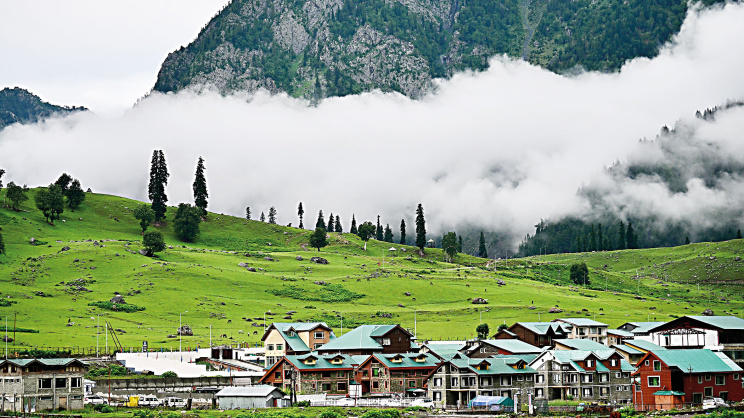
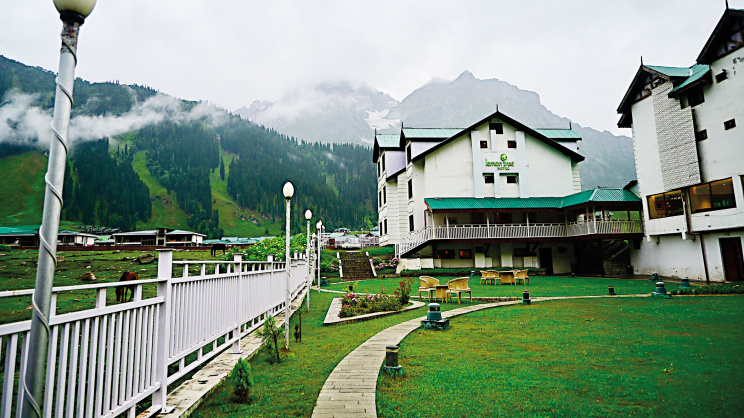
By afternoon we’d reached Sonamarg, the “meadow of gold”, some 90 kilometres from Srinagar. We stayed at the Lemon Tree Hotel, caught between the Sindh River and Thajiwas Glacier, the perfect stop after a rain-soaked drive. A hushed, mineral coolness settled in, mist drifting over the valley, a river gurgling past amid a drizzle.
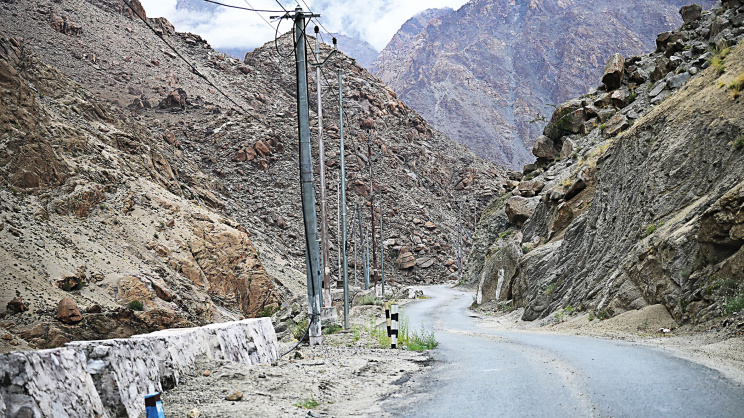
The next morning, as we headed toward Kargil, the landscape changed almost at once -- grass thinning, then vanishing, the mountains shedding their colour until they were rugged rock and scree in grey and dust. Sonamarg’s softness gave way to Kargil’s high desert starkness.
One morning in Kargil has stayed with me more than any photograph could. I stepped onto our hotel balcony and let my eyes wander up the mountain rising directly beside it, too close. A sheer wall of rock blotted out half the sky, a road running along its base like an afterthought. Not fear exactly, just a reminder of how insignificant we are before something that old and that large.
After breakfast, we began the climb toward Hambuting-La, a pass at 13,380 feet, the road half-swallowed in fog and switching back on itself in tight loops, the same valley appearing from three angles within ten minutes. Near the top it started to rain, draping a grey haze over everything. Power lines faded into mist, the road slick and dark. Getting there felt like climbing into the weather itself.
Rather than continuing straight toward Leh, we detoured onto the Batalik road, some 80 kilometres to the Aryan Valley, a cluster of villages along the Indus, home to the Brokpa people, whose ancestry and customs set them apart from the rest of Ladakh.
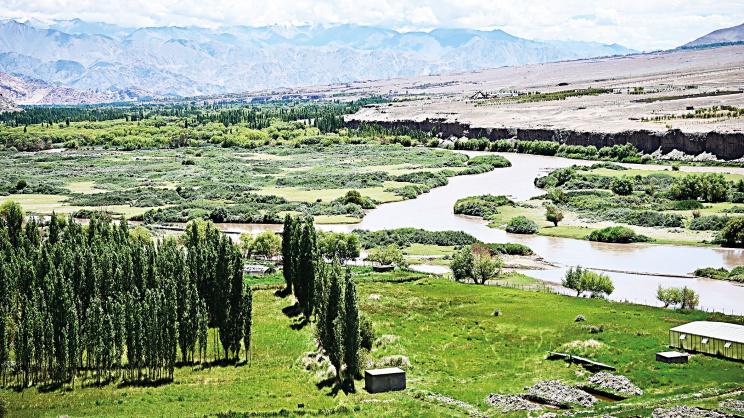
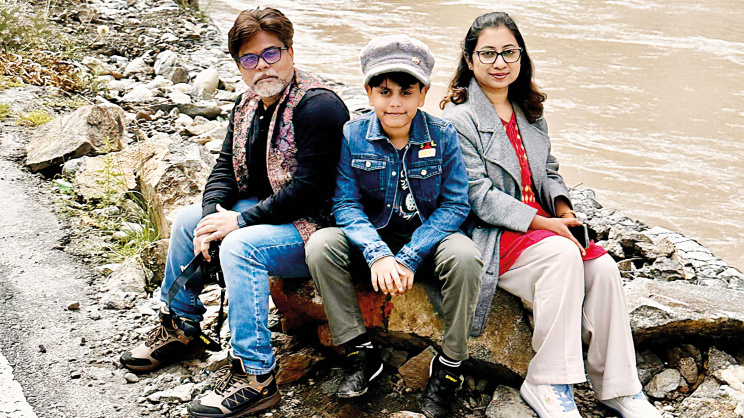
We stayed long enough for a proper morning there -- tea at a window seat, mountains catching the early light in ochre and rust, prayer flags fluttering against a stone wall. The village nestles against towering rock walls; a newly built monastery nearby, painted vividly in red, gold, and blue, looks almost ceremonial against the raw stone cliffs behind it. We posed for a family photo on its steps, dwarfed as much by the decoration above us as by the cliffs beyond. What struck me most was the river. The Indus was running fast and heavy with silt, poplar trees lining its banks, the only softness in an otherwise forbidding landscape.
Apricots were everywhere, trees heavy and unmanicured, the narrow path strewn with fallen fruit. We tried to buy half a kilo from our homestay, more out of curiosity than need, and asked how much we owed. They wouldn’t take any money — what we’d offered to buy came back to us as a gift. Hospitality here isn’t a performance for visitors; it’s just how things are done.
Leaving the valley, we stopped for one last round of photos on a road along the Indus -- my son mid-laugh, arms thrown up against the dark peaks. We left, leaving behind a small debt of kindness, an unearned feeling of having been folded into something bigger than us.
Our next stop was Hemis Shukpachan, in the Sham Valley, Ladakh’s “baby trek” country, a gentler stretch strung with juniper groves and old temples, popular with hikers for how unhurried it feels. Somewhere on the drive in, our phones had quietly given up: no signal, nothing. And for a day, we were genuinely off the grid: disorienting, then oddly freeing, no notifications or map, just the place in front of us. We stayed at the Heshuk Eco Lodge, one of the unfinished guesthouses that dot the valley. Walls were freshly painted, gardens still being dug in, all the better for it.
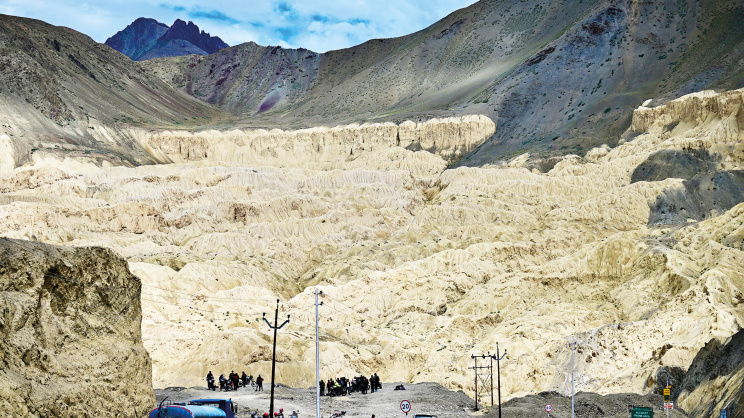
No description of this route is complete without Lamayuru. The “moonland” here isn’t a metaphor so much as a geological fact -- pale, eroded badlands, formed when a tectonic landslide dammed the local river tens of thousands of years ago, backing up a lake that later drained, leaving sediment for wind, frost, and rain to carve into what we see today.
My son and wife leapt for a photo on a dark scree slope with pale formations behind them, and for a moment the whole scene looked like a travel poster for some other planet, which, in a sense, it is. This is what’s left when a lake spends an age quietly disappearing. In the midst of a desolate, eroded landscape sits Lamayuru Monastery, one of Ladakh’s oldest.
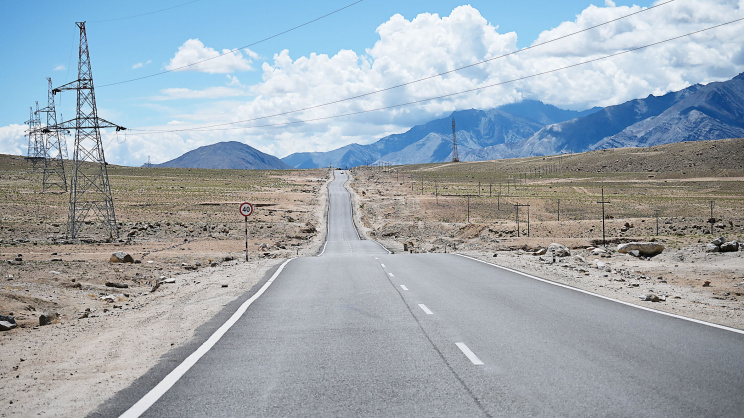
We arrived in Leh tired, altitude-dizzy, already talking about what we’d seen as though it had happened weeks ago. After days of narrow gorges and cloud-choked passes, arriving there felt like the landscape finally exhaling. The sky was a hard, saturated blue that Kargil’s weather never allowed, with cotton-ball clouds hovering over burnt-orange ridgelines.
Our first stop after reaching Leh was Hemis Monastery, some 45 kilometres southeast of town. We climbed the worn stone steps to the entrance, a painted dharma wheel hanging over the door, the Indian and Buddhist flags snapping together above the roofline. In the courtyard, a tall prayer pole wrapped in red and blue cloth stands like a mast against the mountains, the kind of thing that makes every family photo look staged, except none of it was.
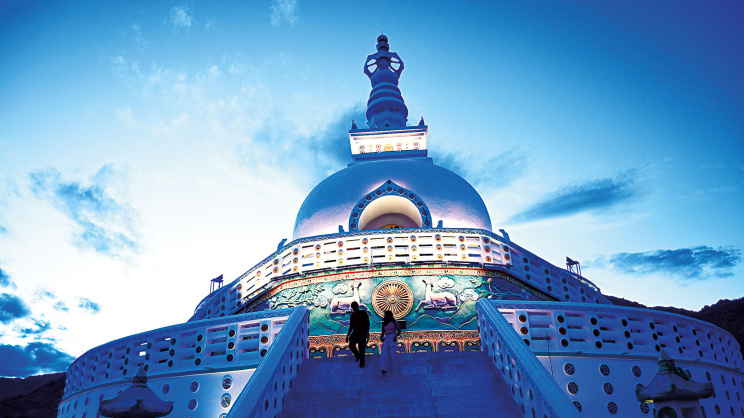
From Hemis, we doubled back toward Leh and caught the Shanti Stupa at exactly the right hour. The sun was dropping toward the western ridge. The temple’s white dome caught the day’s last gold while the sky behind it deepened toward dusk. Built more than three decades ago by Japanese Buddhist monks as a peace pagoda, it sits on a hilltop above Leh. By evening, most people weren’t looking at the view. They were looking at the stupa itself, its spire glowing with the last light against the darkening hills. Photo after photo, we watched the sky shift from bright evening blue to the softer tones of near-dark. The stupa was the one constant.
Six days and one entire mountain range later, we capped the journey with a blessing of peace.
 For all latest news, follow The Daily Star's Google News channel.