


Mustafa Monwar's passing ends a golden chapter of Bangladeshi childhood
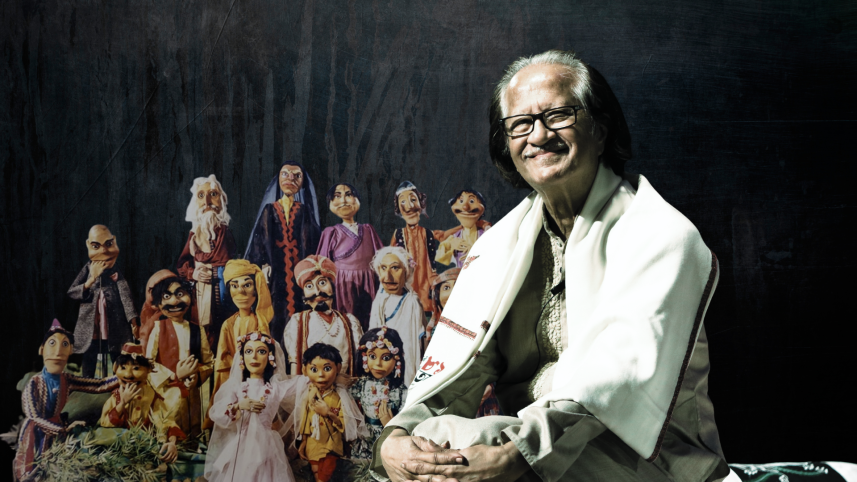
Widely known as the “Puppet Man” of Bangladesh, Mustafa Monwar’s death marks the end of yet another magical era for the ‘80s and ‘90s kids of Bangladesh. Over the years, the master puppeteer played the role of more than just a performer. He was a teacher and a cultural ambassador whose artistry touched generations of audiences, and whose departure leaves behind magic and nostalgia for the entire country.
While Monwar is revered for his contributions to the 1971 Liberation War, there is an entire generation after it that remembers him for Moner Kotha. This puppet show ran on BTV for years and captivated children and adults alike.

Moner Kotha, the show, maps the life of Parul, the Baul, and the cow, imparting subtle life lessons through wit, humour, and innocence, at a time when entertainment was simple and not as complex or nuanced as it is today.
“Before we got cable TV, we used to watch Moner Kotha on BTV,” reminisces communications professional, Rubab Khan.
To her, the boy, the girl, and the cow puppets are a reminder of simpler times, where no one really thought about what was ‘trending’ on TV.
She adds, “Even if I was watching Cartoon Network at my relative's house, I'd still get amused by Moner Kotha. It didn't really ruffle us if the show was 'cool' or 'uncool'; it was a part of memory, of growing up.”
Admirers remember performances that could make them laugh and then pause, thinking differently about their lives for a moment. That gentle power — the ability to move hearts without grandiosity — was his signature.
“My mother, her younger sister, and I, all three generations, have been fans,” shares Amira Jahaan, a homemaker and Master’s student. “My mother and khala have had the privilege of meeting him as well- sadly, I only met him through Baul and Parul.”
But before Moner Kotha, there was Chotoder Ashor.
Habiba Tasneem Chowdhury, a retired communications and public health professional with experience in marketing, social and behaviour change communication, and project management across INGOs and the UN system, has childhood memories of Mustafa Monwar, whom she affectionately calls ‘Shilpi Bhai’.
“Chotoder Ashor was the Sesame Street of our childhood without technology and gimmicks. It was mostly a one-man show. The highlight of my weekends was the early evenings on Sunday, when Chotoder Ashor came live,” she shares. “I was fascinated by how Shilpi Bhai gathered all the children around him with stories. He engaged even those of us in front of the screen. It seemed he was speaking to each of us individually.”
Mustafa Monwar, or Shilpi Bhai, as she calls him, was as charismatic in person as he was on screen.
“One Sunday, my father took me to the Dhaka TV studio at the DIT building,” she continues. “He said it was a surprise.”
Habiba Tasneem Chowdhury recalls the studio floor to be like stepping into sci-fi outer space with cables, huge cameras and lights.
“In the centre of it was dear Shilpi Bhai and a motley group of girls and boys casually sitting around him. I was so overwhelmed when Shilpi Bhai called my name and asked me to come and sit on the ‘mora’ nearest to him – that I froze. Seeing my reaction, he flashed an affectionate smile and asked the others to welcome me into the group.”
The rest of the hour may be a blur now, but Chowdhury remembers how intensely he engrossed the group in stories and transformed them into pictures. “I learned to find colours on dragonfly wings when the sun’s rays smile on them – as Shilpi Bhai would say.”
Those who knew him beyond the stage spoke about his crucial role in modernising the art of puppetry in Bangladesh. Others admired him for his cross-disciplinary contributions as an actor and performer in theatre and TV.
Colleagues remember him as a consummate collaborator: generous with his time, open to experimentation, and always respectful of others’ creative voices. Those who knew him often speak of his warmth: a quiet, steady presence backstage, patient with young artists, and quick to celebrate others’ successes.
As news of his demise spreads, fans receive it with a bittersweet mix of grief and gratitude. Grief, for it hurts to close a chapter of life forever, as if bidding goodbye to a dear friend for the last time. And gratitude, for making our childhoods so memorable, albeit so simple.
“I don't believe his legacy ends with his demise,” mentions Rubab Khan. “And maybe, the best way to commemorate Mustafa Monwar would be to continue to encourage the art of puppeteering to keep people engaged through heartfelt conversations just the way he did.”
 For all latest news, follow The Daily Star's Google News channel.
Comments