


A CHRONICLE of culinary ventures
The underlying causes of the boom give us fascinating indications and insights -- not just about this sector but about our economy, society, lifestyle and the changing preferences and perceptions.
An increased appetite?
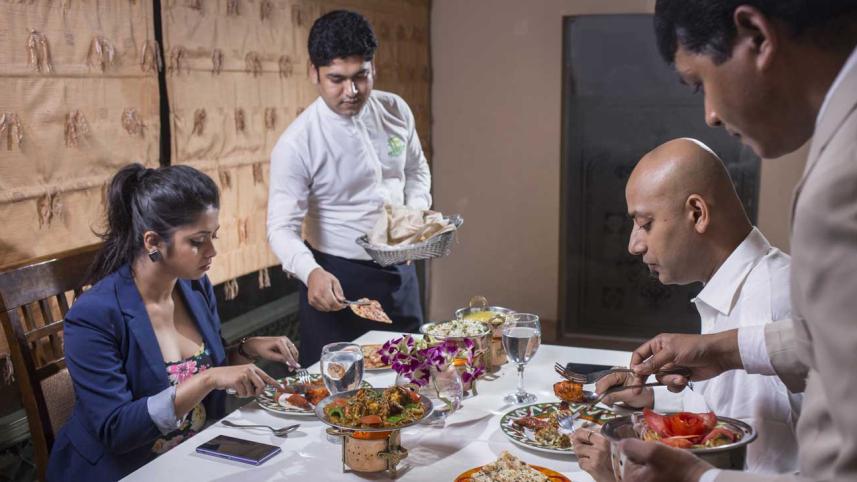
Starting with an obvious reason, the demand for eating out is so high because in Dhaka there are lesser alternatives for entertainment, leisure or recreation. When one seeks to spend quality time with his/her friends or family out in the city, the list of things s/he can expend time and money on is rather limited. This is a key reason why eating out is so popular.
Taskin Rahman, the founder of The Food Talk, agreed. "It is surely one of the biggest segments in the recreational industry of Dhaka," he opined.
The Food Talk is a restaurant rating page on Facebook. With its immense popularity, it has evolved into being more just a Facebook page. For example, it holds The Food Talk Meet-up sessions, where some members and invited guests from the eateries industry (such as restaurant owners) come together and engage in a culinary discussion. To join the group, one can search for 'The Food Talk' on Facebook and send a request.
 For all latest news, follow The Daily Star's Google News channel.
 Taskin has also observed that nowadays there are a large number of restaurants specialising on authentic, exotic cuisines, such as Chinese, Japanese and Korean.
One reason that has led to the rise of this kind of restaurants is the increased inflow of foreigners visiting or staying in our country, owing to the economic growth. A significant consumer segment of these restaurants comprises this demographic.
These eateries are becoming increasingly popular to the local people as well. Even a couple of decades ago, authentic exotic cuisines were much less popular among the locals. But tastes and preferences are changing, and the palate of the people of Dhaka is now more liberal and exploratory.
Many reasons have contributed to this trend. Taskin said, "An increasing number of people now go abroad for travelling and pursuing higher education. When they return to Dhaka, with their gastronomic experience that has familiarised them about different cuisines of the world, they are more eager to go to eateries that serve such cuisines here in our city." Moreover, internet and culinary TV shows have provided the right media exposure that is needed to make people try out and delight in different dishes and cuisines.
Fish & Co. Bangladesh is a seafood eatery that had opened last year. This restaurant has popularised delicacies like fish and chips and mussels to a vast extent. Traditionally, Bangladeshis are not accustomed to cooking and eating fish the way this restaurant offers. But Fish & Co. have proved that the taste the people of Dhaka is indeed diversified.
It is not just about eateries. Home delivery services such as HungryNaki and Foodpanda have started their operation in the recent past. To savour in the foods the myriad eateries have to offer, one simply needs to visit these food delivery websites.
One trend that is attributed to the popularity of this service is the rising number double income households. After a long day's work, parents often feel tempted to order food online instead of cooking at home.
Taskin has other reasons in mind. "A sizeable fragment of the customers are office-goers who frequently order food for lunch, given the unattractive canteen many organisations have," he said. "Another reason is the convenience food delivery systems provide: one does not need to spend time sitting at traffic congestions. Meanwhile, delivery fee is nominal."
The gold rush
Given the increasing demand, it is no surprise that many entrepreneurs and organisations have invested in this sector, opening up eateries - from fine restaurants to fast food outlets to street-side carts. Indeed, many of them are now running successfully.
However, there are eateries that actually did not open up with the primary objective of earning profit. To illustrate, an affluent individual might have a land or a building which is sitting idle. For a better utilisation of the asset, the property is turned into a restaurant.
"Owning a restaurant adds to the prestige of a person, family, or conglomerate," Taskin said. Indeed, it is a symbol of status.
Just being able to afford establishing and running a restaurant does not guarantee success. There are a handful of eateries that lack the know-how or the dedication it requires to make them into profitable ventures.
But of course, not all eateries can be put under this category. On the other hand, the last few years have witnessed food carts mushrooming all over Dhaka. While carts selling 'chotpoti', 'fuchka' and other local delicacies have been in the scene for ages, the trend of selling burgers in a cart is less than five years old.
This subset of the eateries industry has a low barrier to entry. Compared to other forms, food carts do not require a hefty sum for start-up and operation. To exemplify, the expenditure on real estate and construction and maintenance of a proper establishment is extremely high in comparison to those of a cart.
All that glitters…
Despite the frantic growth and the glamorous outlook of this industry, an upsetting fact is that many eateries have faced closures. Continuing our discussion about carts, they are usually located on pavements and streets, which is illegal. "Food cart businesses require bribing the police," informed an entrepreneur who had shut down his cart because of such problems. Seeking anonymity, he said, "In addition to bribe, they demand free 'treats'. Food carts have a good potential; the government should step in. It can, for example, allocate specific locations for carts."
The location is not the only problem. He advises anyone who wants to open up carts to formulate a thorough plan and have a strict management and control, especially over the finances.
Carts are not the only players in the industry that are facing a difficult time surviving. Bronia Café and Gallery is one of the restaurants that have faced closure.
"Running an eatery is one of the toughest businesses. Maintaining factors such as food quality, service and hygiene in a consistent way while asking for an acceptable price is a world of a challenge," Nurul Amin, one of the owners of Bronia, reflected on his experience.
Amin also faced the challenge of maintaining customer loyalty. "The trend is such that people want to try out new places all the time. So, instead of eating out at one or a few selected places frequently, customers constantly hop from one eatery to another," he said. Amin also thinks that retaining chefs is a huge challenge.
"The total expenditure, including the cost of real estate, is staggeringly high. Let not anyone be fooled by the sales or sales revenue figure," he advised.
Therefore, the glitz and the glamour of restaurants do not reflect that they are all of them are running prosperously. But it true that the development in this sector has improved the quality of service and introduced the people of Dhaka to a wide plethora of foods and cuisines. It has, to that extent, raised the standard and expectations of the consumers.
And despite all the difficulties, new eateries continue to pop up. This means that there are individuals and organisations who believe that no matter how challenging it is, launching an eatery makes sense, be it solely for financial reason or for any other.
There is now an intense competition. Therefore, for the new entrants and also for the seasoned, the advice is to plan for sustainability and acquire the necessary business acumen for running an eatery as a successful business venture.
Photo: Shahrear Kabir Heemel
Special thanks to Pan Pacific Sonargaon and Khazana for arranging the photoshoot location


Comments