


Wherever I go
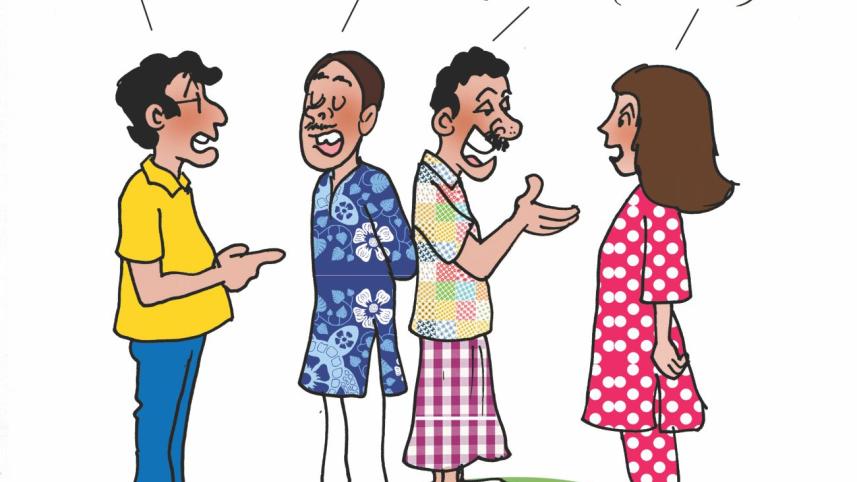
Pride is drawn from many sources. There is, of course, national pride, something which ties us together as Bangladeshis. But dig deeper and you will find numerous subcultures, based on the particular regions that people live in. Rooted in the hometown, or your place of birth, or the home district you belong to, regional pride indeed runs strong among us.
A Chittagonian will be quick to treat foreigners and outsiders with 'kala bhuna' or invite them to their legendary 'mezbaan'. People from Khulna, on the other hand, love their spicy 'chui', their special herb which adds a distinctive flavour to curries.
 For all latest news, follow The Daily Star's Google News channel.
 Even beyond food, one thing we are fiercely passionate and overly protective about is the regional dialect.
Bangladesh boasts a plethora of dialects and accents. They reflect the rich diversity of cultures and histories of this country. And sometimes, they engender utter confusion and miscommunication that you can later on narrate to your friends and have a good laugh over!
Take the episode I once had in a barbershop. My barber, in his mid-thirties, hails from Noakhali. I admire this man. Patient, polite, reserved and professional -- qualities I look for in a barber.
But even he messed up once.
Not long ago, after my hair had been meticulously cut and my beard trimmed, he asked, "Honey dium?" (Shall I give honey?).
The man is asking whether he should give me honey or not, I thought to myself. I was in mood for a little pampering, and assumed that the barbershop launched a new service where they would apply honey to my hair.
But alas! As soon as I told him to do so, he grabbed my neck, dragged my head down to the sink and opened the tap in full force! And as I was not expecting such rude behaviour, I jerked up, spilling water all over my shirt. In the cold, winter evening, I was standing half-drenched and more than a little livid.
It was only after a heated argument that I realised that 'honey' in Noakhali means 'pani': water. I stood dumbstruck, feeling sorry for lashing out at a harmless barber.
Different people, different dialects. Chittagonians and many other people don't say 'pani' either; they call it 'funny'!
Even the name of our currency is pronounced differently by different people.
Like in Sylhet. After a long and tedious train journey, I once found myself at the Sylhet station in the dead of night. Exhausted and dreading the early morning business meeting, all I wanted was to reach my hotel safely.
But the rickshaw-puller, it seemed, had other plans. When I told him the location, he said, something 'tika'. I corrected him and repeated the address I wanted him to take me to. "I don't want to go to Tika!" I helplessly urged.
Fortunately, a kind rickshaw-puller came forward and informed me that 'tika' means taka in this region and that my rickshaw-puller was talking about the fare!
And of course, there is the fascination of Sylheti people with the sound 'kha', produced from the middle of the throat. "What are you doing?" in English; "Ki koro?" in Bengali; and in Sylheti, "Khitaa koro?"
But who am I kidding? I was born and brought up in Chittagong. When I came to Dhaka, I realised, to my utter shock, that I had used certain words that I thought were understood by Bangladeshis everywhere!
One such word is 'baikka'. When I first uttered it to my new friends in the capital city, they stared at me blankly. It was then I realised that this word is alien to most people of Dhaka. For your information, 'baikka' means irrelevant, unnecessary or false; like, 'baikka kotha' or 'baikka kaj'.
Although I never fully spoke the colloquial language, I miss it today. Even if someone is not speaking in Chittagonian, there is a subtle distinctive accent that immediately tells me that the speaker is from my hometown. And this is a fantastic conversation starter.
I've lost that accent over many years of staying in Dhaka, but whenever I go to Chittagong for a few days, I end up 'catching' that flair again: it's quite contagious indeed!
Speaking in the colloquial dialect also draws people closer together. It is perhaps because of the notion that you and I share common roots and probably even love the same kind of food. A common ground. A club exclusive to those who know a particular language!
Knowing colloquial dialect also buys you street credit. If you are a native speaker -- or at least understand the words well -- people assume that you know your way round this place and therefore won't try to rip you off in shops and other places.
Of course Chittagong, Noakhali and Sylhet are just three regions representing three dialects out of many more. From 'Dhakaiyya' to 'Barisailla', our country is one with many sweet accents and dialects.
On the International Mother Language Day, we pay tribute to them all.
By M H Haider


Comments