


Modi ‘overhauls’ Indian cabinet
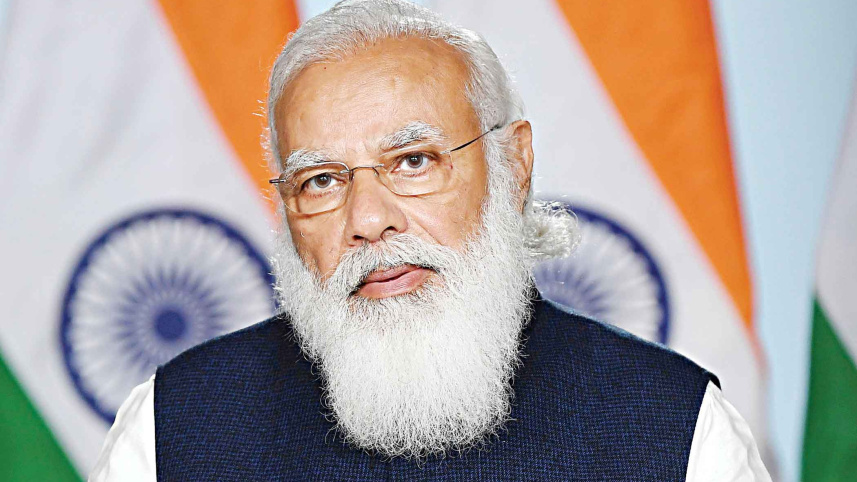
Indian Prime Minister Narendra Modi yesterday carried out a major expansion and reshuffle of his council of ministers inducting 43 people, including 36 new faces, taking its total strength to 77.
Seven cabinet ministers were among a number of ministers dropped in the mega shake-up. Analysts say the mega cabinet reboot is an effort by Modi to offset criticism as the country emerges from a fierce second wave of Covid ahead of key state elections in 2022.

The new members were sworn in at the presidential palace in the evening. It was the first cabinet reshuffle since Modi was re-elected in 2019 on a promise to transform India into a political and economic power.
He has retained his core team at the foreign, finance, home and defence departments even though the economy is in a deep recession and there are widespread concerns that a surge in Covid-19 infections will stall the recovery.
A number of key portfolios -- including health, law, Information and Technology and railways -- have gone to new ministers and junior ministers who got a promotion in Modi's Council of Ministers.
The number of cabinet ministers has been boosted from 21 to 30 in the reshuffle. The number of junior ministers has gone up too, from 23 to 45.
But what made bigger news yesterday was the sacking of IT and Law Minister Ravi Shankar Prasad, Health Minister Harsh Vardhan and Environment and Information and Broadcasting Minister Prakash Javadekar.
Vardhan's removal follows the severe criticism of the Indian government's handling of the second surge of Covid-19 that exposed the country's inadequate health infrastructure.
Javadekar was among the chief spokespersons of the Modi government since 2014.
Ravi Shankar Prasad's ouster from the cabinet followed weeks of the IT Ministry's running feud with global tech companies like Twitter and Facebook over a range of issues, including new IT rules.
The reshuffle saw the induction of younger faces giving representation to various social groups and regions in the reshuffle keeping in view the assembly elections scheduled next year in 7 states, including electorally the most important Uttar Pradesh, and to balance the alliance arithmetic.
Among the most notable inclusions in the cabinet are those of Jyotiraditya Scindia who quit the Congress and joined the Bharatiya Janata Party (BJP) in March last year and Sarbananda Sonowal, the former chief minister of Assam.
Jyotiraditya has been given charge of the Civil Aviation ministry, which was once handled by his father Madhavrao Scindia.
Sarbananda Sonowal has been given charge of the Ports, Shipping and Waterways portfolio. He will also handle the Ayush ministry.
Hardeep Singh Puri, Kiren Rijiju and Mansukh Mandaviya also have been elevated to the cabinet rank.
Puri will be the Minister of Petroleum and Natural Gas, Housing and Urban Affairs. Mandaviya has been given the charge of the crucial health ministry. In addition, he would retain the Ministry of Chemical Fertilizers.
The crucial Law and Justice ministry has gone to Kiren Rijiju.
Ashwani Vashnav, Rajya Sabha MP from Odisha, has been given the charge of Railways and IT ministry.
Anurag Singh Thakur has been given charge of Information and Broadcasting. Additionally, he will handle the Youth Affairs and Sports ministry.
The Education Ministry, vacated by Ramesh Pokhriyal "Nishank", has gone to Dharmendra Pradhan.
 For all latest news, follow The Daily Star's Google News channel.
 Union Home Minister Amit Shah has got the charge of the newly-created Ministry of Cooperation.
Meenakshi Lekhi will be the Minister of State in External Affairs and the Culture Ministry. The Environment, Forest and Climate Change and the Labour and Employment ministries have gone to Bhupender Yadav.
More than two months after failing to oust Mamata Banerjee government in West Bengal assembly poll, Modi brought in four Lok Sabha MPs of the party from the state including Santunu Thakur, the lawmaker from Bongaon belonging to Matua community. Thakur had accompanied the PM to his visit to Bangladesh in March.
The other lawmakers from Bengal who were made ministers yesterday are Subhash Sarkar, a gynaecologist, who represents Bankura constituency, John Barla from Alipuarduar and Nisith Pramanik from Cooch Behar.
More than a dozen ministers are from poll-bound states such as Uttar Pradesh and Gujarat representing different castes and regional communities, a dominant factor in India's electoral politics. Four members from southern Karnataka state were also added.
Comments